TripAdvisor

Everest Marathon Trek – 16 Days

Download PDF
  • Duration 16 Days
  • Destination Nepal
  • Trip Grade Strenuous
  • Starts at Kathmandu
  • Ends at Kathmandu
  • Meals 13 Breakfast, 12 Lunch, and 12 Dinner
  • Accommodation Tea House or Tented Camp
  • Max. Altitude Everest Base Camp (5364 Meters)
  • Activity High-Altitude Trekking + Marathon Running
  • Group Size 1 to 50
  • Best Season Spring (May)
Highlights
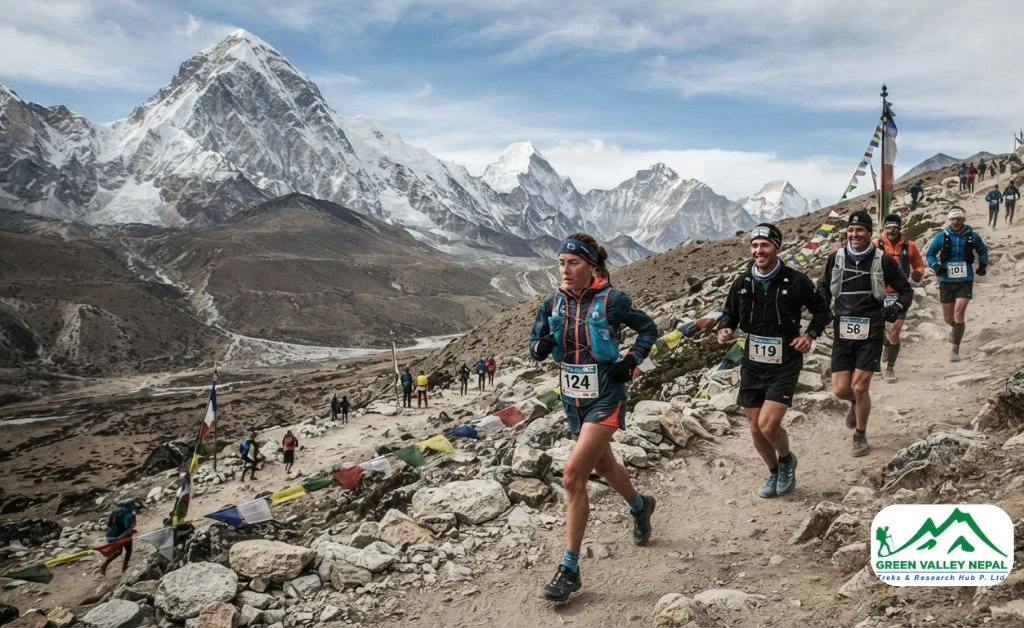
  • Take on the Tenzing Hillary Everest Marathon, the world's highest marathon, starting at 5,364m beside the Khumbu Icefall.
  • Trek the classic route to Everest Base Camp through Sagarmatha National Park with full acclimatization support.
  • Fly into Lukla's dramatic Tenzing-Hillary Airport, the gateway to the Khumbu region.
  • Acclimatize in Namche Bazaar and Dingboche before pushing on toward Base Camp.
  • Visit Tengboche Monastery, the oldest and largest monastery in the Khumbu.
  • Race downhill from Everest Base Camp to Namche Bazaar with official marshalling, checkpoints, and medical back-up.
  • Choose your challenge: 42km Full Marathon, or the brutal 70km Extreme Ultra.
  • Join an internationally recognized event, held annually since 2003 and marking its 22nd edition in 2027.
  • Earn an official finisher's medal and certificate of achievement.
  • Non-runners are welcome too; join the trek and cheer the racers home at Namche Bazaar.

Everest Marathon Trek Overview

Do you want to combine the trek of a lifetime with the ultimate endurance challenge? The Everest Marathon Trek pairs our classic Everest Base Camp route with the Tenzing Hillary Everest Marathon, the highest marathon on Earth. Held every year in the last week of May, this race starts at 5,364 meters beside the Khumbu Icefall and drops through Sherpa villages, pine forests, and high suspension bridges to finish at Namche Bazaar. Officially recognized by the Government of Nepal, the race was named in honor of Tenzing Norgay Sherpa and Sir Edmund Hillary, whose historic 1953 ascent of Mount Everest is celebrated on 29 May every year, the traditional race day.

Runners can choose between two official categories: the 42km Full Marathon starting from Everest Base Camp near the Khumbu Icefall, and the punishing 70km Extreme Ultra Marathon (UTME) for the most experienced mountain athletes. Whichever distance you choose, our 16-day itinerary is built around the same trusted acclimatization schedule we use on our standard Everest Base Camp Trek, with two additional nights of camping at Base Camp itself so you arrive at the start line properly rested, acclimatized, and ready to race.

The journey begins with a scenic mountain flight into Lukla, followed by the same time-tested trekking route used by thousands of EBC trekkers each year, through Phakding, Namche Bazaar, Tengboche, and Dingboche, with two dedicated acclimatization days along the way. Once you reach Everest Base Camp, you will spend a full rest day for a marathon briefing, a short mock race, and a mandatory medical check-up by our accompanying doctor, exactly as required by official race organizers. Race day itself follows a dramatic route down the Khumbu Glacier moraine, through Gorakshep, Lobuche, Dingboche, Pangboche, and Tengboche, finishing with a final climb into Namche Bazaar.

Green Valley Nepal Treks and Research Hub is proud to offer this Everest Marathon Trek Package for runners and trekkers from the USA, UK, Canada, Germany, and around the world. The race itself draws participants from over 40 countries each year, and the current course records stand at 3 hours 28 minutes 27 seconds for the fastest Nepali finisher and 4 hours 24 minutes 2 seconds for the fastest international finisher. Booking is now open for the 2027 and 2028 Everest Marathon. Based on your fitness level, running category, and schedule, we are happy to customize this itinerary to meet your requirements. For questions about the Everest Marathon Trek cost, race registration, or training advice, please don't hesitate to contact us.

What You Can Expect From the Everest Marathon Trek Package?

  • You will experience the full classic Everest Base Camp trekking route, including Sagarmatha National Park, the Khumbu Glacier, and the towering peaks of Lhotse, Nuptse, Ama Dablam, and Pumori.
  • You will camp for two nights at Everest Base Camp itself, alongside expedition teams preparing for their own summit attempts.
  • You will take part in an internationally recognized mountain race with official timing, marshals, checkpoints, and medical support.
  • You will receive a pre-race medical screening from an accompanying doctor to confirm you are fit to run at altitude.
  • You will finish your race in Namche Bazaar, the Sherpa capital, with a finisher's medal and certificate of achievement.
  • You will get to know the Sherpa, Tamang, and Rai communities of the Khumbu, whose hospitality defines this trek.

Is the Everest Marathon Trek Suitable for You?

  • This trip is ideal for experienced trail runners, ultra-runners, and fit trekkers looking for the ultimate high-altitude endurance challenge.
  • Runners must be at least 18 years old and are required to submit a medical certificate confirming fitness for high-altitude activity, along with valid travel insurance.
  • If you have already completed the Everest Base Camp Trek or another Himalayan trek and want a bigger physical and mental test, this is the natural next step.
  • Non-runners are welcome to join purely as trekkers; you will follow the same route to Base Camp and can meet the runners at the finish line in Namche.
  • Because the race takes place above 3,400m for its entire distance, prior experience trekking or exercising at altitude is strongly recommended.
  • This is a physically demanding trip: expect daily treks of 4 to 8 hours before the race, followed by a single race day covering up to 42km on rough mountain trail.

How to Get Prepared for the Everest Marathon Trek?

Preparing for the Everest Marathon Trek means training for two distinct challenges: multi-day trekking at altitude and a mountain trail race on rough, high-altitude terrain. In the months before departure, build your cardiovascular base with regular running, hiking, and hill training, ideally including back-to-back long training days that mimic consecutive trekking days. Practice running on uneven, rocky trails rather than only on roads, since the marathon route crosses moraine, stone steps, and yak trails rather than pavement.

Strength and endurance training should be paired with altitude preparation. Even strong runners can be slowed dramatically above 4,000m, so it is essential to respect the acclimatization schedule built into this itinerary rather than trying to rush ahead of the group. If possible, gain some experience trekking or running above 3,000m before you arrive in Nepal. Mental preparation matters just as much as physical fitness; race day involves 4 to 10 hours of effort at extreme altitude, and a calm, patient mindset is often the deciding factor between finishing strong and struggling.

Remember that registration for the official Tenzing Hillary Everest Marathon requires a medical fitness certificate and proof of travel insurance well before departure, so begin gathering these documents early. Our team can advise on the exact requirements and deadlines for the current race season.

Day to Day Itinerary
Expand allCollapse all

Our Airport Representative will receive you at Tribhuvan International Airport and transfer you to your hotel in a private vehicle. Depending on your arrival time, relax at the hotel or visit our office for a detailed briefing on the Everest Marathon Trek, including race registration requirements and the days ahead.

    An early morning flight takes you over spectacular mountain scenery to Lukla's Tenzing-Hillary Airport, the gateway to the Khumbu. From here, a short and gentle trek brings you to Phakding, where you will spend your first night on the trail, meeting our Sherpa crew and settling into the rhythm of the trek.

    • Tea House or Lodge
    • Lunch, and Dinner
    • 3 to 4 hours
    • 6.2 kilometers

    The trail follows the Dudh Koshi River through pine forest and past Sagarmatha National Park's entrance checkpoint. A steep final climb brings you to Namche Bazaar, the bustling Sherpa capital, with your first views of Everest and the ridges of Lhotse and Nuptse.

    • Tea House or Lodge
    • Breakfast, Lunch, and Dinner
    • 5 to 6 hours
    • 7.4 kilometers

    A crucial acclimatization day. Take a short hike to the Everest View Hotel, Khumjung, or Khunde while your body adjusts to the altitude. This is also a good day for a light training run on the surrounding trails if you are preparing for the marathon.

    • Tea House
    • Breakfast, Lunch, and Dinner

    A scenic trail leads to Tengboche, home to the largest monastery in the Khumbu and one of the finest viewpoints for Ama Dablam, Everest, and Lhotse. This stretch forms part of the official marathon race route, so take note of the terrain.

    • Tea House or Lodge
    • Breakfast, Lunch, and Dinner
    • 5 to 6 hours
    • 9.2 kilometers

    The trail passes through Pangboche, home to the oldest monastery in the Khumbu, before continuing along the Imja Khola valley to Dingboche. Note that Dingboche is the official starting point for the 21km Half Marathon category.

    • Tea House or Lodge
    • Breakfast, Lunch, and Dinner
    • 4 to 5 hours
    • 9.1 kilometers

    Your second acclimatization day. Hike up Nagarjun Hill or toward Chhukung for panoramic views of Makalu, Lobuche, Thamserku, and Ama Dablam, before returning to Dingboche to rest ahead of the final push toward Base Camp.

    • Tea House or Lodge
    • Breakfast, Lunch, and Dinner

    The trail climbs through Thukla, passing memorials to climbers who lost their lives on Everest, before following the lateral moraine of the Khumbu Glacier to Lobuche, opposite the towering pyramid of Lhotse.

    • Tea House or Lodge
    • Breakfast, Lunch, and Dinner
    • 4 to 5 hours
    • 7.9 kilometers

    After breakfast, trek to Gorak Shep for lunch before continuing across the Khumbu Glacier moraine to Everest Base Camp (5364m), the official starting point of the marathon's Full and Ultra categories. Tonight you will camp beneath the Khumbu Icefall alongside international expedition teams, a truly unforgettable setting.

    • Tented Camp at Everest Base Camp
    • Breakfast, Lunch, and Dinner
    • 7 to 8 hours
    • 11 kilometers

    A full rest and preparation day at Base Camp. Race organizers hold an official marathon briefing and a short mock race so runners can test the opening section of the route. Our accompanying doctor conducts a final medical check to confirm every runner is fit to compete, in line with official race requirements.

    • Tented Camp at Everest Base Camp
    • Breakfast, Lunch, and Dinner

    Race day. The 42km Full Marathon and 70km Extreme Ultra start together at Everest Base Camp beside the Khumbu Icefall. The route drops through Gorakshep, Lobuche, Thukla, Dingboche, Pangboche, and Tengboche before a final climb from Phunki Tenga into Namche Bazaar. Every runner is supported by official checkpoints, drink stations, marshals, and emergency medical backup along the way. Non-running trek members will already be in Namche to cheer finishers home.

    • Tea house or Lodge
    • Breakfast, Lunch, and Dinner
    • 4 to 10 hours depending on category and pace
    • 70km (Extreme Ultra) / 42km (Full Marathon)

    A well-earned rest day. Relax at a Namche café, explore the Sherpa capital's shops and bakeries, or simply recover before the final two days of trekking back to Lukla.

    • Tea house or Lodge
    • Breakfast, Lunch, and Dinner

    The final trekking day retraces the trail down through Monjo and Phakding to Lukla. Take a last look at the Khumbu's peaks before saying farewell to the mountains that hosted your marathon.

    • Tea house or Lodge
    • Breakfast, Lunch, and Dinner
    • 6 to 7 hours
    • 19 kilometers

    A scenic mountain flight returns you to Kathmandu. The afternoon is free for well-deserved rest, shopping, or exploring the city.

    • Hotel in Thamel
    • Breakfast
    • 35 to 40 minutes

    This contingency day allows for any flight delays from Lukla. If your flights run on schedule, enjoy a guided half-day tour of Kathmandu's cultural highlights. In the evening, join our Everest Marathon celebration dinner, where finishers' medals and certificates of achievement are presented.

    • Hotel in Thamel
    • Breakfast

    Your Everest Marathon Trek comes to an end. Our representative will transfer you to Tribhuvan International Airport in time for your onward flight.

      Our team guides, porters and accompanying staff are locals with a broad knowledge about each and every location that we travel through.

      Cost Includes
      • Airport Transfers: Pickup and drop-off between Tribhuvan International Airport and your hotel in Kathmandu.
      • Kathmandu Accommodation: 3 nights' accommodation in a standard hotel in Kathmandu on a twin-sharing basis, including breakfast.
      • Domestic Flights: Round-trip flight tickets between Kathmandu and Lukla, including airport transfers as required.
      • Trekking Permits: All necessary trekking permits and entry fees, including Sagarmatha National Park entry, TIMS Permit, and applicable local area fees.
      • Tea House Accommodation: 11 nights' accommodation in comfortable tea houses during the trek on a twin-sharing basis.
      • Everest Base Camp Camping: 2 nights of tented camping at Everest Base Camp, including a camp kitchen and dining tent.
      • Everest Marathon Entry: Official registration and race entry fee for your selected marathon category, including the 42 km Full Marathon or 70 km Extreme Ultra.
      • Meals During the Trek: Breakfast, lunch, and dinner throughout the trek, including meals during the Everest Base Camp camping period.
      • Trekking Equipment: Duffel bag, sleeping bag, and down jacket for use during the trek. These items must be returned after the trip.
      • Experienced Trekking Team: An experienced English-speaking guide trained in first aid and eco-friendly trekking, equipped with a comprehensive medical kit.
      • Porter Service: One porter is provided for every two trekkers and can carry a maximum of 24 kg of luggage.
      • Marathon Medical Support: An accompanying doctor to provide medical support during the Everest Marathon.
      • Staff Costs: Staff members' salaries, insurance, food, accommodation, and necessary trekking equipment.
      • Marathon Finisher Benefits: Official marathon finisher's medal and certificate of achievement.
      • Farewell & Celebration Dinner: Farewell dinner and Everest Marathon celebration dinner in Kathmandu.
      • Final Airport Transfer: Transfer from your hotel to Tribhuvan International Airport for your international departure.
      Cost Excludes
      • International Airfare: International flights to and from Nepal.
      • Nepal Visa Fee: Nepal entry visa and any applicable visa-related charges.
      • Travel & Medical Insurance: Comprehensive travel insurance covering trekking at high altitude, medical treatment, emergency evacuation, and helicopter rescue.
      • Extra Accommodation & Meals: Additional hotel nights, tea house accommodation, or meals outside those specified in the itinerary.
      • Personal Expenses: Expenses such as Wi-Fi, battery charging, hot showers, laundry, beverages, snacks, telephone calls, and other personal purchases.
      • Personal Running Gear: Running shoes, clothing, hydration equipment, trekking/running accessories, and other personal race gear.
      • Race-Day Nutrition: Personal energy gels, sports drinks, supplements, snacks, or other race-day nutrition beyond the meals and refreshments specifically provided by the package.
      • Tips: Tips and gratuities for guides, porters, drivers, doctors, and other support staff are not included and are customary in Nepal's trekking industry.
      • Emergency Evacuation: Any costs associated with helicopter evacuation, emergency rescue, medical treatment, or hospitalization that are not covered by your travel insurance.
      • Additional Expenses: Any services, activities, permits, or expenses not specifically mentioned under the Cost Includes section.
      Departure Dates
      Start:ThursdayMay 20, 2027
      End:FridayJun 04, 2027
      PriceUS$2575
      StatusGuaranteed
      Useful Info

      Everest Marathon Best Time, Season, and Race Date

      The Tenzing Hillary Everest Marathon is held annually in the last week of May, traditionally on 29 May, to commemorate the historic first ascent of Mount Everest by Tenzing Norgay Sherpa and Sir Edmund Hillary in 1953. Spring (March to May) is also the classic trekking season in the Khumbu, with clear skies, blooming rhododendrons, and stable weather that makes both the trekking and racing conditions favorable. Exact race dates can shift slightly year to year, so we recommend confirming with our team before booking flights.

      Everest Marathon Race Categories and Rules

      • 70km Extreme Ultra Marathon (UTME): Starts at Everest Base Camp (5,364m), beside the Khumbu Icefall, and finishes at Namche Bazaar, for highly experienced ultra-runners.
      • 42km Full Marathon: The most popular category, also starting at Everest Base Camp beside the Khumbu Icefall and finishing in Namche Bazaar.
      • Minimum age for participation is 18 years.
      • A medical certificate confirming fitness for high-altitude activity is mandatory for registration.
      • Valid travel and medical insurance is compulsory for all runners.
      • Participant numbers are capped at around 250 runners across all categories to protect the fragile Khumbu ecosystem, with race doctors stationed at Base Camp to support participants throughout the event.

      Everest Marathon Cut-Off Times and Race-Day Baggage

      Official cut-off times apply on race day. Runners who miss a checkpoint deadline are disqualified from continuing and must spend the night at a local lodge before resuming their normal trek the next morning. Please pace yourself with these limits in mind:

      • 42km Full Marathon: 4:00 pm cut-off at the Thyangboche checkpoint.
      • 70km Extreme Ultra Marathon: 11:30 am cut-off at Pangboche, followed by a second cut-off of 5:00 pm at Machhermo. Runners who clear Machhermo before the second cut-off must reach the finish line before 11:59 pm on race day to be recorded as an official finisher.

      You will also need to divide your luggage before the race. Report with your main bag at Gorakshep, then pack a smaller bag of around 7 to 10kg for your two nights of camping at Base Camp. The remainder of your luggage is sent ahead by porter to Namche Bazaar, where our team hands it back to you after the race.

      Food and Meals during the Everest Marathon Trek

      Three meals a day are included throughout your trek and at Everest Base Camp. Tea houses along the route serve a mix of Nepali staples such as dal bhat, momo, and noodle soup alongside simple international dishes like pancakes, porridge, and pasta. On race day, aid stations along the marathon course provide water and light snacks at regular checkpoints, including breakfast at Everest Base Camp before the start, noodle soup or porridge at Dingboche, and fresh fruit at Pangboche. We recommend carrying your own preferred energy gels or bars for race-day fueling.

      Accommodation on the Everest Marathon Trek Route

      You will stay in simple, clean tea houses for most nights on the trek and in mountain tents for two nights at Everest Base Camp, where no lodges are available. Camping equipment, a dining tent, and a camp kitchen are all provided during your stay at Base Camp.

      Everest Marathon Trek Difficulty Level

      This is one of our most physically demanding packages, combining a classic high-altitude trek with a mountain marathon run largely above 3,400 meters. No technical climbing skills are required, but a strong level of fitness, prior trekking or trail-running experience, and mental resilience are essential. Expect daily trekking of 4 to 8 hours before race day, followed by a single race day that can take anywhere from 4 to 10 hours depending on your category and pace.

      Travel Insurance for the Everest Marathon Trek

      Comprehensive travel insurance covering high-altitude trekking, helicopter evacuation, and marathon participation is mandatory for this trip, both for the trek and for official race registration. Please ensure your policy explicitly covers activity above 5,000 meters and competitive running events. Lukla flights are notoriously prone to weather delays and cancellations, so please confirm your policy also covers helicopter transfers in place of a delayed fixed-wing flight, and read the fine print on that specific coverage carefully.

      Altitude Sickness and Remedies during the Everest Marathon Trek

      • Ascend gradually and follow the built-in acclimatization days at Namche Bazaar and Dingboche rather than rushing ahead.
      • Hike high and sleep low where possible during acclimatization days to help your body adjust.
      • Avoid alcohol, smoking, and sleeping pills throughout the trek and especially in the days before the race.
      • Drink plenty of warm water; aim for at least 500ml every half hour of activity.
      • Eat well, even if your appetite drops at altitude, to maintain the energy needed for both trekking and racing.
      • Report any symptoms of Acute Mountain Sickness (AMS) to your guide or the accompanying doctor immediately.

      Everest Marathon Route Distance and Elevation

      The Full Marathon course covers 42.195 kilometers from Everest Base Camp (5,364m), beside the Khumbu Icefall, to Namche Bazaar (3,446m), with a total elevation drop of up to 1,620 meters, including one notorious 500-meter climb from Phunki Tenga up to Khunde before the final descent into Namche. The 70km Extreme Ultra follows a similar but longer route via Gokyo-side trails. Combined with the trekking approach, the full itinerary covers roughly 130 kilometers round trip between Lukla and Everest Base Camp.

      Everest Marathon Trek Packing List, Gear, and Equipment

      A detailed packing checklist is provided on booking. For a basic idea, here’s a recommended packing list:

      Essential Trekking Equipment

      • 40–50L trekking backpack
      • Waterproof backpack cover
      • Duffel bag for porter/transported luggage
      • Daypack (if required)
      • Sleeping bag suitable for temperatures around -10°C to -15°C
      • Down jacket
      • Trekking poles
      • Headlamp with spare batteries
      • Water bottles or hydration bladder (2–3 liters)
      • Water purification tablets or a portable water filter
      • Sunglasses with UV protection
      • Head/neck buff
      • Reusable water bottle
      • Small personal first-aid kit
      • Personal medication
      • Sunscreen (SPF 50+)
      • Lip balm with SPF
      • Quick-dry towel
      • Toiletry kit

      Trekking Clothing

      • Moisture-wicking base-layer tops
      • Thermal underwear
      • Fleece jacket
      • Insulated/warm mid-layer
      • Waterproof and windproof trekking jacket
      • Waterproof trekking trousers
      • Trekking pants
      • Thermal trousers
      • Moisture-wicking T-shirts
      • Underwear
      • Warm trekking socks
      • Liner socks
      • Warm hat/beanie
      • Sun hat/cap
      • Lightweight gloves
      • Warm insulated gloves
      • Waterproof gloves
      • Gaiters

      Trekking Footwear

      • Comfortable, broken-in trekking boots
      • Lightweight camp shoes/sandals
      • Trail/running shoes for the marathon
      • Spare shoelaces
      • Several pairs of trekking and running socks

      Everest Marathon Running Gear

      Since this is not just a normal Everest Base Camp trek, race-day equipment is particularly important:

      • Trail running shoes with good grip
      • Lightweight running shorts or running trousers
      • Technical running T-shirts
      • Lightweight running jacket
      • Running gloves
      • Running cap or visor
      • Buff/neck gaiter
      • Hydration vest or running backpack
      • Soft flasks or hydration bottles
      • Energy gels
      • Electrolyte tablets/drinks
      • Energy bars or other preferred race nutrition
      • Running watch/GPS watch
      • Sports sunglasses
      • Blister prevention tape
      • Anti-chafing balm
      • Personal race bib/safety pins, if required by the organizer

      Personal & Electronic Items

      • Passport and copies
      • Travel insurance documents
      • Trekking permits/documents
      • Cash in Nepalese rupees
      • Mobile phone
      • Power bank
      • Charging cables
      • Universal travel adapter
      • Camera (optional)
      • Memory cards
      • Waterproof phone/document pouch
      • Small combination locks for luggage

      Recommended Optional Items

      • Trekking gaiters
      • Microspikes, depending on trail and weather conditions
      • Lightweight binoculars
      • Trekking towel
      • Earplugs
      • Sleeping bag liner
      • Thermos/flask
      • Hand warmers
      • Small dry bags
      • Waterproof packing cubes
      • Portable charger/solar charger

      Everest Marathon Trek Guide and Safety Measures

      • Our trek leaders and guides bring years of experience leading treks and supporting runners in the Khumbu.
      • Every guide completes thorough wilderness first-aid training.
      • An accompanying doctor monitors runner health throughout the trek and on race day.
      • We carry oximeters, medical kits, and emergency oxygen for the full duration of the trip.
      • Our trek leaders have the authority to adjust or halt the itinerary for anyone showing signs of altitude sickness.
      • Official race-day support includes marshals, checkpoints, and medical evacuation backup coordinated with race organizers.

      Everest Marathon Trek Booking Procedure

      Green Valley Nepal Treks and Research Hub is a government-approved trek and tour operator, recognized by both the Nepal Mountaineering Association (NMA) and the Trekking Agency Association of Nepal (TAAN). To reserve your place, we require a 20% deposit of the total package cost, along with a copy of your passport, a passport-sized photo, travel insurance details, and flight itinerary, needed in advance for official marathon race registration. Payments can be made via bank transfer, Western Union, or online, with cash, bank transfer, or credit card options also available on arrival in Nepal.

      What our travelers saysClient Reviews
      FAQs
      • The Everest Marathon, officially the Tenzing Hillary Everest Marathon, is the world's highest marathon, starting at Everest Base Camp (5,364m) near the Khumbu Icefall and finishing at Namche Bazaar. It has been held annually since 2003, making the 2027 edition its 22nd running.

      • The race is traditionally held on 29 May, marking the anniversary of Tenzing Norgay and Sir Edmund Hillary's historic 1953 ascent of Everest. Exact dates can shift slightly year to year, so please confirm current dates with our team.

      • We offer 2 categories: the 70km Extreme Ultra Marathon and the 42 km Full Marathon, both starting at Everest Base Camp beside the Khumbu Icefall. Both finish in Namche Bazaar.

      • Yes. This is a genuine mountain trail race at extreme altitude. Prior trail-running or ultra-running experience, along with solid trekking fitness, is strongly recommended for the Full Marathon and essential for the Extreme Ultra.

      • Yes, all runners must submit a medical certificate confirming fitness for high-altitude activity, along with proof of valid travel insurance, as part of official race registration.

      • Absolutely. Non-running trek members are welcome and follow the same route to Everest Base Camp, continuing on to Namche Bazaar to greet finishers on race day.

      • This is one of our most demanding itineraries, combining nine days of high-altitude trekking with a single race day covering up to 42km on rough mountain trail above 3,400m. Strong fitness and mental resilience are essential.

      • Your package includes airport transfers, permits, tea house and camping accommodation, all meals during the trek, official race entry, an accompanying doctor, and a finisher's medal and certificate. See the full Cost Includes and Excludes section above for details, or you can contact us directly.

      • To protect the fragile Khumbu ecosystem, race organizers cap participation at around 250 runners across all categories, so early registration is recommended.

      • Combine regular trail running on uneven terrain with hill training, back-to-back long training days, and if possible, some prior experience trekking or exercising above 3,000m. Respecting the acclimatization schedule during the trek itself is just as important as pre-trip training.

      You May Also LikeSimilar Itineraries
      Still looking for your next holiday?

      Get Ready for the Adventure of a Lifetime? This is not just another vacation, it's your chance to stand on the roof of the world, to push your limits, to come back again. Tell us your vision, destination, timeline, budget then watch how we transform it into an unforgettable Himalayan odyssey. From sunrise over Everest to nights under star-scattered skies.Our team lives and breathes these mountains. We know the secret trails that most tourists never see. The villages where time stands still. The viewpoints that will make your heart stop. And we are ready to build your ultimate Himalayan adventure from scratch.

      Call us: +977 9841 392186 (Arjun Pandey), +977 98510 31090 (Rajendra Lamichhane)