Planning your first trek in Nepal? Or maybe doing fifth, but this time you want to actually enjoy it instead of just surviving it? Either way, training properly is the single most important thing you can do before setting foot on a Himalayan trail.
Trekking in Nepal isn't a casual walk in the park. You will be walking 5 to 8 hours a day, often gaining 600–1,000 meters of elevation, on rocky, uneven trails, at altitudes that make your lungs work harder than they have ever worked before.
On challenging trekking days, it's common to gain 800–1,200 meters of elevation while carrying a daypack at high altitude. The good news? With the right preparation, it's also one of the most rewarding experiences of your life.
With more than a decade of experience, we have prepared a guide that covers everything related to training for trekking in Nepal that every trekker in Nepal needs to know.
What's New for Nepal Trekking in 2026?
Before we get into the training, a few important updates for 2026.
Nepal has tightened trekking regulations significantly in recent years. Many popular trekking regions now strongly require or enforce the use of licensed guides, especially on regulated routes such as Manaslu and parts of the Annapurna region. Trekkers should always check the latest permit and guide requirements before departure, as rules and enforcement can change.
You also need mandatory travel insurance that covers helicopter evacuation up to 6,000 meters. This isn't just a good idea; it's now required for permit issuance. Don't try to cut corners here. A single helicopter rescue can cost $5,000–$10,000 USD.
One more thing for Annapurna Circuit trekkers: new road extensions near Chame now make main parts of the trail drivable. Don't take the jeep. Skipping those sections destroys your acclimatization profile and defeats much of the purpose of doing the circuit in the first place.
Assess Your Fitness before You Start Training for Trekking in Nepal
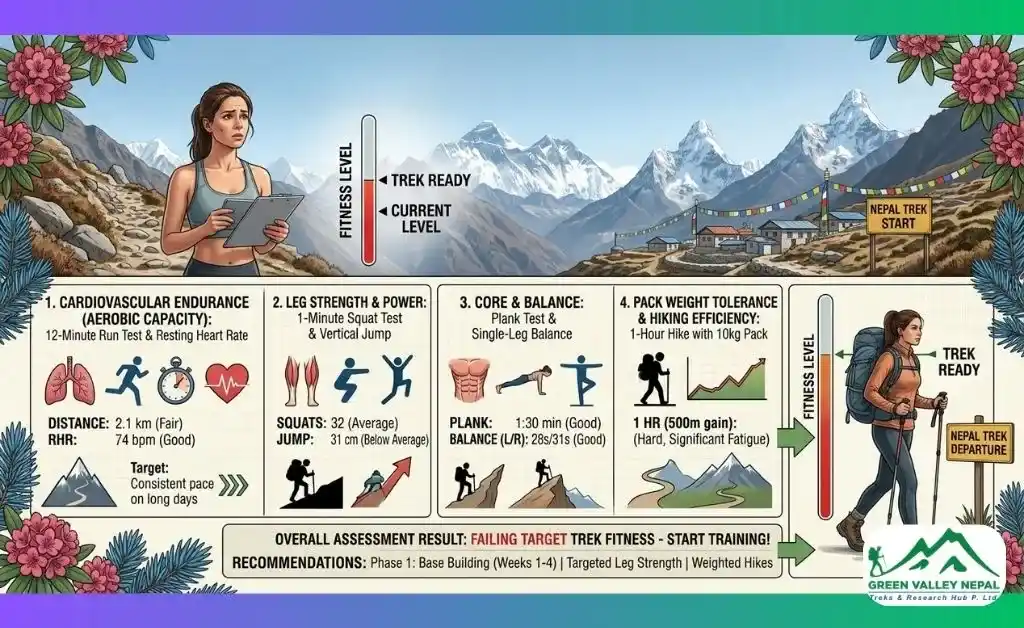
Honest self-assessment is the starting point. Before you follow any training plan, ask yourself:
- Can you walk for 3 hours without stopping?
- Can you climb stairs continuously for 20 minutes?
- Can you carry an 8 kg pack for 2+ hours without serious discomfort?
Based on your answers, you will likely fall into one of three trekker profiles:
- Beginners haven't done much hiking or sustained cardio recently. Give yourself 16 weeks to train, and start with shorter treks like Ghorepani Poon Hill, Langtang Valley, or Ama Yangri Trek. For beginners friendly trek, explore our blog: Best Easy Treks in Nepal for Beginners.
- Intermediate trekkers exercise regularly and can handle a few hours of walking. 12 weeks is your sweet spot, and routes like Annapurna Base Camp or Everest Base Camp are within reach. You can also explore our blog on the best treks in Nepal to test your preparedness for trekking in Nepal.
- Advanced trekkers already hike, run, or train consistently. 8 weeks of focused trek-specific training is usually enough for routes like the Everest Three High Passes, Manaslu Circuit, or Island Peak Climbing with EBC.
Be honest. Many people overestimate their fitness level, especially when they have been gym-goers but not hikers. The mountains don't care about your bench press numbers.
Week-by-Week Training Plan for Trekking in Nepal
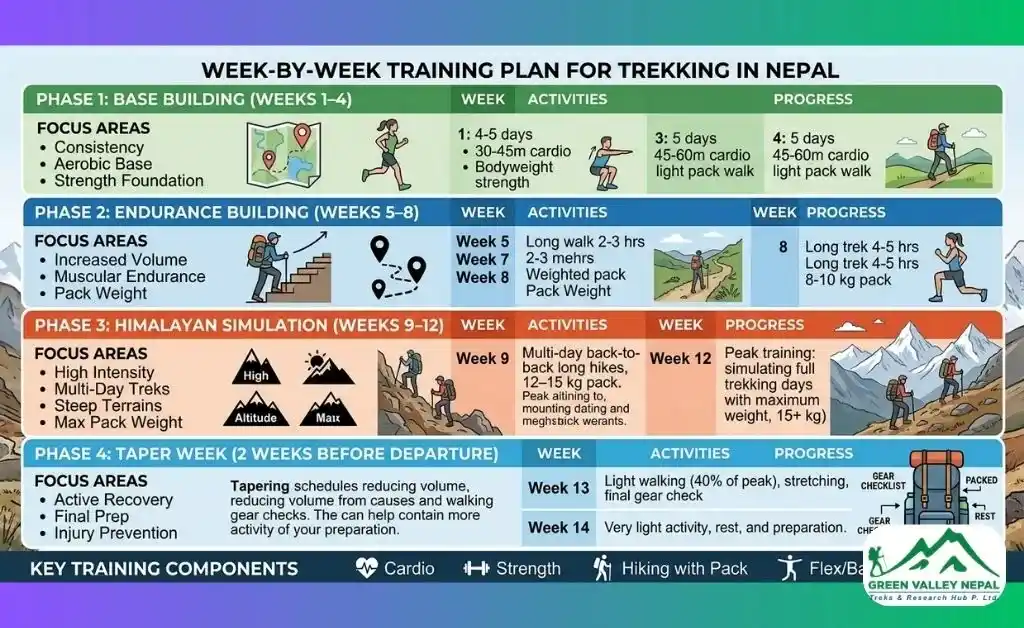
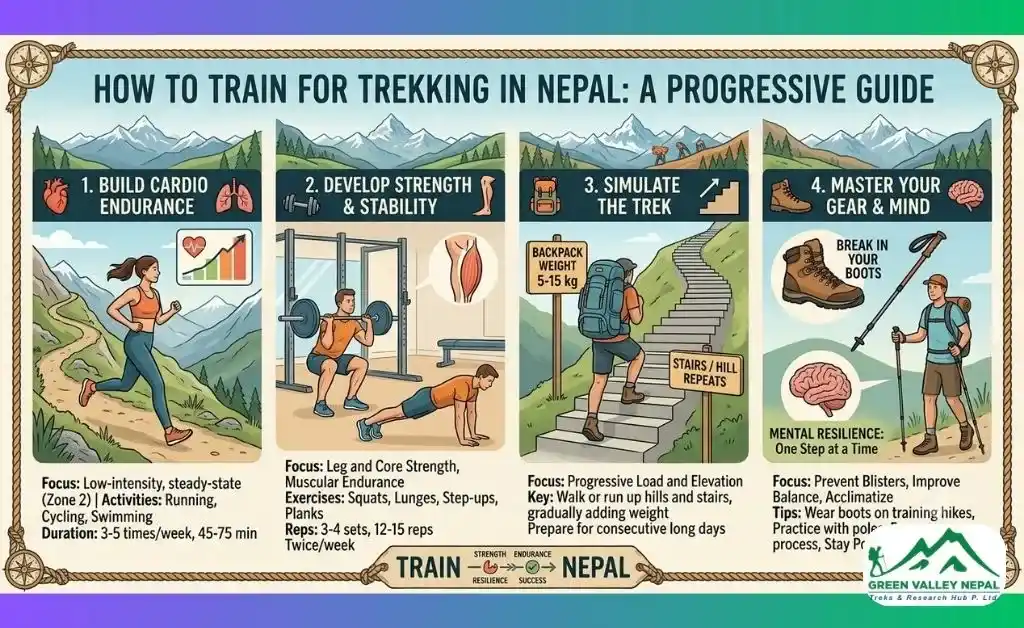
Here's a structured plan covering 12–14 weeks. Adjust the starting point based on your profile above.
Phase 1: Base Building (Weeks 1–4)
The goal here is simple: build your aerobic base and start conditioning your joints, feet, and tendons.
Aim for three cardio sessions per week (30-minute jog or cycle to start, building to 60 minutes), two strength sessions, one long walk, and one full rest day.
Your long walk should begin at 2–3 hours on flat terrain. Most importantly, do it in your trekking boots. Not sneakers, not trail runners you haven't worn before, the boots you will actually wear in Nepal. Blisters formed in training are a blessing compared to blisters formed on day two of EBC.
Phase 2: Endurance Building (Weeks 5–8)
Now you start simulating what Nepal will actually feel like. Extend your long walks to 5–6 hours and add a 6–8 kg daypack. Start incorporating uphill hiking, a steep trail, stadium stairs, or an incline treadmill set to 5–8%.
This is also when leg-specific strength training becomes important (more on that below). Start tracking your heart rate. At altitude, your heart rate will be higher than usual for the same effort; getting familiar with it now helps.
Phase 3: Himalayan Simulation (Weeks 9–12)
This is the hardest phase and the most important. Long hikes should now be 6–8 hours with a 10–12 kg pack, close to what you will carry on the trail.
The key addition here: back-to-back hiking days. Go long on Saturday and go again on Sunday. This simulates the cumulative fatigue of multi-day trekking in a way no single long hike can replicate. Your legs on day three of a trek feel very different from your legs on day one.
If you have access to high-elevation trails, even 2,000–3,000 meters, use them on these weekends.
Phase 4: Taper Week (2 Weeks before Departure)
Two weeks out, cut your training intensity by 40–50%. Short walks, yoga, gentle stretching. Do one final gear test hike with your fully loaded pack to catch any last-minute problems. Focus almost entirely on sleep, hydration, and nutrition. Arriving at Kathmandu airport, tired and overstrained, is a terrible start.
Four Pillars of Trek-Specific Physical Training for Trekking in Nepal
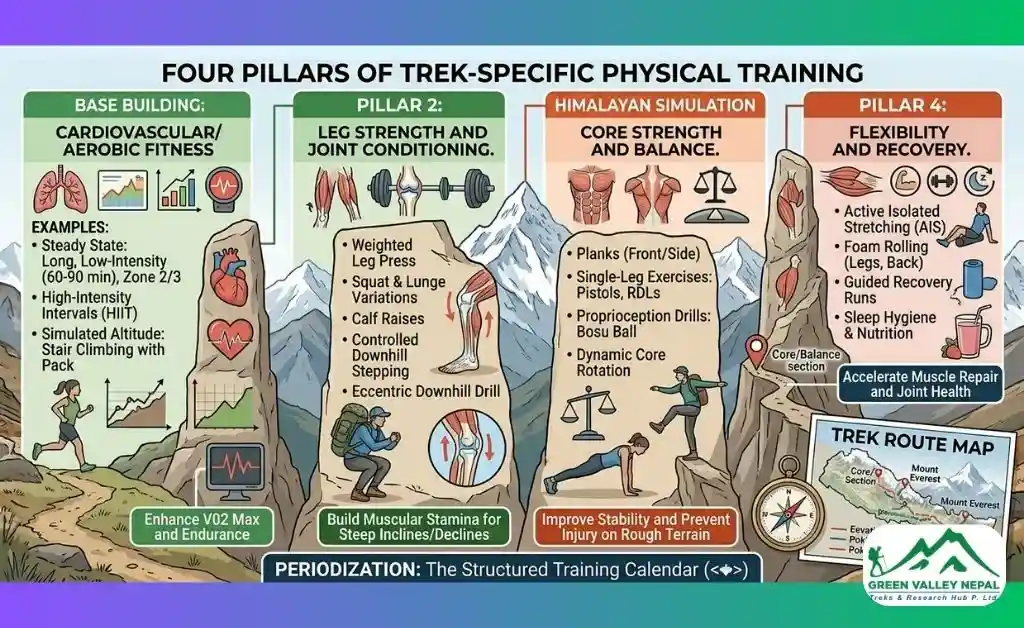
Pillar 1: Cardiovascular/Aerobic Fitness
At 4,000+ meters, the air has roughly 60% of the oxygen you are used to at sea level. Your heart and lungs do the heavy lifting. By the time trekkers reach Everest Base Camp at 5,364 meters, oxygen availability drops to roughly 50% of sea-level conditions, which is why even simple uphill walking can feel exhausting. The best exercises are trail running, road cycling, swimming, stair climbing, and rowing, anything that keeps your heart rate in the moderate zone for extended periods.
Work up to 60–90 minutes of sustained moderate cardio, three times a week. If you are using a treadmill, set it to a 5–8% incline for uphill conditioning and occasionally drop it to flat to train your quads for descent.
Pillar 2: Leg Strength and Joint Conditioning
Your quads will beg for mercy on long descents. Your calves will cramp on steep ascents. Your knees will question every life decision you have ever made.
- Train all of these: squats and weighted step-ups, forward and reverse lunges, single-leg deadlifts for ankle stability, calf raises (both flat and inclined), and wall sits for muscular endurance.
- One thing most people get wrong: they focus only on going uphill. Downhill training is arguably more important. The controlled eccentric loading of descent is what tears up quads and knees. Find a steep trail and hike down it repeatedly.
If you are already in Nepal, there are many training hikes around Kathmandu and Pokhara for building trekking endurance.
Kathmandu:
- Namobuddha to Panauti Day Hiking
- Nagarjun Jamacho Day Hike
- Nagarkot to Dhulikhel Day Hiking Trip
- Champadevi Day Hike
- Phulchoki Day Hiking from Kathmandu
- Shivapuri Day Hike
- Nagarkot Sunrise View and Changunarayan Hike
- Ranikot Village Day Hike from Kathmandu
Pokhara:
- Pokhara Day Tour with Sunrise View from Sarangkot
- Five Himalayan Viewpoints Tour from Pokhara
- Astam Village Day Hiking from Pokhara
- Australian Camp Day Hike from Pokhara
- Kahun Danda Hiking from Pokhara
- Kalikasthan Thulakot Day Hike from Pokhara
- Naudanda Sarangkot Day Hike from Pokhara
- Sarangkot Viewpoint Hike from Pokhara
- Pumdikot Hike with World Peace Pagoda from Pokhara
Pillar 3: Core Strength and Balance
Nepal's trails are not paved. You will be crossing suspension bridges, hopping between boulders, navigating root-covered paths, and walking on slippery stone after rain. Some suspension bridges in the Everest region hang more than 100 meters above river gorges, often swaying in strong afternoon winds. A strong core and good balance keep you stable when the trail tries to throw you.
Planks, side planks, bird-dogs, dead bugs, and single-leg balance work are your friends here. If you have access to a BOSU ball or balance board, use it. Otherwise, simply practicing single-leg stands while brushing your teeth goes further than you'd think.
Pillar 4: Flexibility and Recovery
This pillar gets ignored more than any other, and trekkers pay for it by day four when their hips are screaming, and their IT bands feel like guitar strings.
Do 10–15 minutes of stretching daily: hip flexors, hamstrings, calves, IT band, and lower back. Three yoga poses that are especially useful for trekkers: pigeon pose, downward dog, and warrior II. Add foam rolling after any hard session.
And sleep. Seriously, 7–9 hours is non-negotiable during heavy training weeks. Your muscles don't grow in the gym; they grow while you sleep.
Altitude Acclimatization: Train Your Body before You Land in Nepal
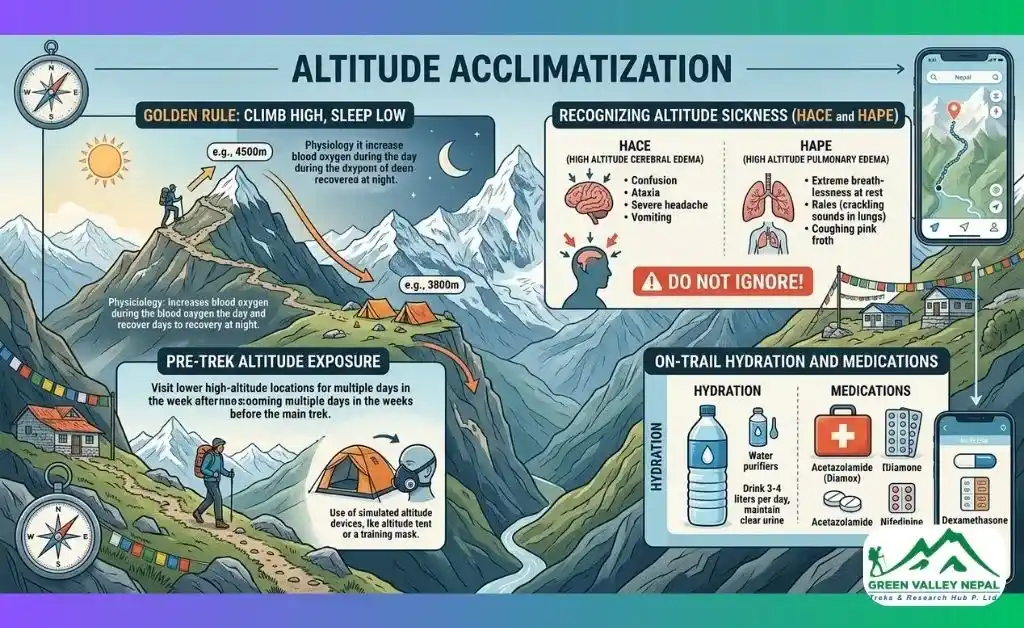
Here's the hard truth: no amount of fitness training fully prepares you for altitude. A highly trained athlete can still get acute mountain sickness (AMS) on the way to Namche Bazaar. Altitude doesn't care about your VO2 max. That said, good fitness absolutely helps your body cope better and recover faster.
Golden Rule: Climb High, Sleep Low
Above 3,000 meters, increase your sleeping altitude by no more than 300–500 meters per day. This is why properly structured itineraries include rest days at places like Namche Bazaar on the EBC trail and Manang on the Annapurna Circuit. These aren't optional rest days; they are acclimatization days that dramatically reduce your AMS risk.
Recognizing Altitude Sickness
Studies suggest that nearly 25–40% of trekkers above 3,500 meters in Nepal experience some form of mild acute mountain sickness (AMS). Know the early signs: persistent headache, nausea, dizziness, unusual fatigue, and poor sleep.
If symptoms appear, don't ascend further until they fully resolve. If they worsen, especially if you notice loss of coordination, confusion, or any fluid in the lungs, descend immediately. This is non-negotiable.
HACE (High Altitude Cerebral Edema) and HAPE (High Altitude Pulmonary Edema) are medical emergencies. The treatment is descent and emergency evacuation. This is exactly why helicopter evacuation insurance is now mandatory.
Pre-Trek Altitude Exposure
If you live near high-elevation areas, weekend trips above 2,500–3,000 meters are genuinely useful. If not, altitude simulation tents and hypoxic training masks exist; they offer some benefit, though they're not magic. The tents are expensive to rent or buy; the masks are cheaper but provide more limited adaptation.
On-Trail Hydration and Medications
Drink 3–4 liters of water per day above 3,000 meters. Garlic soup and ginger tea, staples in teahouse menus, are traditional local remedies that many trekkers swear by. Whether the science fully backs them or not, they're hot, comforting, and won't hurt you.
Diamox (acetazolamide) can help with acclimatization for some people. It has side effects, and it's not right for everyone. Talk to a doctor before your trek, not a trekking forum, a doctor.
Trek-Specific Training Plans for Popular Nepal Routes
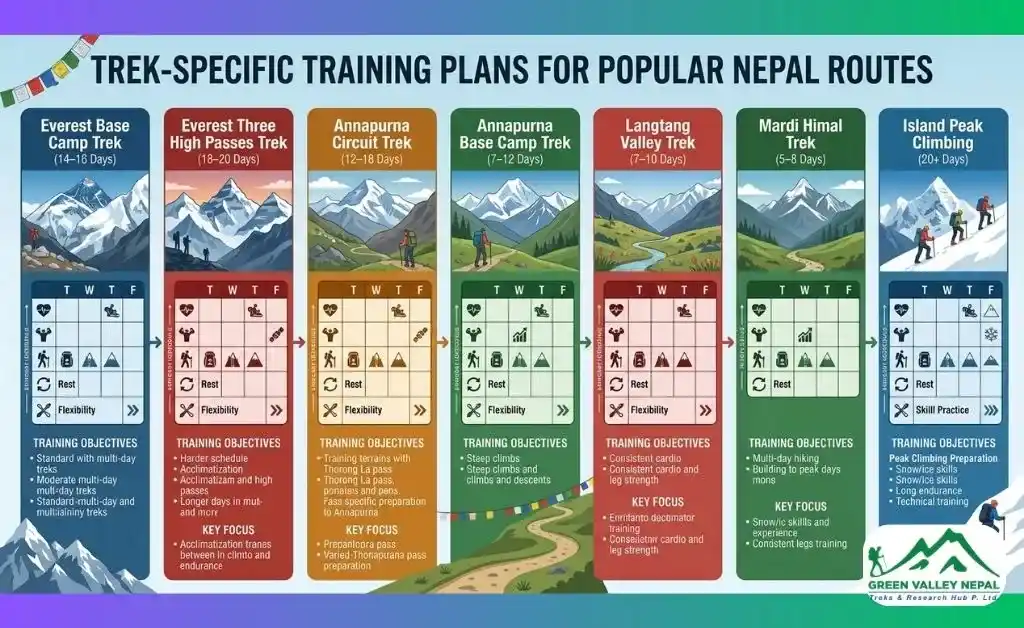
Everest Base Camp Trek (14–16 Days)
The hardest days on the Everest Base Camp Trek are the Namche climb and the Gorak Shep to EBC push above 5,000m. Back-to-back trekking days with little recovery time make base fitness non-negotiable.
12-Week Training Plan
Phase | Weeks | Focus |
Base | 1–4 | Build weekly cardio to 4–5 hrs; introduce stair climbing |
Build | 5–8 | Add weighted pack hikes (8–10 kg); increase back-to-back hiking days |
Peak | 9–11 | Long weekend hikes (6–8 hrs); altitude simulation if possible |
Taper | Week 12 | Reduce volume by 40%; light walks only |
Key workouts:
- Stair climbs with a loaded pack, 3x per week
- Back-to-back hikes on Saturday and Sunday (simulate consecutive trail days)
- Cardio base: cycling, running, or incline treadmill (45 min, 4x per week)
Everest Three High Passes Trek (18–20 Days)
Everest Three High Passes Trek is one of the most demanding treks in Nepal. You will cross three high passes: Kongma La (5,535m), Cho La (5,420m), and Renjo La (5,360m), plus complete the EBC day hike. The combination of altitude, technical terrain, and duration is the core challenge.
14-Week Training Plan
Phase | Weeks | Focus |
Base | 1–4 | 5 hrs/week cardio; introduce elevation gain in hikes |
Build | 5–8 | 10–12 kg pack hikes; quad and glute strength work |
Peak | 9–12 | 7–9 hr weekend hikes; scrambling or rocky terrain practice |
Taper | 13–14 | Drop volume to 50%; mobility and recovery focus |
Key workouts:
- Steep ascent/descent training (not just flat cardio)
- Strength: weighted lunges, step-ups, single-leg squats — 3x per week
- One long hike per week consistently over 6 hours
Annapurna Circuit Trek (12–18 Days)
On the Annapurna Circuit Trek, the Thorong La crossing is the defining challenge, a very long summit day (1,000m+ ascent, 1,600m descent) done in a single push.
12-Week Training Plan
Phase | Weeks | Focus |
Base | 1–4 | Build to 4 hrs/week cardio; flat to moderate hikes |
Build | 5–8 | Distance endurance hikes (5–7 hrs); descent conditioning |
Peak | 9–11 | Back-to-back days; simulate Thorong La with 1,000m gain days |
Taper | Week 12 | Reduce volume; focus on flexibility |
Key workouts:
- Descent conditioning: downhill hiking or stair descents, protect knees for the 1,600m drop off Thorong La
- Long-distance endurance: build up to one 7-hour hike before departure
- Balance work: single-leg exercises and trail running on uneven surfaces
Annapurna Base Camp Trek (7–12 Days)
ABC Trek is shorter than the Circuit, but don't be fooled by the duration. Steep ascent days and cold temperatures, especially at the base camp (4,130m), require genuine preparation. The trail gains significant elevation quickly through the Modi Khola valley.
8-Week Training Plan
Phase | Weeks | Focus |
Base | 1–3 | 3–4 hrs/week cardio; introduce incline hikes |
Build | 4–6 | Steep pack hikes (6–8 kg); cold weather training if possible |
Peak | 7 | One long mountain day (5–6 hrs with elevation gain) |
Taper | Week 8 | Light activity only |
Key workouts:
- Uphill interval training: 20–30 min incline sessions, 3x per week
- Cold exposure: early morning hikes to simulate cold-start trekking conditions at high camp
- Core and stability: balance boards, step-ups, and hip strengthening
Langtang Valley Trek (7–10 Days)
Langtang Valley Trek will be a great altitude introduction for trekkers planning harder routes later (such as EBC). The maximum elevation is around 4,984m at Tserko Ri. The daily walking times are manageable, making this a good fitness benchmark trek.
6-Week Training Plan
Phase | Weeks | Focus |
Base | 1–2 | 3 hrs/week cardio; flat and moderate hikes |
Build | 3–5 | 3–5 hr hikes with light pack (5–6 kg); steady incline work |
Taper | Week 6 | Reduce to easy walks only |
Key workouts:
- Endurance walks: 3–4-hour hikes, 2x per week
- Moderate strength training: bodyweight squats, lunges, calf raises
- Cardio variety: swimming, cycling, or jogging to build an aerobic base without overloading joints
Mardi Himal Trek (5-8 Days)
Mardi Himal Trek, which covers a maximum altitude of around 4500m at Base Camp. This trek is ideal for first-timers, families, and those returning to hiking after a break.
4-Week Training Plan
Phase | Weeks | Focus |
Base | 1–2 | 2–3 hrs/week walking or light jogging; introduce stairs |
Build | 3 | 2–3 hr hike once per week with a light daypack |
Taper | Week 4 | Easy daily walks, 30–45 min |
Key workouts:
- Daily walks of 45–60 minutes, 5x per week
- Stair climbing: 15–20 minutes, 3x per week
- Light stretching routine post-walk: hip flexors, calves, hamstrings
Island Peak Climbing (20+ Days)
Island Peak Climbing (Imja Tse, 6,189m) is a trekking peak, but it demands genuine mountaineering preparation. The summit push is physically intense and requires competence with ice axes, crampons, and fixed ropes.
16-Week Training Plan
Phase | Weeks | Focus |
Base | 1–4 | Build 6 hrs/week cardio; full-body strength foundation |
Skills | 5–8 | Mountaineering course: ice axe arrest, crampon technique, rope work |
Build | 9–12 | High-load hikes (12–15 kg pack); altitude simulation where possible |
Peak | 13–15 | Multi-day mountain routes; final technical skills practice |
Taper | Week 16 | Active recovery only |
Key workouts:
- Upper body strength: pull-ups, rows, shoulder press (essential for rope sections)
- Loaded carries: progressively heavier packs on steep terrain
- Technical skills (non-negotiable): attend a certified mountaineering course before the trip
Nutrition and Hydration for Trekking in Nepal
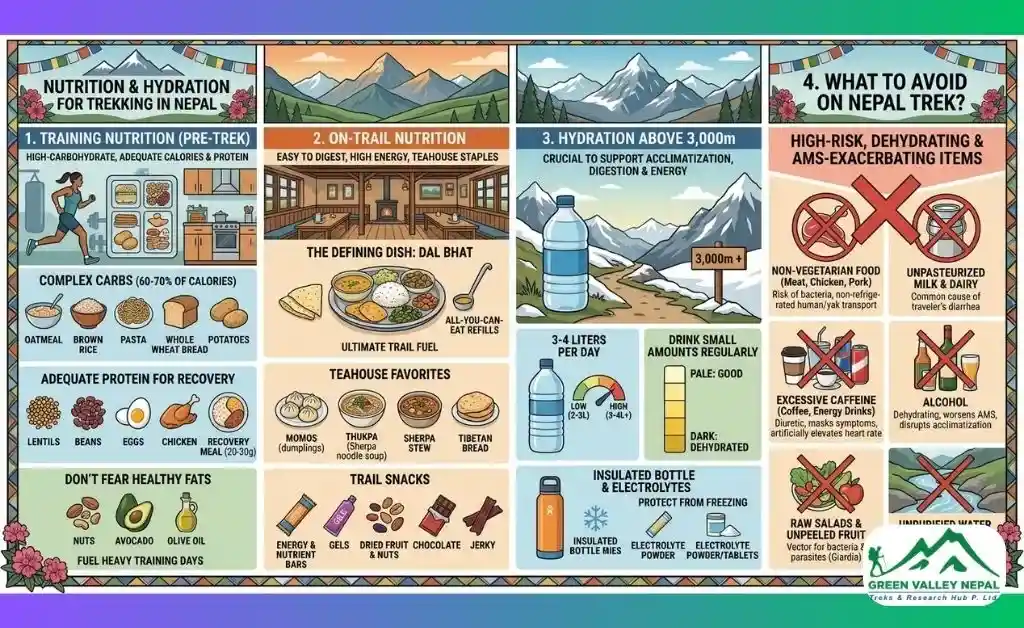
Training Nutrition (Pre-Trek)
What you eat during your training months directly affects how well your body adapts and how quickly it recovers between sessions. Nepal's high altitude adds another layer: your blood needs to carry oxygen efficiently long before you board the flight.
Macronutrient breakdown:
Macro | Target | Why It Matters |
Carbohydrates | 60–70% | Primary fuel for long training hikes |
Protein | 20–25% | Muscle repair between sessions |
Healthy fats | 10–15% | Joint lubrication, sustained energy |
- Eat complex carbohydrates (oats, sweet potato, brown rice) 1–2 hours before a long hike
- Follow hard sessions with protein within 30–45 minutes to accelerate muscle repair
On-Trail Nutrition
Above 3,000m, your appetite often decreases even as your caloric demands increase. Trekkers burn between 3,000 and 5,000 kcal per day depending on terrain, elevation, and body weight.
Dal Bhat (lentil soup, rice, and vegetable curry) is available at every teahouse along every major trail in Nepal. It's carbohydrate-heavy, freshly cooked, and most teahouses offer unlimited refills. It also tends to sit easier on the stomach at altitude than rich or unfamiliar food.
Trail Snack Essentials
- Energy bars or homemade trail mix (nuts, dried fruit, chocolate)
- Peanut butter sachets (calorie-dense and shelf-stable)
- Dark chocolate for quick energy and morale
- Electrolyte tablets or powder to add to water
Hydration above 3,000m
Drink 3–4 liters of water per day above 3,000m, more on big ascent days. Dehydration accelerates altitude sickness symptoms and is one of the easiest problems to prevent. Don't wait to feel thirsty; drink steadily throughout the day.
Electrolytes (sodium, potassium, magnesium) help your body retain water and reduce cramping. Carry electrolyte tablets and use them daily above 3,500m.
What to Avoid on a Nepal Trek?
These are not suggestions; they are mistakes that reliably send trekkers home early:
- Alcohol: Alcohol impairs your body's ability to adapt to altitude, disrupts sleep quality, and dehydrates you.
- Heavy, Greasy, or Unfamiliar Food: The teahouse menu will have tempting options. Avoid anything rich or new the night before Thorong La, the Namche climb, or any high pass. Stick to what your stomach knows.
- Sleeping Pills: They suppress breathing during sleep, which is exactly the opposite of what your body needs above 4,000m.
Mental Side of Training for Trekking in Nepal

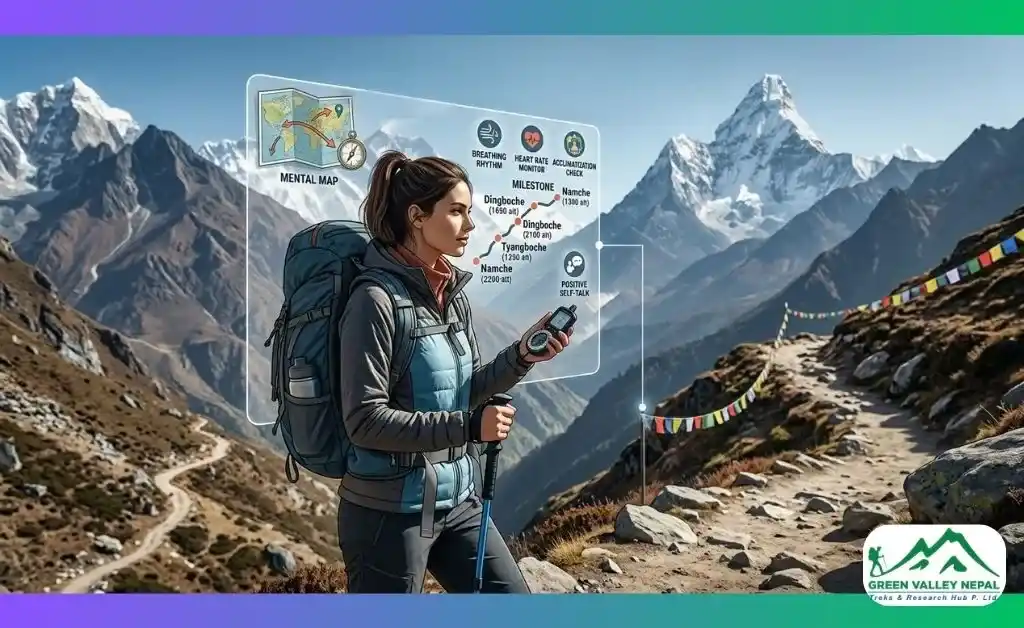
Almost every trekker hits a wall. It usually arrives around day three to five, or at a particularly brutal high-altitude section. Your legs hurt, your lungs feel inadequate, and you wonder why you paid money to do this to yourself.
The trekkers who push through aren't necessarily fitter; they are better prepared mentally. Build mental toughness in training by doing long solo hikes, pushing through tired sessions, and practicing discomfort.
Visualize your trek in detail before you go, imagine the hard days, and imagine getting through them. On the trail, break every difficult day into micro-goals: just to that teahouse, just one more switchback, just to the ridge. It works.
A personal mantra, something simple that you repeat when it gets hard, sounds cheesy until you're at 5,000 meters and you actually need it.
Final Preparation Checklist (2–4 Weeks before Departure)
- Medical: Doctor visit, vaccinations (check requirements for Nepal), Diamox discussion if appropriate, dental check
- Documents: TIMS card, trekking permits, mandatory evacuation insurance to 6,000m (2026 regulation)
- Guide: Confirm current guide requirements for your trekking region and book a licensed, registered guide if required.
- Gear: Final pack weight check; aim for a maximum of 10–12 kg, including all essentials. For detailed information about trekking gear, visit our blog smartly written on the recommended packing list for trekking in Nepal.
- Training: Begin taper phase; maintain movement but reduce intensity
- Digital prep: Download offline maps (Maps.me or Gaia GPS), save emergency contacts, and register with your embassy
- Cultural prep: Learn basic Nepali phrases (namaste, dhanyabad, bistaarai bistaarai, slowly slowly), understand temple etiquette, and know the tipping norms for your guides and porters
Conclusion
Nepal rewards preparation. The trekkers who train consistently, test their gear, pace their acclimatization, and show up mentally ready are the ones who spend their time looking at the mountains, not staring at the ground trying not to collapse. Put in the work before you go, and the Himalayas will give you something back that's hard to put into words.
Planning a trek in Nepal in 2026? The team at Green Valley Nepal can help you choose the right route, prepare properly, and trek safely with experienced licensed guides. Contact us to start planning your Himalayan adventure.
Frequently Asked Questions (FAQs)
- How long should I train before trekking in Nepal?
8 to 16 weeks, depending on your current fitness level and the difficulty of your chosen trek. Don't rush it. Consistency matters far more than intense last-minute training.
- Can a beginner trek to Everest Base Camp?
Yes, but only with proper training and a realistic timeline. 16 weeks of consistent training, combined with a well-paced 14–16-day itinerary, make EBC achievable for determined beginners.
- Does fitness prevent altitude sickness?
No. Fitness helps your body cope and recover better, but altitude sickness can affect anyone, regardless of how fit they are. Acclimatization is its own process.
- What is the best exercise for Nepal trekking?
Uphill hiking with a loaded pack, hands down. Everything else supports it. Stair climbing and long endurance walks are also extremely effective preparation methods.
- How much water should I drink while trekking in Nepal?
3–4 litres per day above 3,000 metres. More on hot days or after heavy exertion. Dehydration increases fatigue and can worsen altitude-related symptoms.
- Do I need a guide for trekking in Nepal in 2026?
Many popular trekking regions in Nepal now require or strongly enforce licensed guides, especially on regulated routes. Always check the latest local regulations before your trek.