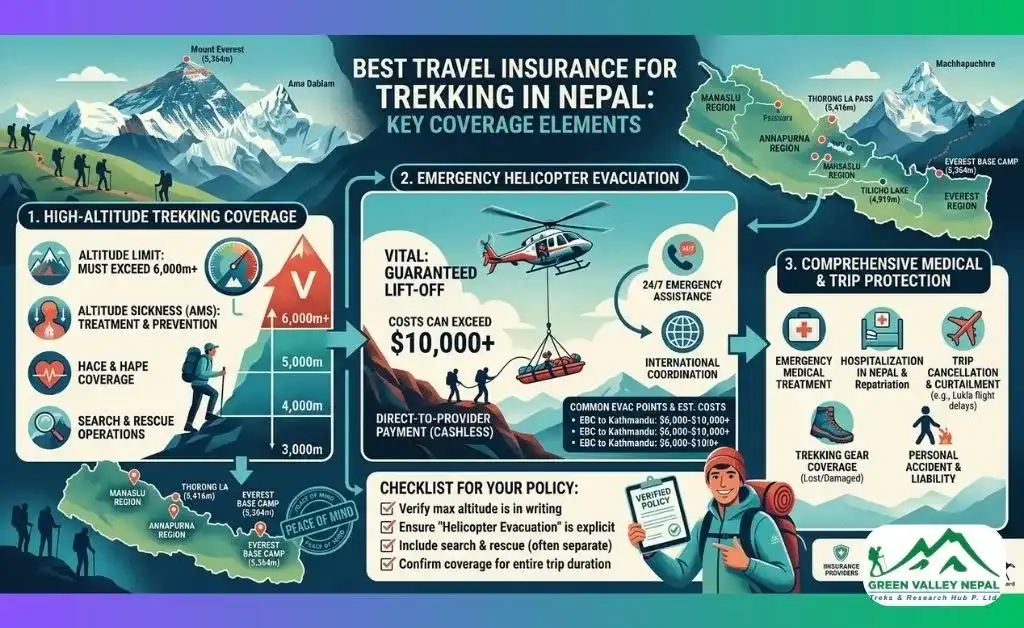
Best Travel Insurance for Nepal Trekking 2026/2027
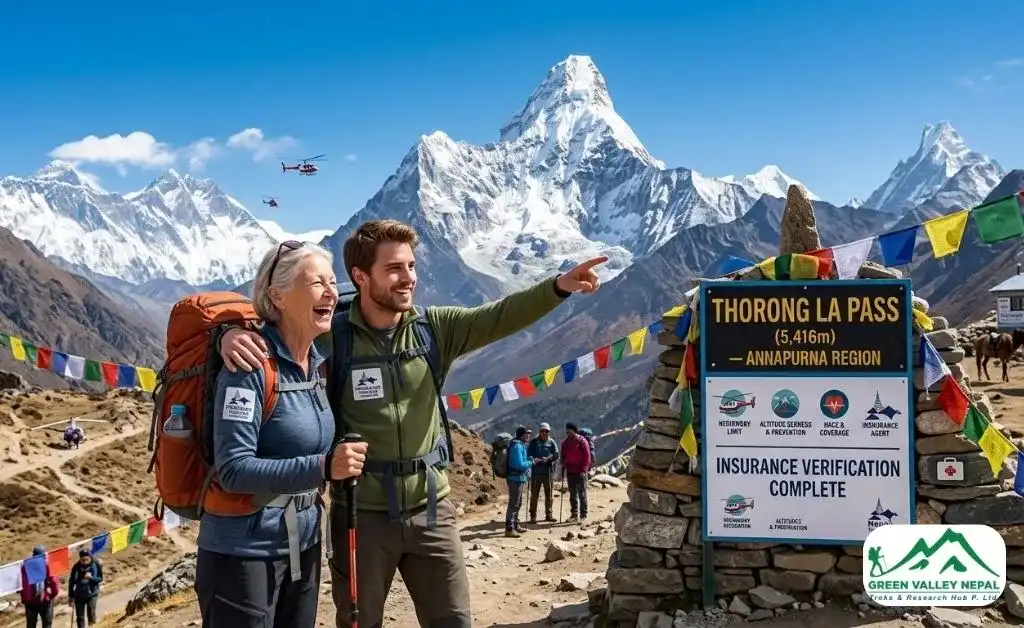
Short on time? Here's the verdict before the details. These picks are based on which providers consistently deliver on altitude coverage, cashless helicopter evacuation, and claims responsiveness for our clients, not on affiliate arrangements; Green Valley Nepal Treks does not sell or earn commission on insurance.
Category | Best Pick | Why |
Best Overall for EBC/ABC/Manaslu-level treks | World Nomads (Explorer Plan) | Covers to 6,000m, purchasable even after departure, strong claims track record among our clients |
Best for Peak Climbing (Island Peak, Mera Peak) | IMG Global + Global Rescue membership | High evacuation limits plus dedicated search-and-rescue dispatch above 6,000m |
Best Evacuation-Only / No-Altitude-Cap Option | Global Rescue | Unlimited altitude, but pair it with a separate medical policy; it doesn't cover cancellation or baggage |
Best Budget Option (short treks like Ghorepani Poonhill Trek, Mardi Himal Trek, Langtang Valley Trek ) | SafetyWing | Affordable, flexible monthly plans; check the altitude cap before booking anything above 4,500m |
Best for UK & European Trekkers | True Traveller | High-altitude add-on with no altitude ceiling on the top tier, fast Nepal claims processing |
Best for Indian Trekkers (Everest Trek from Indians) | Bajaj Allianz or ICICI Lombard | Affordable, strong domestic claims support, widely accepted by Nepal-based evacuation companies |
Best for Germany/Austria | Alpenverein Edelweiss | Popular with alpine-club members, strong reputation for high-altitude mountaineering claims |
Is Travel Insurance Mandatory for Trekking in Nepal?
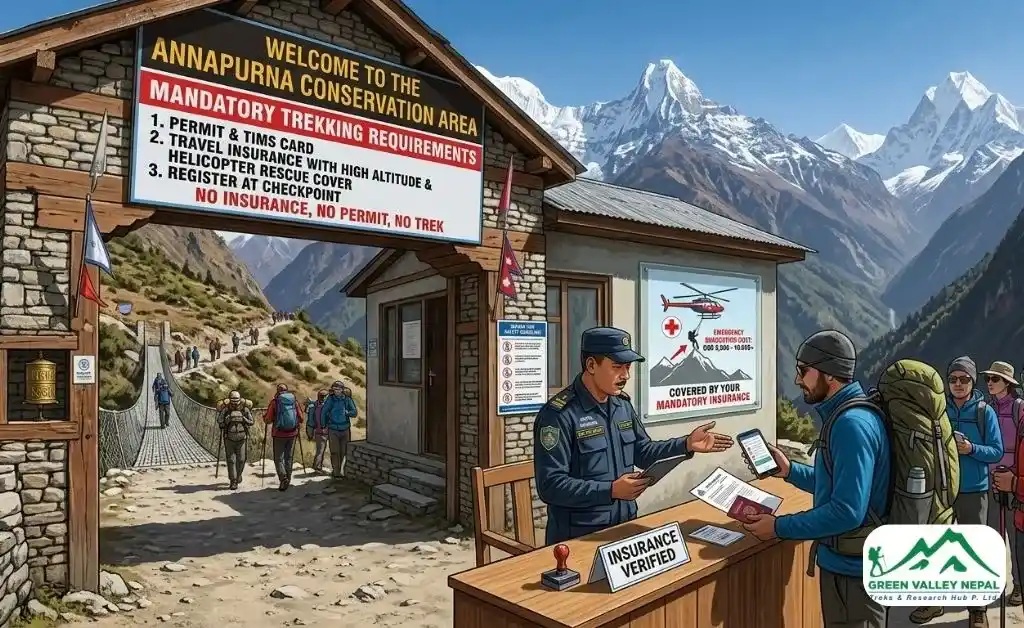
There's no single national law that stops you at immigration and demands a policy. But in practice, it functions as mandatory. Green Valley Nepal Treks requires proof of adequate insurance before confirming any booking, and so does every reputable operator working in Nepal's restricted areas (Upper Mustang, Manaslu, Nar Phu, Dolpo). Your TIMS card and area permits are processed alongside this requirement, and the Nepal Tourism Board strongly recommends coverage for anyone trekking above 3,500m.
Why Standard Travel Insurance Isn't Enough?
This is where most first-time trekkers get caught out. A "worldwide" travel policy bought through a bank, credit card, or airline typically covers hiking up to 2,000–3,000m, fine for a city break, useless for the Himalayas. Even policies marketed with an "adventure sports" add-on often cap out around 4,000m.
Compare that to where you're actually walking:
Every one of these exceeds a standard policy's altitude ceiling. If you are injured or fall sick above your policy's declared limit, the insurer can, and routinely does, deny the claim in full, including the helicopter bill.
Altitude Coverage You Need, By Trek
Buy coverage to at least 1,000m above your trek's highest point. Weather reroutes, optional side trips, and summit pushes regularly take trekkers higher than the original plan.
Trek | Max Altitude | Minimum Policy Altitude |
Ghorepani Poon Hill, Pokhara day hikes | Under 3,210m | 4,000m |
Everest Marathon Trek (16 Days) | 5,364m (EBC start) | 6,000m |
Everest Base Camp Trek | 5,364m | 6,000m |
Annapurna Base Camp Trek | 4,130m | 5,000m |
Annapurna Circuit Trek | 5,416m (Thorong La) | 6,000m |
Manaslu Circuit Trek | 5,106m (Larke La) | 6,000m |
Mardi Himal Trek | 4,500m | 5,500m |
Everest Three High Passes Trek | 5,535m (Kongma La) | 6,500m |
Island Peak / Mera Peak Climbing | 6,189m / 6,476m | 7,000m |
The cost difference between a 5,000m and 6,000m policy is usually $20–$50. The coverage gap it closes is worth thousands.
What Your Travel Insurance Policy Must Actually Cover
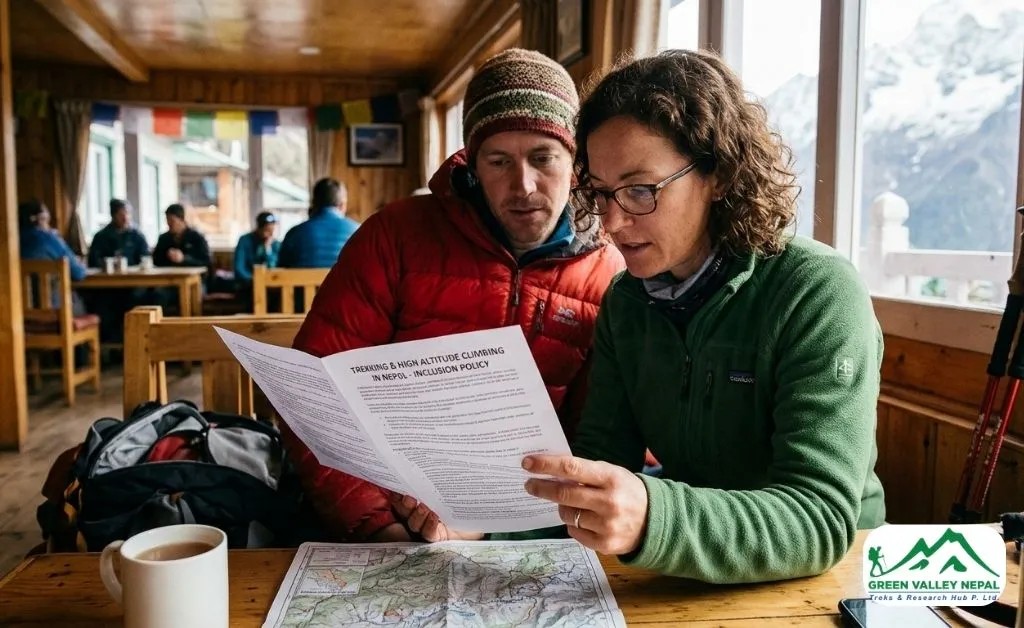
Read the fine print for these ten items before you buy anything:
- Emergency Medical Treatment at Altitude: Must explicitly name Acute Mountain Sickness (AMS), High Altitude Pulmonary Edema (HAPE), and High Altitude Cerebral Edema (HACE), not just "illness."
- Helicopter Evacuation and Rescue: Stated by name. "Medical transport" often means a ground ambulance, which doesn't exist on Himalayan trails.
- Minimum $100,000 Medical Evacuation Limit: Ideally $200,000+ for peak climbing or Three Passes-level routes.
- Minimum $100,000 Emergency Medical Treatment for hospitalization, surgery, and follow-up care.
- Repatriation: Flying you home for specialized treatment, or your remains home in the worst case.
- Trip Cancellation, Interruption, and Delay: Covers Lukla or Jomsom flight cancellations, which happen routinely in poor weather.
- 24/7 Emergency Assistance Line confirmed to work internationally, not just in the insurer's home country.
- Baggage and Gear Coverage for trekking equipment lost, stolen, or delayed in transit.
- Adventure/Hazardous Activity Rider: Many base policies exclude trekking entirely unless this box is checked and paid for separately.
- Pre-existing Condition Disclosure: Declare cardiac, respiratory, or other relevant conditions; undisclosed conditions void claims outright.
Side-by-Side Travel Insurance Provider Comparison
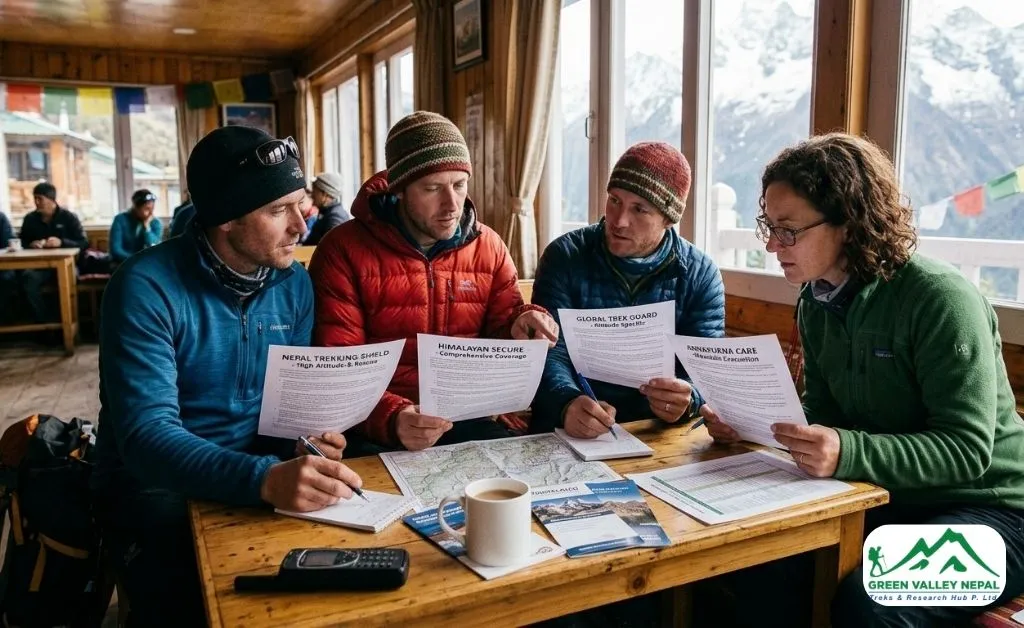
A quick scan across the providers trekkers ask us about most, so you can compare without opening ten tabs. Always confirm current figures directly with the provider; insurers revise these terms annually.
Provider | Max Altitude | Evacuation Limit | Adventure Sports Rider | Gear Coverage | Trip Cancellation | Approx. Cost (14 Days) |
World Nomads (Explorer) | 6,000m | Full policy max | Included | Up to $3,000 | Included (higher tier) | $110–$180 |
IMG Global | 6,000m | Up to policy max | Required rider | Optional add-on | Add-on available | $100–$160 |
True Traveller | 6,000m+ (unlimited on top tier) | Full coverage | Included | Up to £2,000 | Included | $90–$150 |
SafetyWing | 4,500m (extendable) | Up to $100,000 | Adventure add-on | Not included | Interruption only | $60–$100 |
Allianz Global Assistance | 4,000–5,500m (plan-dependent) | Limited helicopter | Often excluded on base plan | Minimal | Strong cancellation cover | $100–$170 |
Global Rescue (membership) | Unlimited | Full extraction, no cap | Included (mountaineering) | Not a travel policy | Not included | $200–$400+ (annual varies) |
Bajaj Allianz / ICICI Lombard | Up to 5,500–6,000m | Policy-dependent | Adventure sports add-on | Limited | Included | Varies by plan |
Reading this table: the "Adventure Sports Rider" column matters most. If a provider requires it and you skip it to save money, trekking itself is excluded from your policy, altitude coverage notwithstanding.
Helicopter Rescue in Nepal: Real Costs
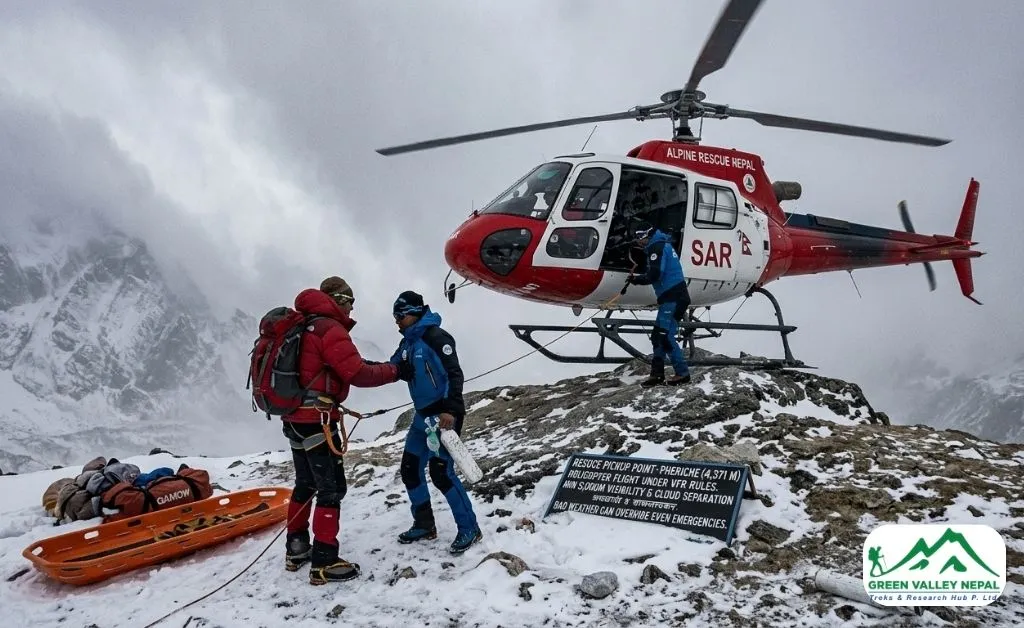
Helicopter evacuation is far more common on Nepal's trekking routes than most visitors expect, especially in the Khumbu during peak season. Cost scales with altitude and distance from Kathmandu:
In many cases, payment confirmation is required before the helicopter departs. Without insurance, or with an insurer that can't issue a cashless payment guarantee, that bill is yours to settle on the spot, often by wiring funds from family back home while your guide negotiates with the operator.
This is precisely why the evacuation limit on your policy matters more than the headline premium: a $60 policy capped at $30,000 can leave you exposed on a complex high-altitude rescue, while a $120 policy with a $250,000 cap fully absorbs it.
What to Do If You Need a Helicopter Rescue?
If altitude sickness or injury strikes on the trail, here's how the process actually works with a reputable operator like Green Valley Nepal Treks:
- Your guide assesses the situation first. Most operators require this step before calling a helicopter; it protects you from Nepal's history of commission-driven, unnecessary evacuations, and confirms whether descent on foot is safer and sufficient.
- Your guide contacts our Kathmandu office and your insurer's 24/7 emergency line simultaneously. This is why saving that number in your phone before you fly matters; a satellite phone connection with no saved number wastes critical time.
- The insurer issues a payment guarantee (if your policy is cashless). This authorizes the helicopter operator to dispatch immediately without upfront payment. If your policy is reimbursement-only, you or a family member typically need to pay before the helicopter departs.
- Evacuation to the nearest appropriate facility. Usually Kathmandu for anything beyond basic treatment, occasionally Namche Bazaar or Lukla for lower-altitude injuries.
- Hospital admission and treatment, with your insurer's local claims contact coordinating billing directly with the hospital where possible.
- Documentation for your claim: keep every receipt, the flight manifest, and medical reports; your operator and guide can help assemble these afterward.
Having this process front-loaded, rather than figuring it out mid-emergency, is exactly why the pre-trip step of saving contacts and confirming your cashless status matters more than almost anything else on this page.
How Much Does Nepal Trekking Insurance Cost?
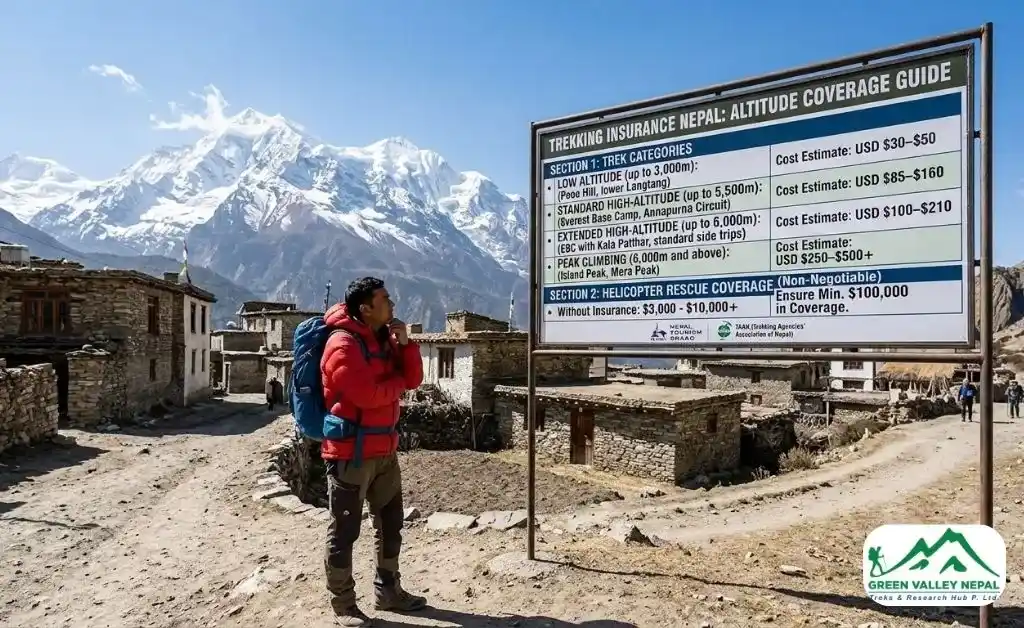
Pricing scales primarily with the altitude tier you declare, plus your age and trip length.
Coverage Tier | Typical Treks | 14-Day Cost (Est.) |
Up to 3,000m | Poon Hill, short Pokhara hikes | $30–$50 |
Up to 5,500m | Annapurna Base Camp, Mardi Himal | $85–$160 |
Up to 6,000m | Everest Base Camp, Everest Marathon Trek, Annapurna Circuit, Manaslu Circuit | $100–$210 |
6,000m+ (peak climbing) | Island Peak, Mera Peak, Three High Passes | $250–$500+ |
Travelers over 50 typically pay 30–50% more than under-35 rates. Adding trip cancellation coverage adds roughly $30–$60; full gear replacement adds $20–$50. Whatever tier applies to your trip, the premium is a rounding error against a $3,000–$10,000 uninsured rescue bill.
Best Travel Insurance Companies by Countries

This list is compiled from feedback gathered directly from Green Valley Nepal Treks clients across our trekking seasons, not a paid or affiliate placement. Confirm altitude limits and evacuation caps directly with the provider before booking, as terms change.
American and Canadian Citizens:
United Kingdom (British Citizens):
Germany, Austria & Continental Europe:
Australia and New Zealand:
Malaysia and Singapore:
Asia and the Middle East:
South Africa:
Global / Nationality-Independent Options:
Travel Insurance for Peak Climbing & Expeditions in Nepal
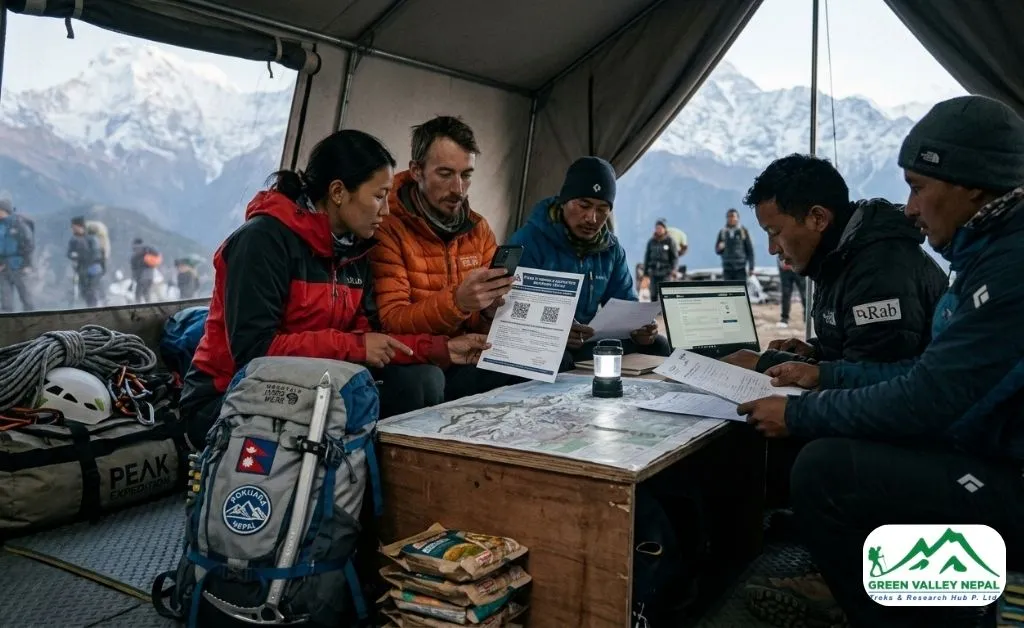
If your trip includes a climbing peak: Island Peak, Mera Peak, Lobuche East, a standard high-altitude trekking policy usually isn't enough on its own, even one rated to 6,000m. Peak climbing insurance needs to explicitly cover:
- Roped travel and technical mountaineering, not just walking trekking trails. Many "trekking to 6,000m" policies exclude glacier travel, fixed-rope sections, and use of crampons/ice axes unless mountaineering is separately declared.
- Search and rescue (SAR), distinct from helicopter evacuation. SAR covers locating a climber in poor visibility or after a fall, a real scenario on Island Peak's summit ridge, and isn't automatically bundled with evacuation cover.
- Higher evacuation limits: $200,000–$500,000. Rescues above 6,000m involve more complex logistics, often two-stage (high camp to base camp, then base camp to Kathmandu), which costs more than a standard EBC-route rescue.
- Nepal Mountaineering Association (NMA) peak permit compliance: as an NMA-registered operator, we can confirm which of your documents your insurer will need to process a claim tied to a peak permit.
Global Rescue paired with a primary medical policy is the combination most climbing guides recommend, precisely because Global Rescue has no altitude cap and specializes in exactly this kind of dispatch.
What's Not Covered in Travel Insurance: Common Exclusions?
Read this section before you assume your policy has you covered; these are the exclusions that catch trekkers most often:
- Undeclared pre-existing conditions. Cardiac, respiratory, or diabetic conditions not disclosed at purchase can void the entire policy, not just the related claim.
- Injuries involving alcohol or drugs. Claims are routinely denied if intoxication contributed to the incident.
- Undeclared high-risk activities. If you add on paragliding, canyoning, or technical climbing beyond what you originally declared, those specific activities are excluded unless you update your policy first.
- Trekking without the adventure sports rider. The single most common denial reason: trekking itself was never covered because the rider was never added.
- Pregnancy beyond 24–28 weeks. Most insurers exclude trekking claims from this point onward, and almost none cover labor complications on the trail.
- Political unrest and travel advisories. Some policies exclude claims if you're traveling against your home country's official travel advisory, or if the incident is connected to civil unrest; worth checking given Nepal has seen periods of localized unrest in recent years.
- Natural disaster nuance. Trip cancellation for earthquakes or landslides is often covered, but check whether your policy requires the event to occur within a specific window before departure versus during the trek itself.
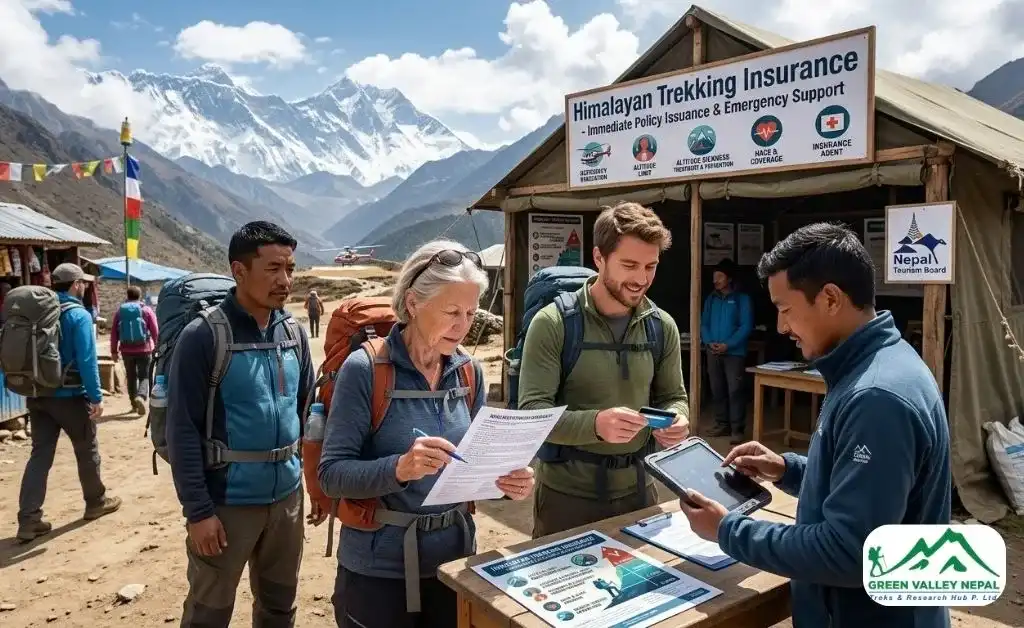
Documents You Need to Buy and Carry for Travel Insurance
To purchase your policy, most insurers ask for:
- A clear copy of your passport
- Your detailed travel itinerary (flights, accommodation, planned trekking dates and route)
- A health declaration disclosing any pre-existing conditions
- Proof of residency (for some UK/EU insurers)
- Payment details
To carry on the trek, keep both digital and printed copies of:
- Your insurance certificate showing policy number, coverage altitude, and evacuation limit
- The insurer's 24/7 emergency contact number
- A one-page coverage summary, useful to hand to your guide on day one so they know exactly what your policy allows for
We request a copy of your policy alongside your TIMS and permit paperwork before departure; having these ready in advance speeds up your final trip briefing.
How to Choose the Right Travel Insurance Policy?

- Match the altitude to your actual route, not the trek name; a "Base Camp" trek and an add-on Kala Patthar sunrise hike are different altitudes.
- Confirm the helicopter evacuation limit in writing, not from marketing copy; email the insurer and get the number in text.
- Check whether the payment is cashless or reimbursement-only. Cashless guarantees mean the helicopter dispatches immediately; reimbursement-only means you or your family pay first.
- Declare pre-existing conditions honestly. Altitude sickness risk interacts with cardiac and respiratory conditions, and non-disclosure voids the whole policy, not just the related claim.
- Buy before departure. Coverage can't be backdated, and symptoms that begin before purchase are treated as pre-existing.
- Save the 24/7 emergency number in your phone, and give a printed copy of your policy to your guide before you start trekking.
Common Mistakes Trekkers Make
- Assuming a standard "worldwide" policy covers Everest Base Camp. It rarely does; the altitude exclusion is usually buried in the policy wording, not the marketing page.
- Not checking the helicopter evacuation cap. A policy can technically include helicopter rescue while capping the payout at $20,000–$30,000, which is well short of a complex high-altitude evacuation.
- Declaring a lower altitude to save a few dollars. If your trek exceeds the declared altitude, including an unplanned high pass or side trip, any claim above that point is void.
- Treating "adventure sports" as automatic. Most base policies exclude trekking entirely until you actively select and pay for the adventure sports rider.
- Buying or upgrading after symptoms appear. Policies cannot be backdated, and any condition that began before purchase, including early altitude sickness symptoms, is excluded.
Filing a Claim after Your Trek
If you were treated, evacuated, or had gear lost or delayed during your trek, most insurers expect the following once you're back:
- Notify Your Insurer Within Their Stated Window: Often 30 days from the incident, sometimes sooner. Check your policy document for the exact deadline.
- Submit Itemized Documentation: Hospital invoices, the helicopter operator's invoice, your original policy certificate, and for gear claims, receipts or proof of value for lost items.
- Include your guide's incident report if available. Green Valley provides a written incident summary for any medical evacuation or significant injury on our trips, which speeds up claims processing considerably.
- Follow up in writing. Email correspondence creates a paper trail that phone calls don't; keep every reference number the insurer gives you.
Claims tied to cashless evacuations (where the insurer already paid the helicopter operator directly) are typically faster to close, since the largest expense is already settled before you're even back in Kathmandu.
Final Thoughts
Travel insurance is the one piece of trip preparation that's easy to underestimate until you actually need it. The right policy costs less than a pair of trekking boots and stands between a manageable emergency and a financial catastrophe thousands of miles from home. Confirm your altitude limit, verify your evacuation cap in writing, and carry your policy documents with you on the trail.
If you have any questions about matching your insurance to your specific Green Valley itinerary Everest Marathon Trek, EBC, Annapurna Circuit, Manaslu, or peak climbing- get in touch with our team before you book.
Frequently Asked Questions (FAQs)
- Do I need travel insurance for Everest Base Camp?
Yes. EBC sits at 5,364m, well above the altitude limit of most standard policies. You need coverage explicitly stated to at least 6,000m, plus helicopter evacuation with a minimum $100,000 limit. Green Valley requires proof of this before confirming your booking.
- How much does a helicopter rescue cost in Nepal?
A rescue from Namche Bazaar to Kathmandu runs $3,000–$5,000. From above 5,000m, Lobuche, Gorakshep, or Base Camp expect $6,000–$10,000. Rescues from trekking peaks above 6,000m can exceed $15,000.
- Does travel insurance cover altitude sickness in Nepal?
Only if it explicitly names AMS, HAPE, or HACE and covers the altitude you're trekking at. Generic "illness" coverage on a standard policy usually excludes altitude-related conditions above 3,000–4,000m.
- Is travel insurance legally mandatory to enter Nepal?
No blanket national law requires it. In practice, reputable trekking agencies, restricted-area permits, and TIMS processing all require proof of adequate coverage, making it non-negotiable for any serious trek.
- What altitude coverage do I need for the Annapurna Circuit?
At minimum, coverage to 6,000m to safely clear Thorong La Pass at 5,416m, with a margin for weather delays or route changes.
- Can I buy travel insurance after arriving in Nepal?
Some local Kathmandu-based providers sell it on arrival, but this should only be a backup. Buying from your home country before departure ensures coverage activates for your outbound flight and avoids gaps.
- How much does Nepal trekking insurance typically cost?
For a standard 14-day Everest Base Camp or Annapurna Circuit trek with 6,000m altitude coverage and full helicopter evacuation, expect $100–$180. Peak climbing coverage above 6,000m runs $250–$500+.
- What's the minimum evacuation coverage I should buy?
$100,000 for standard high-altitude treks like EBC, ABC, or Manaslu. For peak climbing above 6,000m, increase to $200,000–$500,000 given the higher cost and complexity of rescues at those altitudes.
- Is a standard trekking policy enough for Island Peak or Mera Peak?
Usually not. Peak climbing needs a policy that explicitly covers roped travel, glacier crossing, and search and rescue, with evacuation limits of $200,000–$500,000. A trekking-only policy rated to 6,000m often excludes technical mountaineering entirely.
- Does travel insurance cover trip cancellation due to Lukla flight delays?
Yes, if your policy includes trip interruption and delay coverage. Lukla and Jomsom flights are weather-dependent and cancel routinely, so this add-on is worth the extra $30–$60 for EBC and Annapurna Circuit trekkers.
- What voids a Nepal trekking insurance claim most often?
Not adding the adventure sports rider, declaring a lower altitude than you actually reach, and undisclosed pre-existing medical conditions. All three are more common causes of claim denial than any single medical condition.
- Is this guide still valid for a trek I'm planning in 2027?
Yes. Altitude requirements, exclusion patterns, and evacuation logistics in Nepal don't change year to year. Confirm current pricing and policy terms directly with your chosen provider closer to your departure date, since premiums are revised annually.
- How do I file an insurance claim after a helicopter rescue in Nepal?
Notify your insurer within their claim window (often 30 days), and submit the hospital invoice, helicopter operator invoice, your policy certificate, and your guide's incident report. Cashless evacuations, where the insurer paid the operator directly, typically process fastest.
Disclaimer: This recommended provider list is compiled from client feedback across our trekking seasons and is not a paid placement. Always verify current policy terms, altitude limits, and evacuation caps directly with the provider before purchase.