Who Was Nirmal Purja?
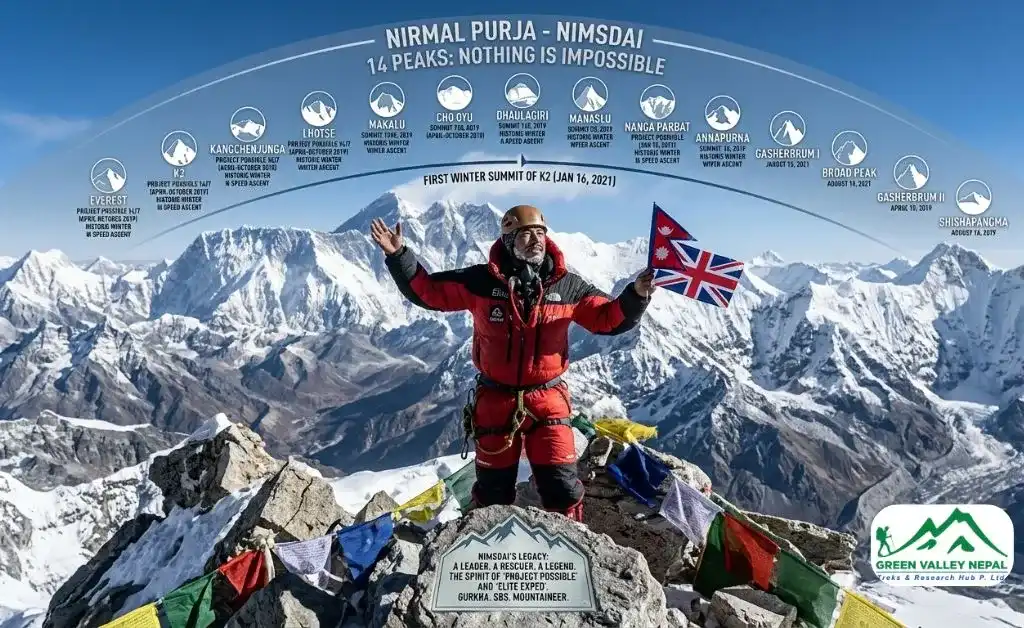
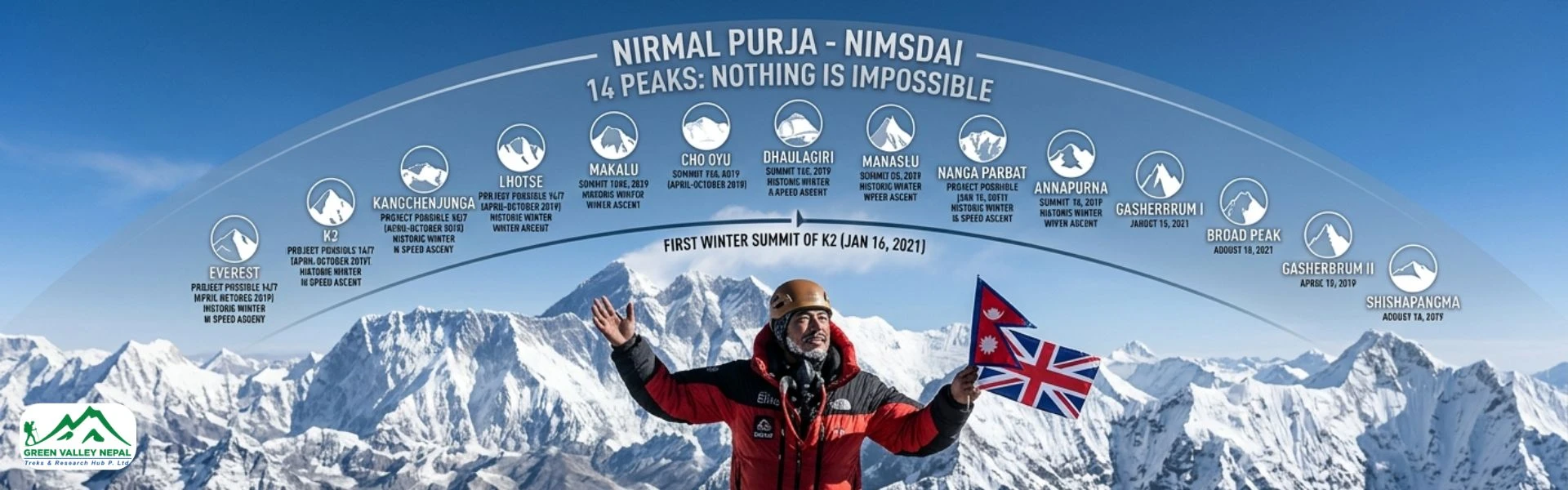
Nirmal Purja was born in Nepal's Myagdi district and grew up with modest means before enlisting first in the Brigade of Gurkhas and later serving in the UK Special Boat Service, one of Britain's most elite Special Forces units. That background, extreme endurance, discipline under pressure, and a refusal to accept conventional limits, became the foundation of everything he later did in the mountains.
In April 2019, Purja walked away from his military career to attempt something almost nobody believed was possible: summiting all fourteen of the world's 8,000-meter peaks in under seven months. The previous record for completing the "14 x 8,000ers" stood at nearly eight years. Purja called his attempt "Project Possible," and he finished it in six months and six days, redefining what elite mountaineers thought the human body and mind could sustain in the death zone.
Two years later, Netflix released 14 Peaks: Nothing Is Impossible, a documentary that introduced Purja's magnetic charisma and his signature catchphrase: "Giving up Is Not in the Blood, Sir" to a global audience. The film turned a former Special Forces soldier into one of the most recognizable adventure athletes on the planet.
Off the mountain, Purja wrote a bestselling memoir, Beyond Possible, and founded Elite Exped, one of the first international high-altitude guiding companies to be owned and operated by Nepali climbers rather than Western outfitters, a meaningful shift in an industry that had long relied on Nepali Sherpas and guides for labor while foreign companies collected the recognition and profit.
Purja wasn't finished even after Project Possible. In October 2024, he became the first person in history to climb all fourteen 8,000-meter peaks a second time, largely without supplemental oxygen. At the time of his death, Purja was 43, and after Broad Peak he had planned to attempt Cho Oyu, which would have made him the first person ever to complete the full cycle of fourteen 8,000ers twice.
Broad Peak: A Mountain with a Dangerous History
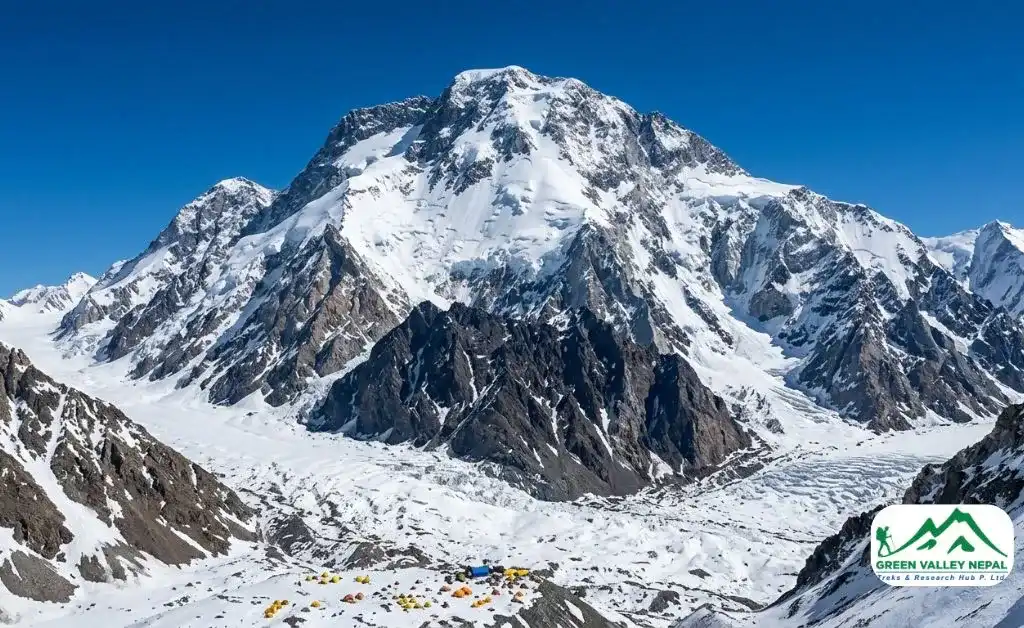
Broad Peak gets its English name from its unusually wide summit ridge, which stretches nearly 1.5 kilometers and includes multiple subsidiary summits, the true main summit at 8,051 m, the Rocky Summit at 8,028 m, and Broad Peak Central at 8,011 m. That broad, exposed ridge, combined with the Karakoram's brutal weather, frequent avalanches, and rockfall, gives the mountain a reputation among veteran climbers as more dangerous than its "easy 8,000er" label suggests.
The mountain was first climbed on June 9, 1957, by a four-man Austrian expedition: Hermann Buhl, Kurt Diemberger, Marcus Schmuck, and Fritz Wintersteller, who summited without supplemental oxygen or porter support above base camp, a remarkably bold style for that era. Tragedy was never far away even then: weeks later, on the descent from a nearby peak, Buhl fell through a cornice to his death.
Broad Peak's fatal history since then has been long and sobering. In 1975, a Polish expedition made the first ascent of Broad Peak Central, but three of the summiting climbers died in a storm during descent. In March 2013, Polish climbers Maciej Berbeka and Tomasz Kowalski completed the first winter ascent of Broad Peak, and died during the descent. Mountaineering researchers estimate Broad Peak has around eight deaths for every 100 successful summits, among the higher rates of the fourteen 8,000ers. And just across the glacier, K2 had its own defining tragedy in 2008. Pakistan's worst modern mountaineering disaster before 2026, when 11 climbers died in a single 48-hour period after a serac collapse.
Purja himself first climbed Broad Peak in July 2019, during his record-breaking "Project Possible 14/7" campaign. Returning to the same mountain seven years later, this time as the site of his death, adds a painful symmetry.
The Ten Lives Lost in Broad Peak Avalanche
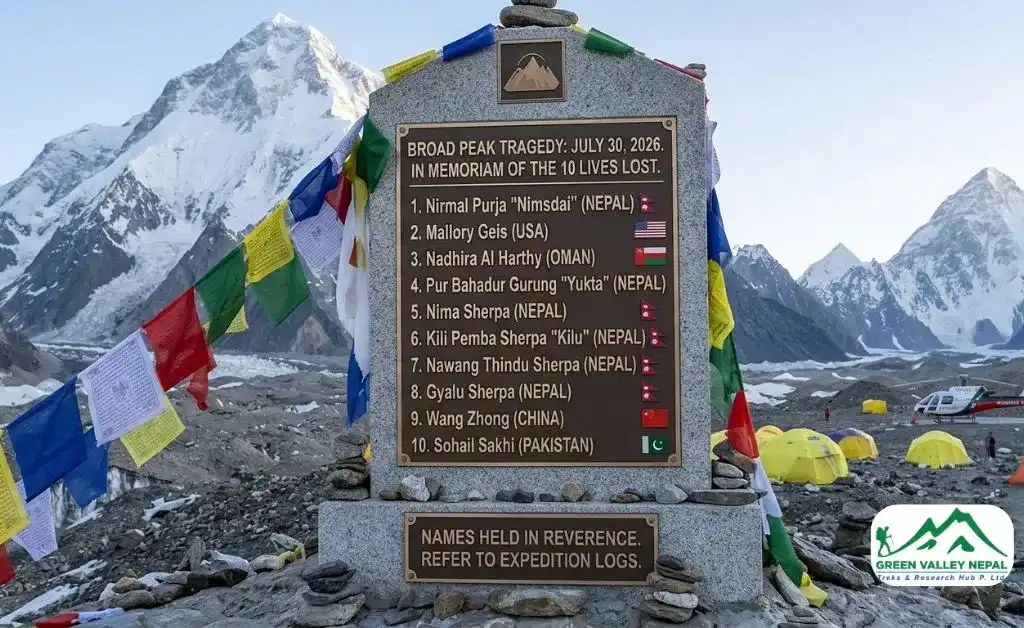
Every name on this list represents a family shattered and a community in mourning:
- Nirmal Purja "Nimsdai" (Nepal/UK), expedition leader and record-breaking mountaineer, attempting to become the first person to summit all fourteen 8,000ers twice
- Mallory Geis (USA), a 39-year-old from San Antonio on her first-ever 8,000-meter attempt, who had recently closed her Pilates studio to take "a giant leap of faith into the unknown"
- Nadhira Al Harthy (Oman), a celebrated Omani climber
- Pur Bahadur Gurung "Yukta" (Nepal)
- Nima Sherpa (Nepal)
- Kili Pemba Sherpa "Kilu" (Nepal)
- Nawang Thindu Sherpa (Nepal)
- Gyalu Sherpa (Nepal)
- Wang Zhong (China)
- Sohail Sakhi (Pakistan), a mountain guide and photographer who had told friends this was meant to be his final expedition before retiring from the profession
The climbers came from five countries: Nepal, Pakistan, Oman, the United States, and China, a reflection of how far Broad Peak's reputation as one of the fourteen "8,000ers" now reaches. Nepal's Prime Minister, Balendra Shah, called their deaths "shocking," adding that while their physical journeys had been interrupted, "the history of their courage, dedication, and contributions will always remain inspiring." UK Defence Secretary Wes Streeting, referencing Purja's years of British military service, said he was "incredibly" saddened by the loss.
Facts and Figures of Broad Peak: Putting the Tragedy in Context
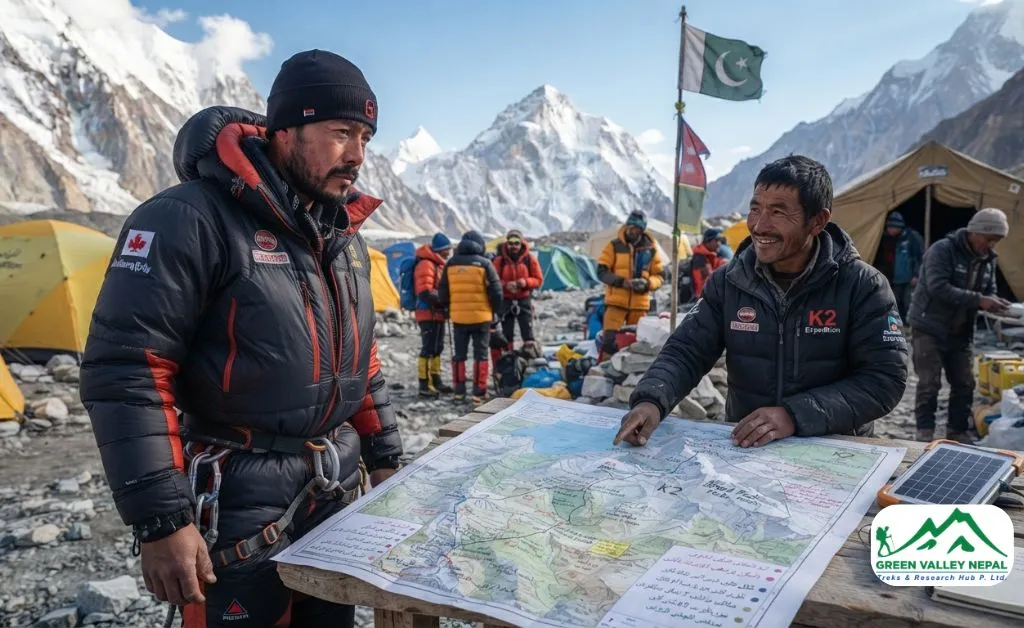
A few numbers help put the scale of the 2026 disaster in perspective:
- 8,051 m (26,414 ft): Broad Peak's summit elevation, the 12th-highest point on Earth
- ~6,600 m: The altitude where the avalanche struck, between Camp 2 and Camp 3
- 10 of 10: Every member of the expedition was killed, an almost unheard-of 100% fatality rate for a single incident
- 5 countries represented: Nepal, Pakistan, Oman, the USA, and China
- ~8 deaths per 100 successful summits: Broad Peak's long-term fatality rate
- 1957: The year of Broad Peak's first ascent
- 2008: Pakistan's previous worst modern mountaineering disaster; 11 climbers died on neighboring K2
- 14: Total 8,000-meter peaks on Earth; 8 in Nepal's Himalaya, 5 in Pakistan's Karakoram, 1 in Tibet
- 6 months, 6 days: The record time Purja summited all fourteen 8,000ers in 2019, versus the previous record of nearly eight years
The Karakoram Range is notorious among high-altitude climbers because, unlike the Nepal Himalaya, whose weather is governed largely by the predictable summer monsoon, its snowpack is almost continuously unstable and driven by more erratic mid-latitude storm systems. Snow and avalanche activity occur there nearly year-round.
What Happened on Broad Peak?
Broad Peak stands 8,051 meters (26,414 feet) tall, making it the twelfth-highest mountain on Earth. It sits in Pakistan's Karakoram Range, in the remote Gilgit-Baltistan region, directly across the Godwin-Austen Glacier from K2, the world's second-highest and arguably most dangerous mountain. Broad Peak draws only a small fraction of the crowds seen on Everest, and its remoteness is part of both its appeal and its danger.
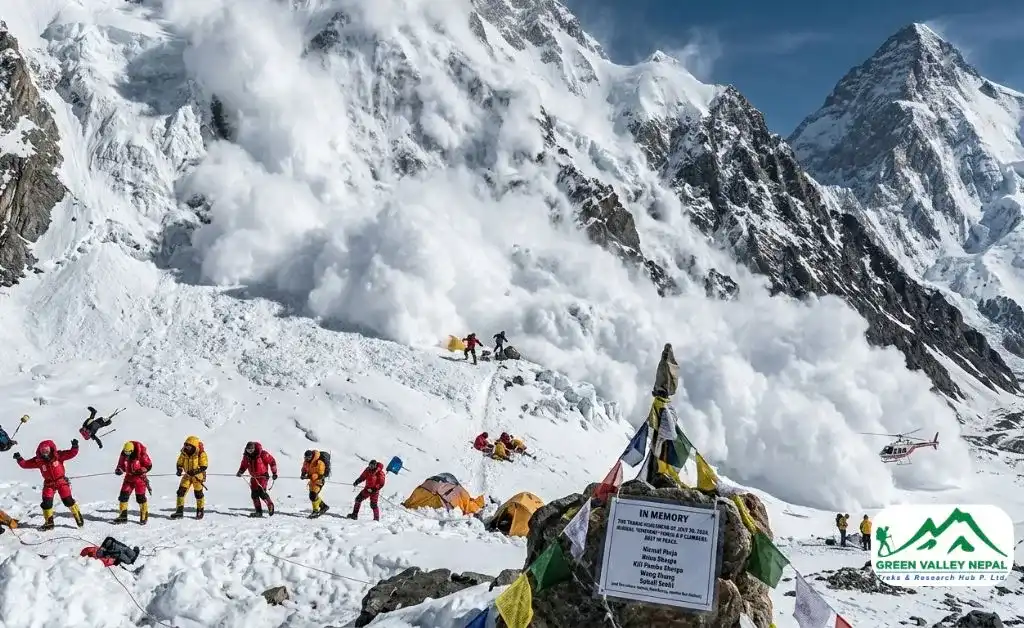
On July 30, 2026, Purja was leading an international expedition of ten climbers toward the summit. According to his own final social media posts, Broad Peak wasn't even his original target for the season; he had planned to focus on Gasherbrum II, but seized the opportunity to knock out the mountain that stood between him and his historic "twice over" goal. Around midday, at an altitude of roughly 6,600 meters, on the exposed slope between Camp 2 and Camp 3, an avalanche broke loose and swept the entire group down the mountain.
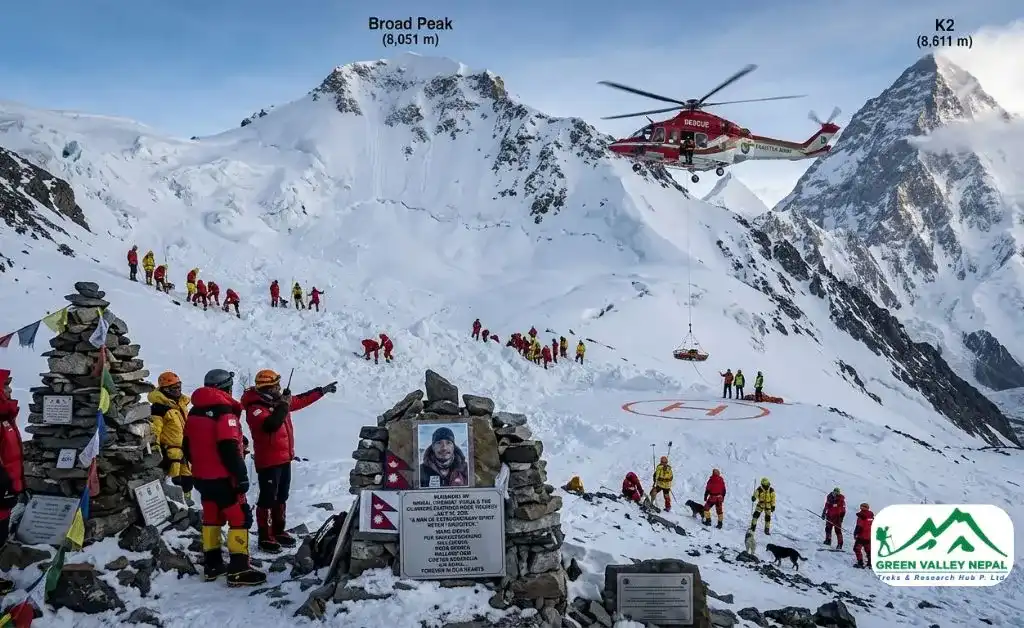
What followed was a grim, multi-day search operation. Two military helicopters began aerial searches the next morning, joined by ground teams working out of Camp 1 despite dangerous, unstable conditions. Pakistan's Alpine Club coordinated the effort, and Elite Exped flew additional Nepali climbers in to join the search.
A drone eventually spotted several bodies, but confirming identities from the air proved nearly impossible, and GPS trackers on some of the missing climbers showed their last known positions around 5,800 meters, nearly a kilometer below where the avalanche struck.
The identification process was slow and heartbreaking. On July 31, three bodies, American climber Mallory Geis, Omani climber Nadhira Al Harthy, and Nepali climber Pur Bahadur Gurung, were recovered from the debris field opposite Broad Peak Base Camp and flown by military helicopter for identification.
By August 1, Elite Exped confirmed the news the world had been dreading: none of the ten had survived, Purja among them. Ground teams later reached his body along with Chinese climber Wang Zhong and Nepali climbers Nima Sherpa and Kili Pemba Sherpa. The final body, Pakistani guide and photographer Sohail Sakhi, was recovered days later, closing a difficult and technically dangerous retrieval operation.
Could Broad Peak Tragedy Have Been Forecast?
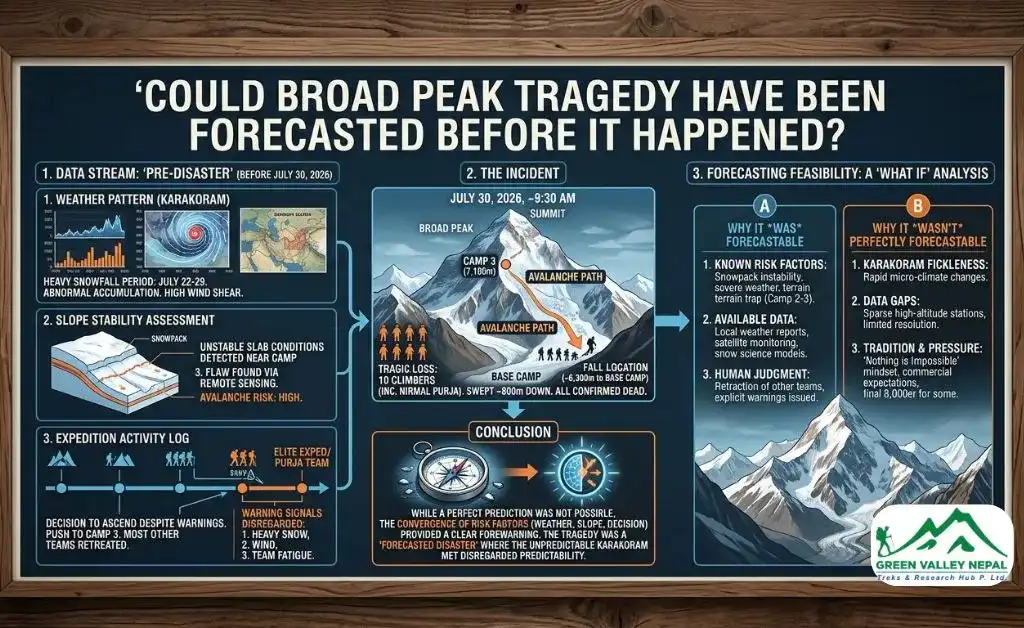
This is the question every climber, guide, and trekking operator has been asking since the news broke, and the honest answer is layered rather than simple.
The Terrain Makes Forecasting Exceptionally Hard
Research into Karakoram avalanche hazards has consistently found that the snowpack on these slopes almost always contains unstable layers, meaning some level of risk is essentially constant rather than a spike tied to one storm. Structural mitigation- the barriers, fences, and controlled blasting used at ski resorts- is largely infeasible on terrain this steep, remote, and glaciated.
The Monitoring Infrastructure Isn't There Yet
Regions like the European Alps and North America benefit from dense networks of high-altitude weather stations, decades of snowpack records, and daily operational avalanche bulletins. The Karakoram still lacks that density across most expedition routes.
A 2023 scientific assessment concluded that the relationship between regional climate patterns and specific avalanche triggers here remains insufficiently understood, largely due to limited long-term data, extreme terrain, and the cost of maintaining equipment at altitude.
Climate Change Is Complicating The Picture Further
Warmer temperatures and shifting snowfall patterns are changing how, when, and where avalanches release worldwide. Researchers caution that scientists cannot responsibly claim climate change directly triggered this specific avalanche without a formal event-attribution study.
What can be said with more confidence is that the broader climatic backdrop against which Karakoram avalanches occur is shifting faster than the region's monitoring systems are being built out to track it.
What Forecasting Tools Do Exist, And Why They Haven't Reached Broad Peak Yet.
Modern avalanche science leans on numerical weather prediction models, satellite-based snow cover monitoring, and increasingly, machine-learning models trained to flag dangerous combinations of slope angle, recent snowfall, wind loading, and temperature.
India's Snow and Avalanche Study Establishment (SASE) has deployed some of these systems in the eastern Karakoram, primarily around the Siachen Glacier for military purposes, using ground surveys, automated weather stations, and observations from villagers and border personnel.
But this kind of dense, real-time forecasting infrastructure hasn't reached commercial expedition routes like Broad Peak, where teams still rely on general satellite weather-window forecasts and visual snowpack assessment on the day, rather than a localized, data-driven avalanche bulletin.
What Could Realistically Change?
A few concrete steps could reduce, though never eliminate, this kind of risk: expanding automated weather station networks along the most heavily climbed Karakoram routes; extending satellite-based snow-load monitoring to expedition corridors, not just border regions; building shared, real-time hazard-reporting systems between operators, the way Alpine avalanche centers crowdsource observations; and more conservative route-timing decisions that avoid known avalanche-prone slopes during and immediately after heavy snowfall or rapid warming, even at real cost.
How the Climbing World Is Responding?
The scale of the loss, a ten-person, 100% fatality event involving one of the sport's most famous figures, has triggered tributes from professional athletes, expedition companies, and government leaders alike. It has also reopened a long-running industry conversation about risk disclosure on 8,000-meter expeditions and Pakistan's more limited helicopter long-line rescue capacity compared to Nepal: capability that, while it would not have prevented this avalanche, could change outcomes in future incidents where climbers survive an initial slide but are stranded.
Lessons for Future Expeditions
A few practical takeaways stand out for operators, guides, and climbers planning future Karakoram seasons: treat "usually stable" terrain as never fully stable, since Camp 2–3 style traverses carry background risk even in good weather; push for shared, real-time hazard data between operators and alpine clubs; build in more conservative decision points, delaying summit pushes after fresh snowfall or rapid warming even at real cost; and treat GPS trackers, satellite communicators, and rapid-response rescue agreements as essential minimums, not optional extras.
A Legacy That Outlives the Mountain
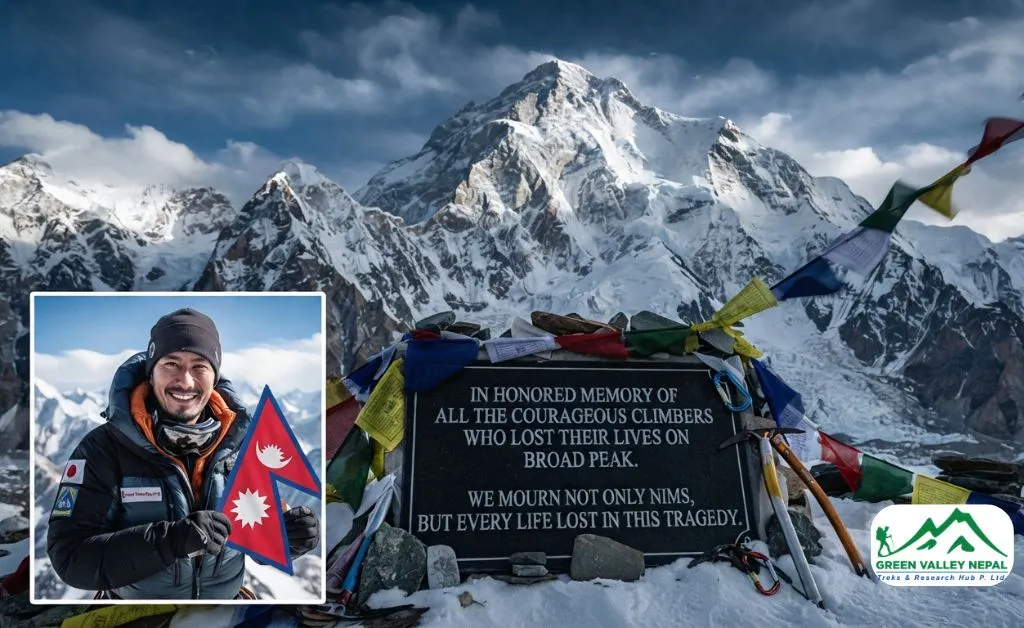
Nirmal Purja spent his career trying to prove that limits were negotiable, that six months was enough for fourteen 8,000ers, that Nepali climbers deserved the same recognition as their Western counterparts, that "giving up is not in the blood." Elite Exped's own statement after his death captured it best: "we mourn not only Nims, but every life lost in this tragedy."
The ten climbers who died on Broad Peak were guides, dreamers, a Pilates instructor chasing a new chapter, a photographer on his planned final trip, and a record-setter attempting the impossible for a second time. Their loss is a reminder of both the extraordinary pull of the world's highest mountains and the very real, still-imperfectly-understood risks of answering that call.
For those of us in the trekking and expedition industry, their story is also a call to action to keep pushing for better weather intelligence, more conservative route planning, and a culture that never treats "just this once" as an acceptable shortcut on the world's highest peaks.
Frequently Asked Questions (FAQs)
- How did Nirmal Purja die?
Nirmal Purja died in an avalanche on Broad Peak in Pakistan's Karakoram range on July 30, 2026, while leading a ten-member international expedition at an altitude of around 6,600 meters, between Camp 2 and Camp 3.
- How many climbers died in the Broad Peak avalanche?
All ten members of the expedition were killed, including climbers from Nepal, Pakistan, Oman, the United States, and China.
- What was Nirmal Purja famous for?
Climbing all fourteen of the world's 8,000-meter peaks in just over six months in 2019, a feat documented in the Netflix film 14 Peaks: Nothing Is Impossible. In October 2024, he became the first person to complete all fourteen 8,000ers a second time, largely without supplemental oxygen.
- When was Broad Peak first climbed?
June 9, 1957, by an Austrian expedition of Hermann Buhl, Kurt Diemberger, Marcus Schmuck, and Fritz Wintersteller, without supplemental oxygen or high-altitude porter support.
- Is Broad Peak dangerous compared to other 8,000ers?
Yes. Despite being called one of the "easier" 8,000ers, Broad Peak has a fatality rate of roughly eight deaths per 100 successful summits, driven by its wide, exposed summit ridge and unpredictable Karakoram weather.
- Could the Broad Peak avalanche have been predicted?
Not reliably. The Karakoram's snowpack is almost continuously unstable, and the region still lacks the dense forecasting networks used in the Alps or North America.