TripAdvisor

Mardi Himal Trek from Pokhara - 5 Days

Download PDF
  • Duration 5 Days
  • Destination Nepal
  • Trip Grade Moderate
  • Starts at Pokhara (drive to Kande trailhead)
  • Ends at Pokhara (drive from Sidhing)
  • Meals 4 Breakfasts, 5 Lunches, 4 Dinners
  • Accommodation Tea Houses (Twin-share Rooms)
  • Max. Altitude 4,500 m / 14,760 ft (Mardi Himal Base Camp)
  • Activity Tea house trekking with a licensed guide
  • Group Size 1–12 trekkers (private departures on any date)
  • Best Season Spring (March–May) and Autumn (late September–November)
Highlights
  • Stand at Mardi Himal Base Camp (4,500 m) in just five days, round trip from Pokhara.
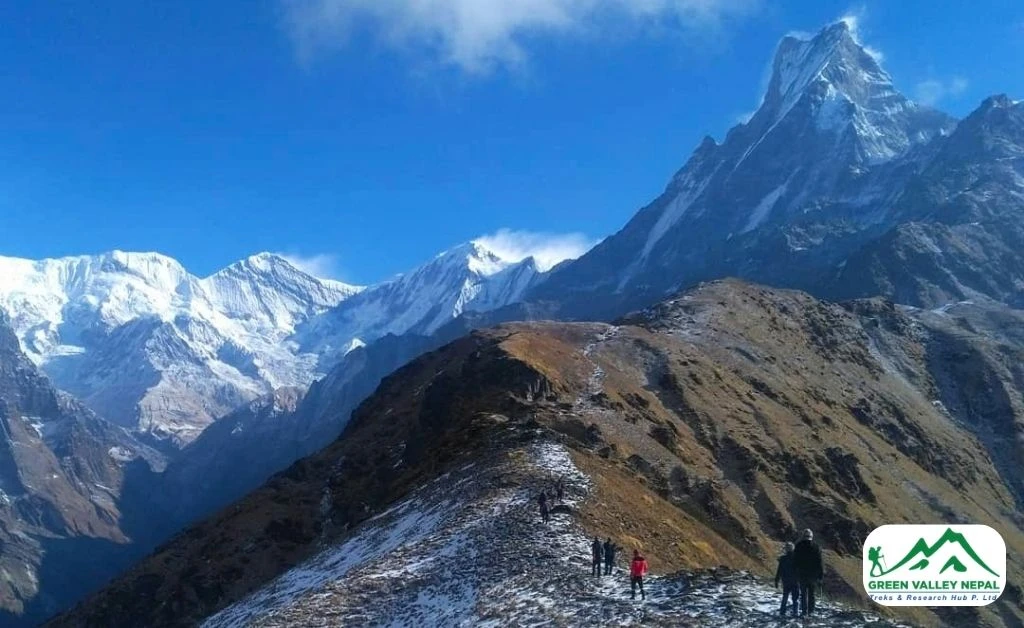
  • Walk a true high ridge trail with Machhapuchhre (Fishtail), Annapurna South, Hiunchuli, and Annapurna I in front of you for most of the climb.
  • Sleep at High Camp (3,600 m) and wake up to a Himalayan sunrise from your tea house door.
  • Hike through rhododendron, oak, and bamboo forest that bursts into color in spring.
  • Follow a quieter trail than Annapurna Base Camp or Poon Hill, with warm Gurung hospitality in tea houses and villages.
  • An acclimatization-friendly design: a short, slow Day 3 at High Camp before the big summit-day push.
  • Fully guided by licensed Nepali trekking guides, with permits, transport, and tea house meals arranged for you.

Mardi Himal Trek from Pokhara: Overview

The 5-day Mardi Himal trek from Pokhara is the fastest practical way to reach Mardi Himal Base Camp (4,500 m) without skipping the best parts of the trail. Because the trek starts and ends in Pokhara, you do not lose days on long road transfers or internal flights. You drive about one hour to Kande, then climb a forested ridge through Australian Camp, Deurali, Forest Camp, Low Camp and Badal Danda to High Camp. From there you make a pre-dawn push to the base camp, and return along the same ridge to Sidhing, where your vehicle takes you back to Pokhara.

Mardi Himal opened to tea house trekking only in 2012, and it still feels like a quiet corner of the Annapurna Conservation Area. Most Himalayan treks follow a river valley, so the big mountains stay hidden behind foothills for days. This route does the opposite. It follows a high mountain spine, so the views open up early and keep growing. The peak you walk toward, Mardi Himal (5,587 m), stands beside Machhapuchhre, also known as Fishtail (6,993 m). Annapurna South (7,219 m), Hiunchuli (6,441 m), Annapurna I and Gangapurna complete a skyline that rivals far busier routes like Annapurna Base Camp Trek and Everest Base Camp Trek.

Five days is a compressed schedule, so how the days are arranged matters more than the number. On this itinerary, you sleep no higher than High Camp (3,600 m). Day 3 is deliberately short, only 2 to 3 hours of walking, so your body has the afternoon and evening to adjust before summit morning. On Day 4 you start in the dark, reach Mardi Himal Base Camp for first light, and then drop to Low Camp (3,050 m) to sleep at a much lower altitude. Your guide checks your oxygen saturation and heart rate with a pulse oximeter twice a day and sets the pace for the group. If symptoms appear, the plan changes.

This trek suits first-time Nepal trekkers with good general fitness, travelers on a short break who want a real high-altitude finish, and returning visitors who prefer quieter trails. It is graded moderate. There are no technical sections, but the days are long, and the climb above High Camp is steep and rocky. If you have more time or prefer a gentler rhythm, we can stretch the same route into a six- or seven-day trek with extra rest at High Camp, or you can book our regular 9 Day Mardi Himal Trek.

On the trail, the days follow a simple rhythm. Tea houses are family-run, meals are hot and filling, and the dining room is the warm place to be once the sun drops. In the lower forest, you may see langur monkeys, Himalayan thar, and colorful birds, and in spring the rhododendron forests are in bloom. Higher up, the open grassy ridge gives you wide views of the Annapurna range from the moment you step outside your tea house.

If you can add time to your Himalayan journey, then you can also connect the Mardi Trek with another exciting short trek, the ABC Trek from Pokhara.

What You Can Expect from Mardi Himal Trek from Pokhara

  • Trail and Terrain: Expect stone steps and forest paths on Days 1–2, open grassy ridge above the tree line on Day 3, and steep, rocky, exposed ground above High Camp on Day 4. The ridge is narrow in places, which is why a guide matters when clouds roll in.
  • Walking Time: Roughly 4–8 hours per day. The longest days are Day 2 (6–7 hours) and Day 4 (7–8 hours, including the descent to Low Camp). Total walking distance is roughly 40–50 km, depending on the exact route and tea house stops.
  • Views: Annapurna South and Hiunchuli appear above the tree line, Machhapuchhre dominates the ridge from Badal Danda onwards, and Annapurna I, Gangapurna and Dhaulagiri join the panorama at Mardi Himal Base Camp. Pokhara Valley and Phewa Lake are visible from the lower trail on clear mornings.
  • Wildlife and Nature: Forest sections are home to Himalayan thar, barking deer, langur monkeys, and many Himalayan birds, including the Danphe (Himalayan monal) at higher elevations. Spring brings rhododendron blooms.
  • Daily Rhythm: Wake up at 6:00–6:30 am, breakfast, walk, lunch stop at a tea house, afternoon walk, and an early evening in the dining room. On summit day, we start around 3:30–4:30 am to catch sunrise and the clearest views.
  • Weather: Mornings are usually the clearest. Afternoon cloud (the "badal" in Badal Danda means cloud) is common, so we move early.

Is the Mardi Himal Trek from Pokhara Suitable for You?

This trek is a good fit if you:

  • Walk or hike regularly and can manage 5–7 hours of steady uphill walking.
  • Want a short Himalayan trek with a genuine high-altitude finish.
  • Prefer tea houses to camping, and a licensed guide to doing everything on your own.
  • Are a first-time Nepal trekker with reasonable fitness and a positive attitude.

Think twice, or ask us for a longer, slower version, if you:

  • Have no hiking experience and have never done multi-hour uphill days.
  • Have heart, lung, or blood-pressure conditions (speak to your doctor first).
  • Are travelling with children under 10 or older adults who prefer a gentler pace.
  • Want to spend a night at the base camp or have more time for views. A 6- or 7-day Mardi Himal schedule is easier on the body.

The truth: five days is a compressed schedule. The distance is moderate, but the elevation gain between High Camp (3,600 m) and Base Camp (4,500 m) is steep and happens in one morning. That is why we build in a short acclimatization day, keep the sleeping altitude at or below 3,600 m, and check oxygen saturation with a pulse oximeter every day.

You can go through our blog, How to Train for Trekking in Nepal, to get prepared before participating in this amazing trek.

Preparation for the 5 Day Mardi Himal Trek from Pokhara

Fitness (4–6 weeks before):

  • Hike hills or stairs 3 times a week with a loaded daypack (5–7 kg).
  • Add cardio: running, cycling or swimming, 30–45 minutes, 2–3 times a week.
  • Strengthen quads, glutes and calves with squats, lunges and step-ups. Downhill knees take the biggest beating on Day 4–5.
  • Do at least one 5–6 hour hike back-to-back with a second day of walking.

Gear: Break in your boots before you arrive. Test every layer. See our packing list below.

Altitude awareness: Learn the early signs of AMS: headache, nausea, dizziness, unusual fatigue, and poor sleep. Tell your guide immediately. Never ignore symptoms to "push through".

Documents and Money: Valid passport, Nepal visa, travel insurance covering trekking up to 4,500 m, and enough Nepali rupees in cash for personal expenses. ATMs and card payments are not available on the trail.

Arrive Early in Pokhara: Give yourself at least one night in Pokhara before the trek begins. Our team will brief you, check your gear, and arrange rentals the evening before departure.

Mardi Himal Trek from Pokhara Cost 2027 and 2028

Price per person in US dollars. Final price depends on group size and season.

Group sizePrice per person
1 PaxUS$ 520
2 – 4 PaxUS$ 385
5 – 8 PaxUS$ 375
9 – 12 PaxUS$ 350

What Affects the Price

  • Group size: larger groups share vehicle and guide costs.
  • Season: March–May and October–November are the busiest months.
  • Porter: adding a porter makes the trek more comfortable for 2 trekkers.
  • Private vs. joining a group: every departure can be fully private.

Typical Extra Costs on the Trail

Budget around US$ 10–20 per day for snacks, hot showers, charging, bottled water, and tips on top of your trek price. Carry cash in small Nepali rupee notes.

Day to Day Itinerary
Expand allCollapse all

After an early breakfast, your guide meets you at your hotel and drives you about an hour to Kande, the trailhead. After registering at the check post, you start walking uphill through farmland and forest. A steady climb leads to Australian Camp (2,060 m), a grassy viewpoint with a first look at Pokhara Valley, Machhapuchhre and the Annapurna range. After a tea stop, continue through rhododendron and oak forest to Pitam Deurali and on to Samjay Deurali, where you spend the night.

The Day 1 walk is mostly forest, so you stay cool and shaded. The trail is uphill but not steep. After dinner, your guide checks your oxygen saturation and goes over the plan for tomorrow.

  • Tea House
  • Lunch, and Dinner
  • 4 to 5 Hours
  • 5 to 6 Kilometers

This is the longest day for the forest section of the trek. Leave early and follow the ridge through mossy rhododendron forest, passing Forest Camp (2,520 m), where the main Annapurna Sanctuary crowds are behind you, and then Low Camp (3,050 m). Trees thin out as you climb. Himalayan thar, langur, and, with luck, pheasants appear in the quiet forest.

A final climb brings you to Badal Danda ("cloud hill"). If the weather is clear, the view of Machhapuchhre, Annapurna South, and Hiunchuli will stop you in your tracks. Spend the evening in the dining room, drink plenty of tea, and rest early.

  • Tea House
  • Breakfast, Lunch, and Dinner
  • 6 to 7 Hours
  • 13 to 14 Kilometers

A short morning walk takes you above the tree line, through open grassy ridge with some of the best views of the trek. You pass Middle Camp and keep climbing steadily to High Camp (3,600 m).

You arrive before lunch, and the rest of the day is yours to settle in, acclimatize, and enjoy the surroundings. Your guide may take you on a short, slow walk higher up the ridge for views and altitude adaptation, then back down to sleep. This relaxed afternoon is the key to your success tomorrow. Eat well, drink water, and go to bed early.

  • Tea House
  • Breakfast, Lunch, and Dinner
  • 2 to 3 Hours
  • 2 to 3 Kilometers

Wake very early (around 3:30–4:30 am) with your headlamp and warm layers. Climb the steep ridge above High Camp toward the Upper Viewpoint (~4,200 m), where the first light touches Machhapuchhre. Continue along the rocky ridge to Mardi Himal Base Camp (4,500 m), with Mardi Himal, Hiunchuli, Annapurna South, Annapurna I, Gangapurna and Machhapuchhre all around you.

Take your photos, have a warm drink, and enjoy the moment, but don't stay too long in the cold and thin air. Return to High Camp for breakfast, then continue down the ridge past Badal Danda to Low Camp (3,050 m) for the night. It's a long day, but the downhill walking is steady, and you will sleep better at a lower altitude.

  • Tea House
  • Breakfast, Lunch, and Dinner
  • 7 to 8 Hours
  • 17 to 18 Kilometers

After breakfast, walk down through the bamboo and rhododendron forest to the village of Sidhing, passing terraced fields and traditional Gurung houses. Your vehicle will be waiting to take you back to Pokhara, where the trip ends at your hotel. If you want, we can arrange a celebratory lakeside dinner or a Pokhara sightseeing day.

  • Breakfast, and Lunch
  • 3 to 4 Hours
  • 4 to 6 Kilometers

Our team guides, porters and accompanying staff are locals with a broad knowledge about each and every location that we travel through.

Cost Includes
  • Private Transportation: Private vehicle from Pokhara to Kande and from Sidhing to Pokhara.
  • Trekking Permits: Annapurna Conservation Area Permit (ACAP) and any other trekking permits or registration required for the route.
  • Professional Trekking Guide: Licensed, experienced English-speaking trekking guide with salary, meals, accommodation, insurance, and equipment.
  • Assistant Guide: Assistant guide for groups of 6 or more.
  • Meals During Trek: Breakfast, lunch, and dinner during the trek, plus tea or coffee with meals.
  • Tea House Accommodation: Four nights of tea house accommodation on a twin-share basis.
  • Daily Health Monitoring: Pulse oximeter checks twice a day to monitor oxygen saturation and heart rate.
  • First Aid Support: First-aid kit carried by your guide.
  • Emergency Evacuation Assistance: Emergency evacuation coordination (cost covered by your travel insurance).
  • Government Taxes: Government taxes and service charges.
  • Luggage Storage: Storage of extra luggage at our Pokhara office or your hotel.
Cost Excludes
  • International Flights & Visa: International flights and Nepal entry visa fee.
  • Accommodation & Meals in Cities: Hotel and meals in Pokhara and Kathmandu.
  • Travel Insurance: Mandatory travel insurance covering trekking up to 4,500 m and helicopter evacuation.
  • Personal Trekking Gear: Personal gear, sleeping bag, down jacket, and poles (rental available).
  • Porter Service: Optional porter service (1 porter per 2 trekkers).
  • Additional Tea House Facilities: Hot showers, battery charging, Wi-Fi, and bottled drinks on the trail.
  • Alcoholic & Soft Drinks: Alcoholic and soft drinks.
  • Tips & Gratuities: Tips for the guide, porter, and driver.
  • Extra Accommodation Costs: Extra nights due to weather, trail closure, or personal choice.
Add-ons & Options

At Green Valley Nepal Treks, our decades of experience have positioned us as leaders in Himalayan adventures. As we continue to push the boundaries of excellence, we are excited to present a selection of exclusive add-ons designed to elevate your Mardi Himal Trek from Pokhara!

  • Porter Service – USD 125: A dedicated porter to carry your trekking luggage throughout the trek.
  • Kathmandu to Pokhara Flight – USD 120: One-way flight ticket from Kathmandu to Pokhara, including airport transfers at both ends.
  • Pokhara to Kathmandu Flight – USD 120: One-way flight ticket from Pokhara to Kathmandu, including airport transfers at both ends.
  • Kathmandu Hotel – USD 40 per Room per Night: Accommodation at Hotel Surya Heritage or a similar hotel, including breakfast. Maximum two persons per room.
  • Pokhara Hotel – USD 35 per Room per Night: Accommodation at Hotel Crystal Palace or a similar hotel, including breakfast. Maximum two persons per room.

How to Add Options to Your Mardi Himal Trek from Pokhara?

Step 1: Choose your preferred departure date

Step 2: Indicate the number of travelers

Step 3: Click the 'Book Now' or 'Add to Cart' button

Step 4: Select your desired add-ons from the available options

Step 5: Complete your payment process

Departure Dates
Start:TuesdayOct 13, 2026
End:SaturdayOct 17, 2026
PriceUS$520
StatusGuaranteed
Start:ThursdayOct 15, 2026
End:MondayOct 19, 2026
PriceUS$520
StatusGuaranteed
Start:SaturdayOct 17, 2026
End:WednesdayOct 21, 2026
PriceUS$520
StatusGuaranteed
Start:SundayOct 18, 2026
End:ThursdayOct 22, 2026
PriceUS$520
StatusGuaranteed
Start:TuesdayOct 20, 2026
End:SaturdayOct 24, 2026
PriceUS$520
StatusGuaranteed
Start:ThursdayOct 22, 2026
End:MondayOct 26, 2026
PriceUS$520
StatusGuaranteed
Start:SaturdayOct 24, 2026
End:WednesdayOct 28, 2026
PriceUS$520
StatusGuaranteed
Start:SundayOct 25, 2026
End:ThursdayOct 29, 2026
PriceUS$520
StatusGuaranteed
Start:TuesdayOct 27, 2026
End:SaturdayOct 31, 2026
PriceUS$520
StatusGuaranteed
Start:ThursdayOct 29, 2026
End:MondayNov 02, 2026
PriceUS$520
StatusGuaranteed
Start:SaturdayOct 31, 2026
End:WednesdayNov 04, 2026
PriceUS$520
StatusGuaranteed
Useful Info

Mardi Himal Trek from Pokhara: Best Time

  • Autumn (late September to November): Our favorite window. Stable weather, clear mornings, and the best mountain views. October and early November are the busiest weeks, but the Mardi trail never feels as crowded as the main Annapurna routes.
  • Spring (March to May): Warm lower trail, rhododendron forests in bloom (March–April), and generally good visibility early in the day. Afternoon haze and clouds become more common in May.
  • Winter (December to February): Cold, crisp, and quiet. Nights at High Camp can fall well below freezing, and the upper trail may hold snow. The trek is possible with the right gear and a flexible schedule, but not recommended for first-time trekkers.
  • Monsoon (June to August): Wet, leech-prone lower trails and cloudy views. Only for experienced trekkers who accept the conditions.

Read our blog: Best trekking season in Nepal to know the weather conditions and season before booking trekking in Nepal.

Food Options on Mardi Himal Trek from Pokhara

Tea houses serve fresh, hot, simple meals made with local ingredients. Expect:

  • Breakfast: porridge, eggs, Tibetan bread, pancakes, muesli, toast, tea or coffee.
  • Lunch and dinner: dal bhat (rice, lentils, vegetables and pickle, with free refills), noodles, fried rice, momos, pasta, soup, potatoes and vegetable curries.
  • Drinks: hot lemon, ginger tea, masala tea, black tea, coffee and hot chocolate.

Vegetarian meals are widely available. Tell us in advance about vegan, gluten-free, or other dietary needs. Bring your own energy bars, nuts and chocolate for summit day. We recommend avoiding meat above Badal Danda because supplies are carried up on foot and storage is limited. Drink 3–4 litres of water or hot drinks a day.

Accommodation on Mardi Himal Trek from Pokhara

You sleep in family-run tea houses along the ridge. Rooms are simple twin-share rooms with a mattress, pillow, and blanket. Bathrooms are shared and basic, and rooms are not heated. The dining room is the warm spot in the evening. At High Camp, facilities are more basic and the nights are cold.

Bring a sleeping bag liner or a warm sleeping bag (rental available through us). Hot showers, charging, and Wi-Fi may be available for a small fee in lower villages but rarely at High Camp.

Nights:

  1. Samjay Deurali
  2. Badal Danda
  3. High Camp (3,600 m)
  4. Low Camp (3,050 m)

Mardi Himal Trek from Pokhara: Difficulty

Grade: Moderate. You do not need technical skills, but you do need stamina.

  • Days 1–2: Steady uphill on stone steps and forest trails, long but not high.
  • Day 3: Short and gentle, but you are now above 3,000 m, so you will feel the thin air.
  • Day 4: The hardest day. About 900 m of climbing in the dark and cold on a steep, rocky ridge to Mardi Himal Base Camp, followed by a long, knee-testing descent to Low Camp.
  • Day 5: Downhill on stone steps. Good boots and poles help your knees.

Altitude. Mardi Himal Base Camp is at 4,500 m. Altitude sickness can affect fit people too, especially on a short schedule. Our guides monitor your oxygen saturation, stay with your pace, and will turn the group back if symptoms appear.

What makes it easier: poles, an early start, slow steady pacing, a layering system, and enough water.

Travel Insurance for the Mardi Himal Trek from Pokhara

Travel insurance is mandatory for all Green Valley Nepal Treks clients. Your policy must cover:

  • Trekking up to at least 4,500 m without a technical ascent exclusion.
  • Emergency helicopter evacuation and medical repatriation.
  • Medical treatment and hospitalization.
  • Trip cancellation, delay, and baggage loss (recommended).

Carry a printed copy of your policy and the 24-hour emergency number. Send us your policy details before departure so we can coordinate quickly if help is needed. Many standard travel policies exclude trekking at altitude, so read the small print.

Mardi Himal Trek from Pokhara Packing List

Clothing

  • Moisture-wicking base layers (2 tops, 1 bottom)
  • Trekking shirts (2) and trekking pants (2)
  • Mid-layer fleece or light insulated jacket
  • Warm down jacket (essential for High Camp and summit morning)
  • Waterproof and windproof shell jacket and pants
  • Warm hat, sun hat, and neck gaiter
  • Lightweight gloves and warm insulated gloves
  • Trekking socks (3–4 pairs) and 1 warm pair for sleeping
  • Comfortable underwear and a sports bra

Footwear

  • Broken-in waterproof trekking boots with ankle support
  • Camp shoes or sandals
  • Gaiters (spring and winter)

Equipment

  • Backpack, 30–40 L, with rain cover (porter duffel provided if you hire one)
  • Sleeping bag rated to −10 °C (rent from us) and liner
  • Trekking poles
  • Headlamp with spare batteries (needed for the pre-dawn start)
  • Water bottles (1–2 L) and purification tablets or filter
  • Sunglasses (UV 3–4) and sunscreen SPF 50+
  • Lip balm with SPF

Personal and health

  • Passport copy and insurance papers
  • Cash in Nepali rupees
  • Personal first-aid items: blister plasters, pain relief, rehydration salts, any prescription medication
  • Toilet paper, hand sanitizer, wet wipes, toiletries
  • Power bank and charging cables
  • Snacks, energy bars and electrolyte tablets

Leave at the hotel in Pokhara: anything not needed for 5 days. We store it for free.

What our travelers saysClient Reviews
FAQs
  • Yes. With a Pokhara start and finish, and a drive to Kande and from Sidhing, five days is realistic for a fit, well-prepared trekker. Many people prefer six or seven days to rest more.

  • Moderate. You walk 4–8 hours a day on steep trails, and the push to Base Camp on Day 4 is demanding. No technical skills are needed.

  • Yes, it can affect anyone above 3,000 m. Our itinerary keeps the sleeping altitude at a maximum of 3,600 m, includes a short Day 3, and our guides check oxygen saturation daily. Descend if symptoms worsen.

  • The Annapurna Conservation Area Permit (ACAP) is required. We arrange and include all permits and registrations required for the route.

  • We strongly recommend a licensed guide, and all our departures include one. The ridge is narrow, clouds can reduce visibility, and a guide helps with altitude, safety, and communication.

  • Not required, but recommended if you want to carry less than a daypack. One porter can carry the bags of two trekkers.

  • March to May and late September to November.

  • Mobile signal is patchy; some tea houses offer Wi-Fi for a fee, but High Camp has limited connectivity.

  • Yes, in most tea houses, for a small fee. Carry a power bank.

  • Nights can be near or below freezing, especially in winter and early spring. Bring a warm down jacket and sleeping bag.Nights can be near or below freezing, especially in winter and early spring. Bring a warm down jacket and sleeping bag.

  • Yes. The trail is well used, and tea houses are welcoming. A guide is included on every departure.

  • Your guide will help you descend, arrange transport, or coordinate helicopter evacuation through your insurance company.

  • Yes. We can add extra days for a relaxed 6- or 7-day Mardi Himal trek, or combine it with Poon Hill, Pokhara sightseeing, or a wildlife tour.

  • Yes. We can arrange the Kathmandu–Pokhara flight or a tourist bus and hotel before and after the trek.

  • Contact Green Valley Nepal Treks by email, phone, or WhatsApp. We confirm your date, send a booking form, and secure your spot with a deposit.

You May Also LikeSimilar Itineraries
Still looking for your next holiday?

Get Ready for the Adventure of a Lifetime? This is not just another vacation, it's your chance to stand on the roof of the world, to push your limits, to come back again. Tell us your vision, destination, timeline, budget then watch how we transform it into an unforgettable Himalayan odyssey. From sunrise over Everest to nights under star-scattered skies.Our team lives and breathes these mountains. We know the secret trails that most tourists never see. The villages where time stands still. The viewpoints that will make your heart stop. And we are ready to build your ultimate Himalayan adventure from scratch.

Call us: +977 9841 392186 (Arjun Pandey), +977 98510 31090 (Rajendra Lamichhane)