Why Travel Insurance Is Essential for the Everest Base Camp Trek?
Trekking to Everest Base Camp is one of the most famous high-altitude and remote expeditionary climbs in the domain of the world’s highest mountain, Everest. Running for 14 days on steep and twisted trails, the journey is demanding and fraught with natural risks, but in reality, it is never a death spot. Although death is rare, the ultimate point, Kala Patthar (5,555 m), poses unexpected accidents and injuries, more commonly, ankle strains and altitude sickness. Likewise, speedy and medical assistance is impractical here; the only approach is helicopter rescue, but it comes at a standard price, making comprehensive travel insurance necessary.
Literally, General travel insurance does not provide the required coverage for trekking at the high altitude of the Everest Base Camp. Instead, you need to purchase the best one, which offers high-altitude coverage up to 6,000 m, gear loss, medical, and evacuation benefits. Travellers headed to EBC can secure robust trip insurance, such as SafetyWing, Global Rescue, World Nomads, and True Traveller, which covers a wider range of eventualities than ordinary travel insurance.
With no technicalities and no passes, the journey is quite straightforward compared to the rigorous Everest Three Passes Trek, making it suitable for anyone with good physical and mental fitness. No matter whether you are a solo traveller, a guided trekker, or a first-timer. But some preparation, packing lists, and documents, including travel insurance, are equivalent. Trekkers who do not have insurance covering such accidents may suffer more than those travelling with insurance. Without insurance, the risk of severe financial loss and personal hardship is considered high.
Everest Base Camp Trek: Risks You Must Insure Against
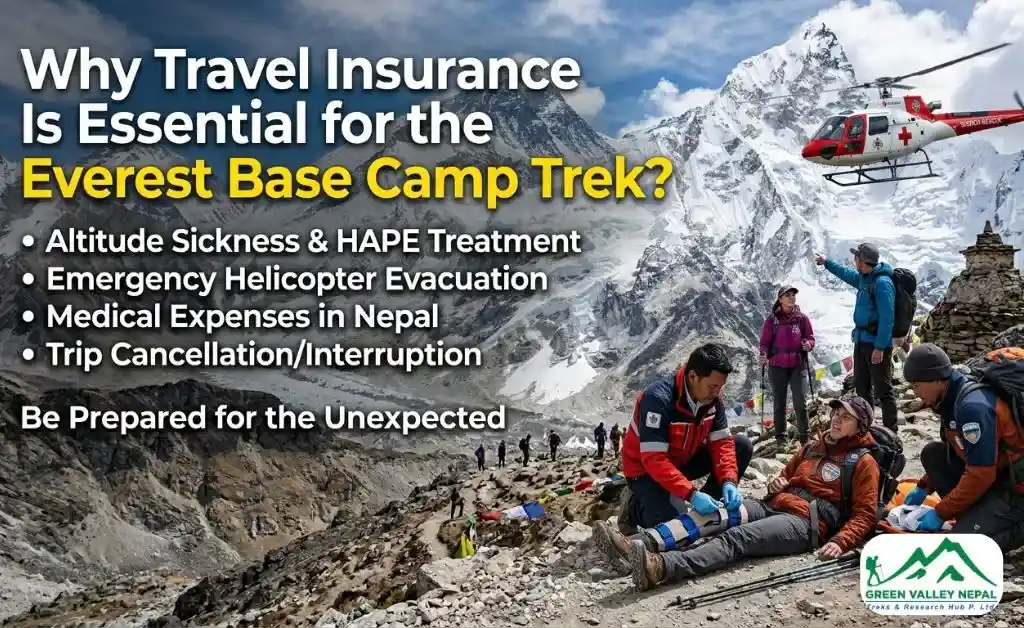
The maximum and the final point in the Everest Base Camp Trek is the 5,555 m (Kala Patthar), where the altitude sickness will be at its peak and can easily get out of control and lead to High-Altitude Pulmonary Edema (HAPE) and High-Altitude Cerebral Edema (HACE) unless health assistance is secured at the earliest. Likewise, two or three hospitals or health posts are available beyond the lower village, and the weather is intermittent, which can burden the operation of the incoming and outgoing transit service in the district.
Acute illness, slips, sprained ankle, food poisoning, cold, and extreme fatigue are also endemic, which might lead to hospitalization. When it comes to emergencies, the helicopter medical evacuation is the only approach; however, it is costly. Ensure you are covered by an insurance policy that offers altitude-related medical evacuation and helicopter evacuation.
Mandatory and Recommended Insurance Coverage for Everest Base Camp Trek
Minimum Insurance Requirements for Trekking in Everest
The minimum insurance requirements for trekking in the Everest region specify that trekkers must have insurance policies with coverage of USD 100,000+, including medical and mandatory air rescue. Moreover, policy verification by the trekking company is suitable before embarking; if any part of the policy is insufficient, the insurance company may refuse to pay any costs incurred as a result of a claim.
Emergency Evacuation and Helicopter Rescue Coverage
Emergency evacuations and helicopter rescues at high altitudes above 5,000 meters cost USD 5,000 for a rescue. As we previously mentioned, the valley is remote and offers a high risk of altitude sickness, accidental injuries from rockfall, and physical deterioration with scarce medical support. Therefore, the only approach to provide immediate support is by helicopter. Regular travel insurance may be insufficient for Everest and require you to have high-altitude coverage for repatriation.
Coverage for Trip Cancellation, Delay, and Interruption
Your policy must be worthwhile to cover the advance cost of accommodation, food, guide, porter, and permit expenses incurred as a direct consequence of trip delay or interruption. Several circumstances occur before the journey, such as sickness, a family crisis, or a flight delay, due to changing weather, that require you to forgo your travel. Confirm your policy covers cancellations/interruption reasons, including illness or weather.
What to Look for in Travel Insurance for Everest Base Camp Trek?
High-Altitude Trekking Coverage (Non-Negotiable)
For the Everest Base Camp Trek, the minimum altitude required is 6,000 m. As the walk exceeds the altitude of 5,000 m, purchasing a standard policy up to 4,000 m is inappropriate for this hike and may result in a claim denial. If you are undertaking a mountain expedition above 6,000 m, you will need to purchase more high-altitude coverage up to 8,000 m.
Medical and Hospitalization Coverage in Nepal
As Kathmandu offers high-quality medical services to its patients, it is best to have medical coverage up to 100,000. It may charge you a cost between USD 200 and USD 2000 for minor injuries and even more for severe damage. Typically, the emergency medical transport will cost you USD 5,000.
Insurance Exclusions You Must Check Carefully
The insurance coverage and premiums differ from insurer to insurer, but simply signing with a quality provider does not mean that it covers all inclusions. There are some exclusions; you must pay a genuine consideration on pre-medical conditions, alcohol-related incidents, unguided expeditions, and the main altitude, as many insurers support medical and helicopter emergencies only for treks up to 4,000 m.
Best Travel Insurance Providers for Everest Base Camp Trek
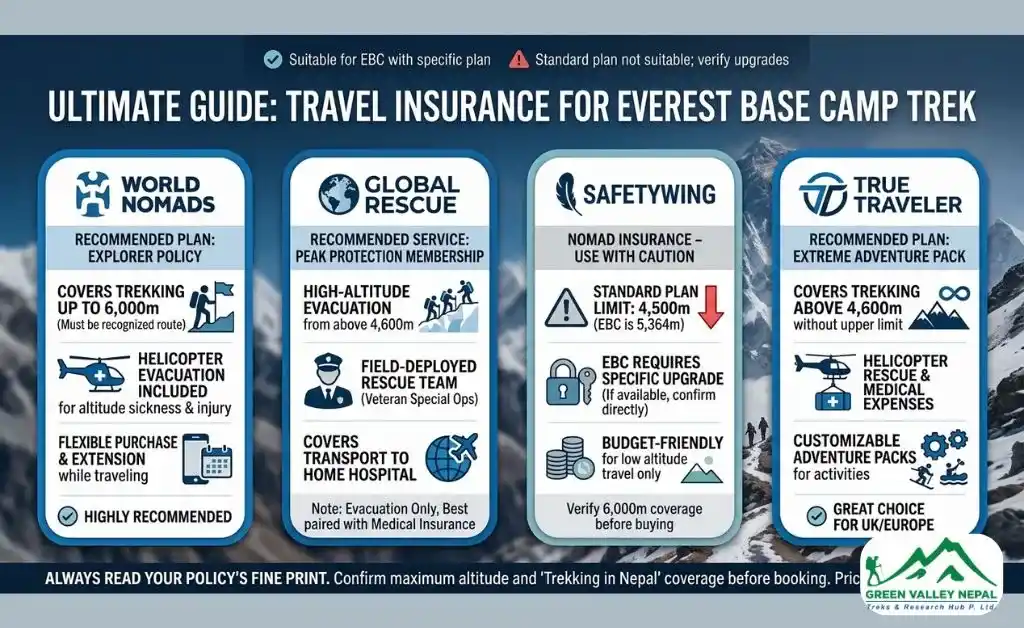
Some of the best travel insurance providers you can trust for the Everest Base Camp Trek are listed here:
Things to Confirm Before Buying Any Insurance
- Written confirmation of altitude coverage: Confirm your policy has high-altitude coverage up to 6,000 m in writing to ensure an appropriate level of protection is assessed, as various surprises occur during the claim due to the lack of fair documents.
- Helicopter evacuation inclusion: In addition to aviation and baggage coverage, you must confirm that the costs of medical and helicopter evacuations are sufficiently covered.
- 24/7 emergency assistance number: Ensure your purchase from a reliable insurer with full 24/7 support worldwide, with representatives available at major destinations ready to authenticate and attend to claims.
- Claim process while trekking in Nepal: Read the fine print carefully and ensure the claiming process. Equally reviews the reputation of the company.
Travel Insurance Requirements
Travel insurance with minimum altitude coverage of up to 6,000 meters and medical coverage up to USD 100,000+ must be in place for all trekkers undertaking the Everest Base Camp Trek or climbing peaks above 5,000 meters. However, adventurers must make some document submissions before the journey, such as
- Trekkers' identification card or passport with full name
- Travel date
- A copy of travel insurance for the EBC trek
- 24/7 contact number of the insurers
We insist on a proper insurance policy to ensure clients' safety. The Everest valley scarcely offers medical services, with no means of transport, and to ease the conditions quickly, chopper rescue is the only approach. However, it is costly without a proper insurance policy.
Using an insurance policy, we can maintain a close partnership with a rescue team to respond to your situation immediately via helicopter.
How Much Does Travel Insurance Cost for Everest Base Camp Trek?
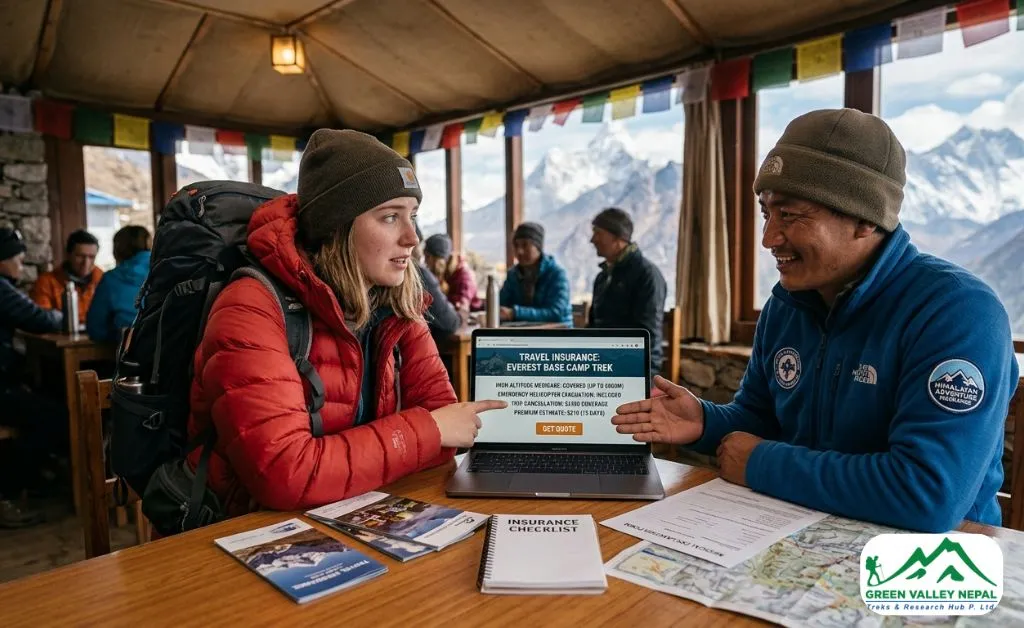
Travel insurance premiums relevant for a trek to EBC cost between USD 100 and USD 300 and provide full coverage up to 6,000 m, with medical and helicopter evacuation. It is surprisingly reasonable compared to the Everest Base Camp Trek. However, the premiums are primarily influenced by duration, coverage, traveler age, and, not least, insurer. The estimated premium range for the Everest Base Camp Trek is listed here as:
Age | Duration and Cost | Estimate Cost |
14 Days | 21 Days | 25 Days | 30 Days | Medical | Helicopter Evacuation |
2-39 | USD 150 | USD 225 | USD 260 | USD 300 | USD 100,000 | USD 100,000 |
40-49 | USD 200 | USD 275 | USD 320 | USD 350 | USD 100,000 | USD 150,000 |
50-59 | USD 250 | USD 350 | USD 400 | USD 450 | USD 150,000 | USD 150,000 |
60-69 | USD 300 | USD 425 | USD 500 | USD 600 | USD 150,000 | USD 200,000 |
How to Save Money without Compromising Safety?
If you think it is practically impossible to save money during a trek to Everest Base Camp without compromising safety, then you are far from reality. Actually, high-altitude-specific Everest Base Camp Trek travel insurance is itself a strategy to reduce unnecessary financial expenses, covering medical bills, gear losses, trip cancellation/interruption, and high-altitude evacuation in a single purchase. Likewise, there are several strategies you can consider to pay less without losing safety, which are listed here
- Annual vs. single-trip insurance: It makes more sense to purchase insurance that covers multiple trips rather than an individual policy. Cost-wise, a yearly policy often comes out lower than a single-trip option.
- Avoid cheap policies: It is precise that less expensive policies provide less coverage and can be risky as well, while higher-cost options compensate for greater risks.
- Forbid underinsurance: Underinsurance policies often do not cover high-altitude and medical emergency claims, requiring a significant budget for rescue.
You can compare policy inclusions and exclusions, evaluate higher deductibles and coverage limits, and choose regional partners that authorize or endorse friendly providers, all of which are ways to save money.
Common Mistakes Trekkers Make When Buying Insurance
- Assuming regular travel insurance is enough: Exceeding the threshold of 5,500 m, the Everest Base Camp Trek is excluded by a standard policy and requires you to purchase the best Everest Base Camp travel insurance policy with altitude coverage up to 6,000 m, along with medical and helicopter evacuation.
- Buying insurance after leaving home country: We observe that most visitors purchase travel insurance after leaving their home country, but the purchase is significant at least several weeks before departure.
- Ignoring altitude limits: Many trekkers fail to consider altitude limits adequate for the base camp of Mount Everest (above 6,000 m), and this ignorance can be hazardous and result in higher prices.
- Not informing insurers about trekking plans: Some trekkers make the biggest mistake by not updating their trekking plan to the insurer regarding trekking weather and trekking location, and this mistake leads to claim denial.
Conclusion: Choose the Right Insurance for a Safe Everest Base Camp Trek
Everything goes excellently when you have an adequate insurance policy. Generally, travel insurance is considered best for the Everest Base Camp when it covers a high altitude of 6,000 m and provides medical and emergency helicopter evacuations in addition to trip cancellation/interruptions. You can purchase from the best and most reliable insurers, such as World Nomads, True Traveler, Safety Wing, and Global Rescue, as they are the best players for arranging travel insurance in high-altitude areas like Everest. As many insurers offer different policies, coverage, and premiums, it is necessary to check the claim history, attitude limits, and costs. If you have further issues in selecting the best insurance for the Everest trek, you can take the help of our professionals at any time.
Frequently Asked Questions (FAQs)
- What is the minimum altitude coverage required for Everest Base Camp Trek?
We recommend that the altitude coverage must be no less than 6,000 m when going up to Everest Base Camp, as it is above a 5,000 m trek, which ultimately reaches the highest altitude of 5,555 m at Kala Patthar and requires special high-altitude and medical considerations.
- Is travel insurance mandatory for Everest Base Camp Trek?
Travel insurance for the Everest Base Camp is not at all a mandatory document by the Government of Nepal; however, a copy of the policy is required for permit access.
- Does insurance need to cover a helicopter evacuation while trekking in Nepal?
Not always. However, an insurance policy with a heli-rescue is significantly necessary for a trip above 5,000 m, such as the Everest Base Camp Trek.
- Can I trek Everest without proper insurance?
Obviously, you can do the Everest tour without adequate travel insurance. But we do not recommend it to our trekkers, as the risks of severe altitude sickness are high, especially after Lobuche.