What Makes the Annapurna Circuit Trek Challenging?
Thorong La Pass: The 5,416m Challenge
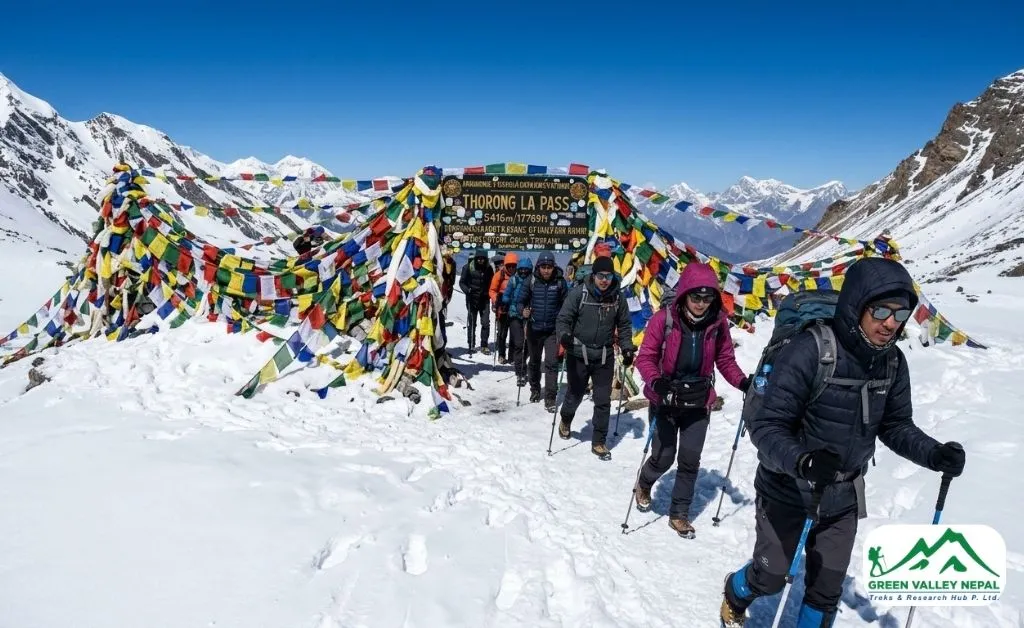
Thorong La Pass is the single biggest difficulty factor on the circuit. At 5,416 meters (17,769 feet), you are breathing air with roughly 50% of the oxygen available at sea level.
The Thorong La reality:
- You will wake at 4:00-5:00 AM for the crossing
- Start temperature: -10°C to -20°C (14°F to -4°F)
- Walking time to pass: 4-6 hours uphill
- Steep switchbacks for the final 2-3 hours
- Possible headache, nausea, dizziness from altitude
- Strong winds are common (40-60 km/h)
- Snow and ice during the winter months
The pass itself is about 400 meters higher than Everest Base Camp and 1,286 meters higher than Annapurna Base Camp. This altitude difference matters significantly for acclimatization and physical performance.
Many trekkers who felt strong at 3,000-4,000 meters struggle at Thorong La. Your body simply works harder at this altitude, heart rate increases 20-40%, breathing becomes labored, and every step requires deliberate effort.
Critical factor: Most altitude-related emergencies on the circuit happen at or near Thorong La Pass. Proper acclimatization isn't optional; it's essential.
Extended Duration and Distance
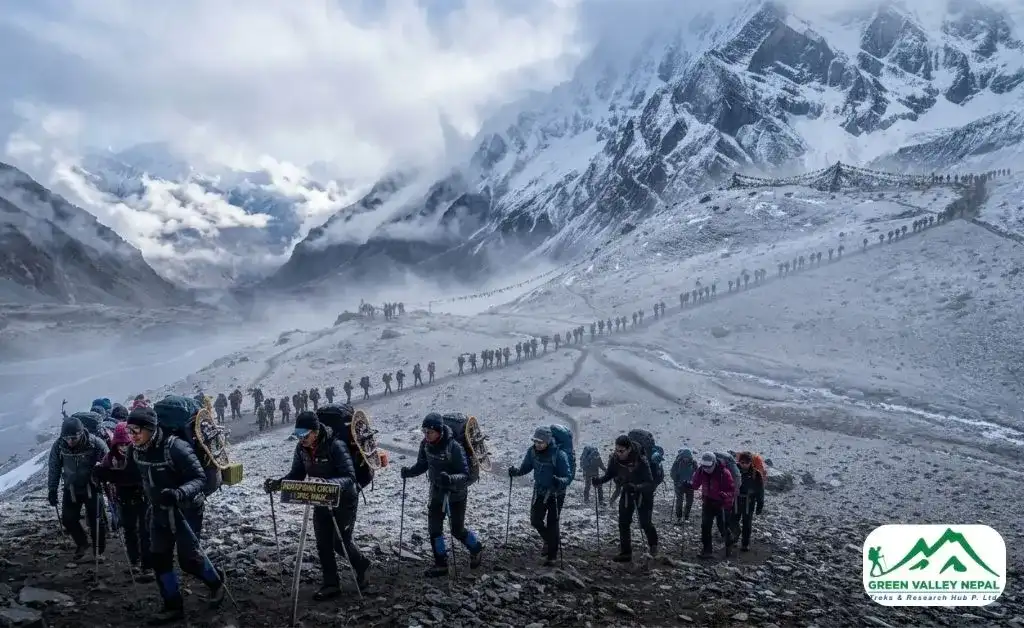
The Annapurna Circuit isn't a weekend hike. Even the shortest itineraries require 10-12 days of continuous trekking. Standard routes take 14-18 days. Choosing a longer itinerary, i.e., 14 days, the full Annapurna circuit would be perfect.
What this means physically:
- You don't get full rest days (maybe 1-2 acclimatization days)
- Cumulative fatigue builds daily
- Minor aches and pains compound over weeks
- Sustained calorie deficit despite eating constantly
- Sleep quality decreases at altitude
- Recovery happens while trekking
By day 8-10, most trekkers experience significant fatigue. Your legs are sore from the previous days. The altitude is affecting sleep. You are mentally tired of walking. Then you still have Thorong La Pass ahead.
Distance reality:
- Short circuit (via Besisahar to Jomsom): ~140-160km
- Classic circuit (via Bahundanda to Nayapul): ~180-200km
- Extended circuit (with side trips): 220-250km
For comparison, the ABC trek covers approximately 110km total. The Circuit requires walking 50-140km more, depending on route choices.
Terrain Diversity and Elevation Changes
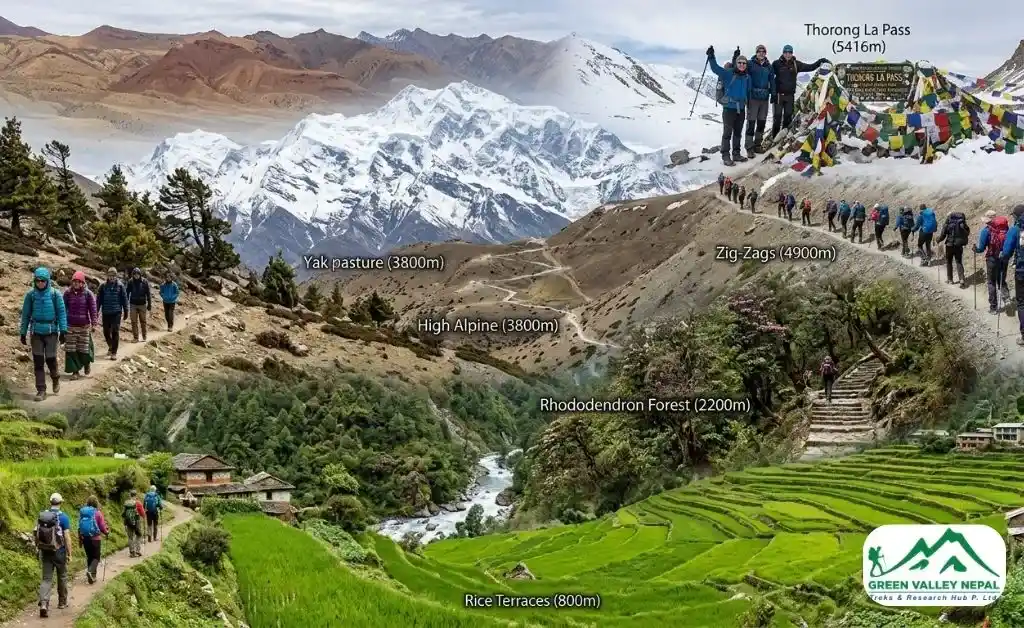
The circuit crosses incredibly varied terrain, each section bringing new challenges:
Lower section (800-2,000m): Subtropical forests
- Hot and humid
- Stone staircases
- Leeches during the monsoon
- Steep ups and downs
Middle section (2,000-3,500m): Temperate zone
- Rocky trails
- River crossings
- Forest paths
- Moderate climate
Upper section (3,500-4,500m): Alpine zone
- Thin air
- Cold temperatures
- Barren landscape
- Steeper grades
Thorong La approach (4,500-5,416m): High alpine
- Extreme altitude
- Snow and ice
- Freezing temperatures
- Oxygen-depleted air
Descent to Muktinath (5,416-3,800m): Rapid drop
- Knee-pounding descent
- Loose scree
- 1,600m elevation loss in 3-4 hours
Each zone demands different physical responses. You are never fully adapted because conditions constantly change.
Daily Elevation Gains and Losses
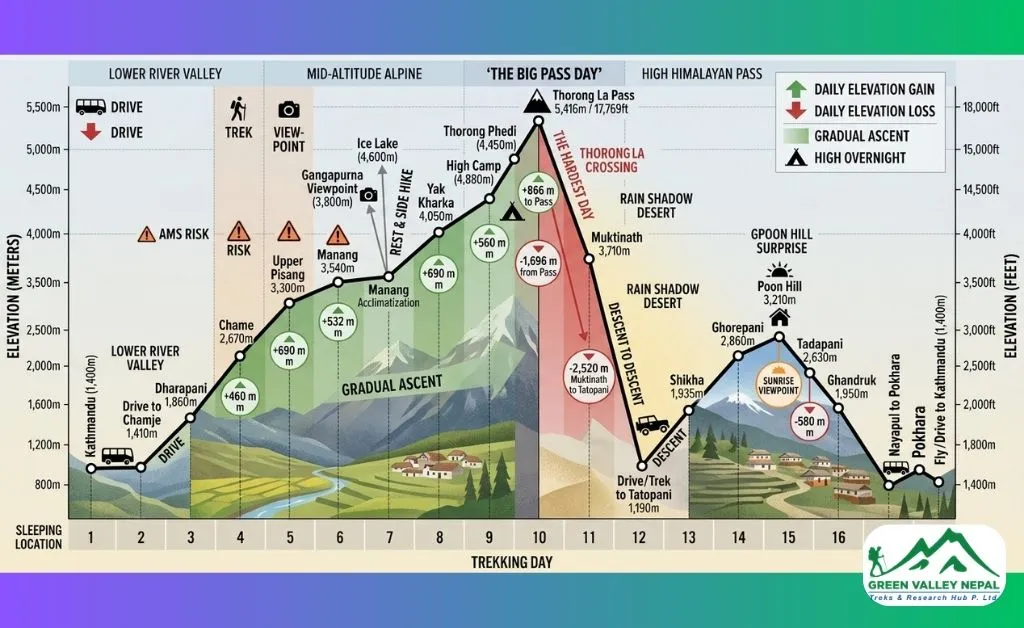
Unlike ABC, which generally climbs steadily, the Circuit features massive daily elevation changes, sometimes gaining 1,000 meters then losing 800 meters the same day.
Tough climbing days:
- Chame to Upper Pisang: 1,000m gain
- Manang to Thorong Phedi: 1,300m gain over two days
- Thorong Phedi to Thorong La: 600m gain
- Ghasa to Tatopani: 1,600m descent
These constant ups and downs stress your legs differently than steady climbing. Descents especially destroy quadriceps and strain knees, particularly on days 14-18 after Thorong La when you're already fatigued.
Mental Endurance Challenge

Physical fitness gets you through individual days. Mental endurance carries you through three weeks.
Mental challenges:
- Monotony of daily trekking routine (wake, walk, eat, sleep, repeat)
- Homesickness and missing comforts
- Dealing with basic accommodation for weeks
- Managing discomfort without quitting
- Staying motivated when tired
- Handling uncertainty (weather, trail conditions, health)
Around day 10-12, many trekkers hit a psychological low point. The novelty has worn off. Thorong La looms ahead. Home feels very far away. Your body hurts. Mental toughness becomes as important as physical fitness.
Altitude Sickness: The Hidden Difficulty
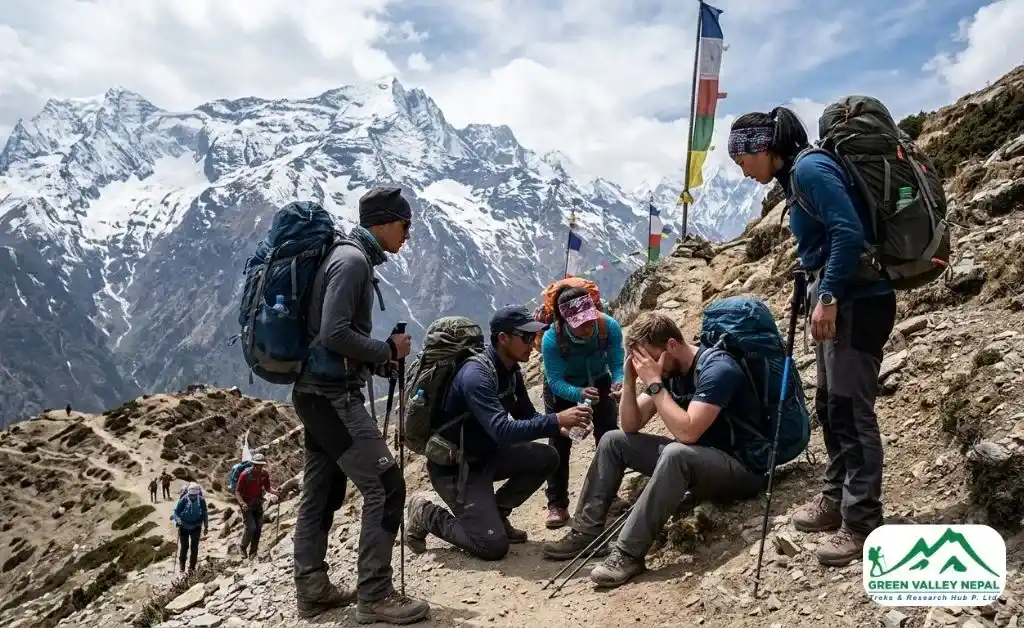
Fitness helps you walk. Altitude stops even fit people. Not only being fit is ok to compete with altitude, but confidence is the key to overcoming fear. At Thorong La Pass, altitude is the defining challenge.
How Altitude Affects You?
- 3,000m (Manang): Most people feel fine, maybe slight breathlessness
- 4,000m (Yak Kharka): Noticeable reduction in performance, sleep may be difficult
- 4,500m (Thorong Phedi): Mild headaches are common, appetite decreases, and every task feels harder
- 5,416m (Thorong La): Heart pounds during minimal exertion, headaches likely, nausea possible, thinking becomes foggy
Acute Mountain Sickness (AMS) Risk
Approximately 30-40% of circuit trekkers experience mild AMS symptoms at some point. Severe AMS affects 5-10%.
Common symptoms:
- Headache
- Nausea
- Fatigue beyond normal tiredness
- Dizziness
- Loss of appetite
- Difficulty sleeping
Key prevention strategies:
- Ascend slowly (no more than 500m per day above 3,000m)
- Include acclimatization days at Manang (essential)
- Drink 4+ liters of water daily
- Avoid alcohol above 3,000m
- Consider Diamox (consult doctor)
- Recognize symptoms early
The circuit's itinerary naturally aids acclimatization by ascending the Marsyangdi Valley gradually before Thorong La. However, some trekkers still ascend too quickly or ignore symptoms.
Critical rule: If AMS symptoms worsen despite rest, descend immediately. Don't push through to Thorong La with active altitude sickness.
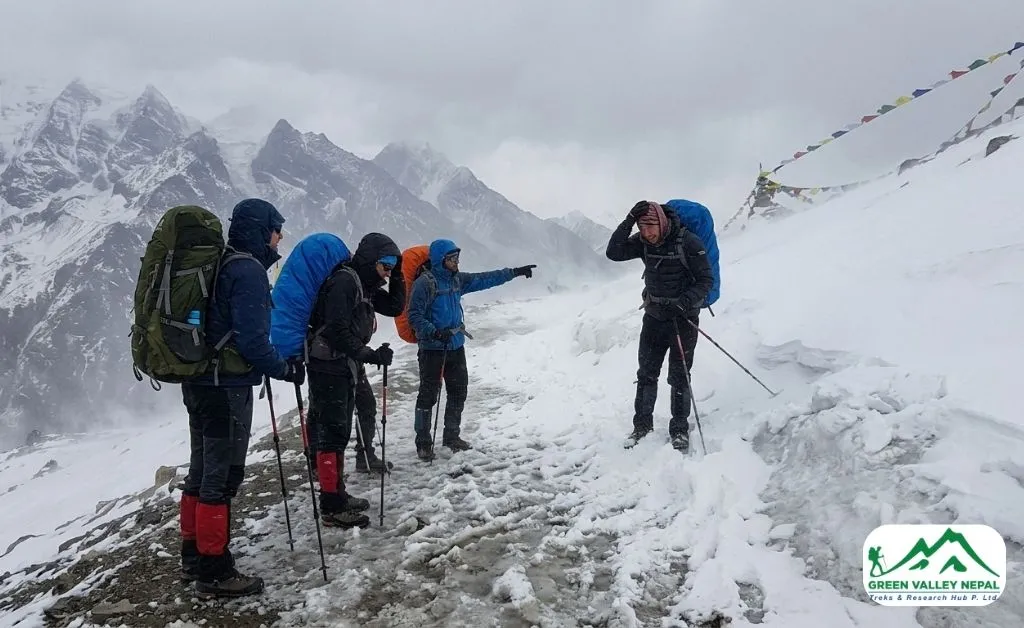
Weather and Seasonal Difficulty
Spring (March-May)
- Difficulty: Moderate (6/10)
- Thorong La is crossable on most days
- Warmer temperatures make the high altitude more bearable
- Afternoon clouds can obscure views
- Rhododendron blooms lower down
- Higher chance of successful crossing
Autumn (September-November)
- Difficulty: Moderate (6/10)
- Peak season for good reason
- Stable weather, clear skies
- Colder than spring at high altitude
- October gets crowded at teahouses
- Best visibility all year
Winter (December-February)
- Difficulty: Very Hard (9/10)
- Thorong La Pass may be closed due to snow
- Extreme cold (-20°C to -30°C at pass)
- Many teahouses closed above Manang
- Only for experienced winter trekkers
- Beautiful but brutal
Monsoon (June-August)
- Difficulty: Hard (8/10)
- Lower sections are very wet, muddy, and leech-infested
- Thorong La is still passable (rain shadow area)
- Views obscured by clouds
- Slippery trails
- Very few trekkers
Choosing the right season can be the difference between a successful summit and a forced turnaround. Explore our best trekking season page to choose the right time.
Age and Annapurna Circuit Trek Difficulty

Teenagers (15-19)
- Success rate: Very high with proper acclimatization.
- Challenges: May lack patience for the slow pace required at altitude.
- Verdict: Circuit is suitable for fit teenagers
20s-30s (Peak Trekking Age)
- Success rate: 90-95%
- Challenges: Often push too hard early, leading to burnout
- Verdict: Ideal age range if properly trained
40s-50s
- Success rate: 85-90%
- Challenges: Recovery takes longer, joints feel strain more
- Verdict: Very achievable with consistent training and extra rest days
60s+
- Success rate: 75-85%
- Challenges: Altitude affects older bodies more, longer recovery needed
- Verdict: Definitely possible, but requires excellent fitness and 17-21 day itineraries
Fitness Requirements: What You Actually Need

Cardiovascular Endurance
The circuit demands sustained aerobic capacity. You will walk 5-8 hours daily for 2-3 weeks at progressively higher altitudes.
Benchmark test: Can you hike continuously for 6 hours with a 6-8kg daypack without complete exhaustion? If yes, your cardio is probably adequate.
Training recommendations:
- 3-4 cardio sessions weekly (running, cycling, swimming, stair climbing)
- Gradually build to 60-90 minute sessions
- Add 30-degree incline treadmill walks
- Focus on sustained moderate intensity, not sprints
Leg Strength and Endurance
Strong legs handle the circuit's constant elevation changes better and reduce injury risk.
Benchmark test: Can you do 60 bodyweight squats without stopping? Climb 15 floors of stairs without gasping?
Key exercises:
- Weighted squats and lunges
- Step-ups with 10-15kg
- Calf raises
- Single-leg deadlifts
- Wall sits
Core Stability
A strong core reduces back strain from carrying daypacks and helps with balance on uneven terrain.
- Training: Planks, side planks, dead bugs, bird dogs—3x weekly.
- Prior Trekking Experience: While not strictly "fitness," experience trekking multiple consecutive days helps significantly. Your body needs to know what sustained multi-day effort feels like.
- Ideal preparation: Complete 2-3 multi-day treks (3-5 days each) in the 3-6 months before your circuit trek.
Training Timeline: 12-Week Preparation
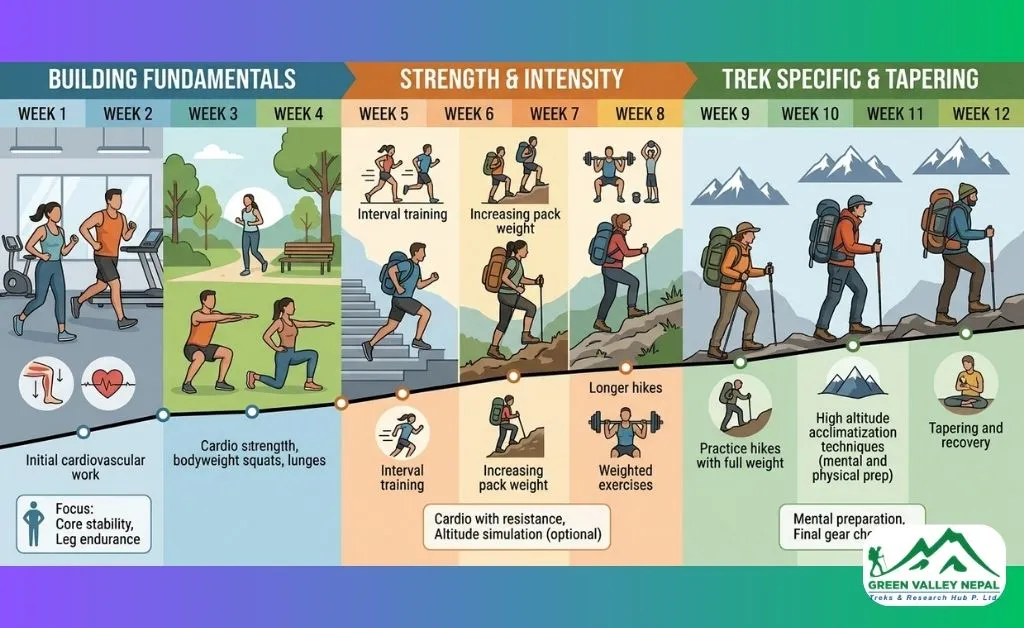
Weeks 1-4: Build Base
- 3x weekly cardio: 30-45 minutes
- 2x weekly leg strength
- 1x weekly long hike: 2-3 hours
- Focus: Consistency
Weeks 5-8: Increase Intensity
- 4x weekly cardio: 45-60 minutes, add hills/incline
- 2x weekly strength (add weight)
- 1x weekly long hike: 4-5 hours with an 8kg pack
- Focus: Elevation gain
Weeks 9-11: Peak Training
- 4x weekly cardio: 60-75 minutes
- 2x weekly strength maintenance
- Weekend back-to-back hikes: Saturday 5-6 hours, Sunday 3-4 hours
- Focus: Consecutive day endurance
Week 12: Taper
- Reduce volume 40%
- Maintain intensity
- Rest before departure
Can you skip training? Technically, yes, but your experience will be miserable, injury risk increases dramatically, and completion becomes uncertain. The circuit punishes lack of preparation.
Common Reasons Traveler Fail to Complete Annapurna Circuit Trek
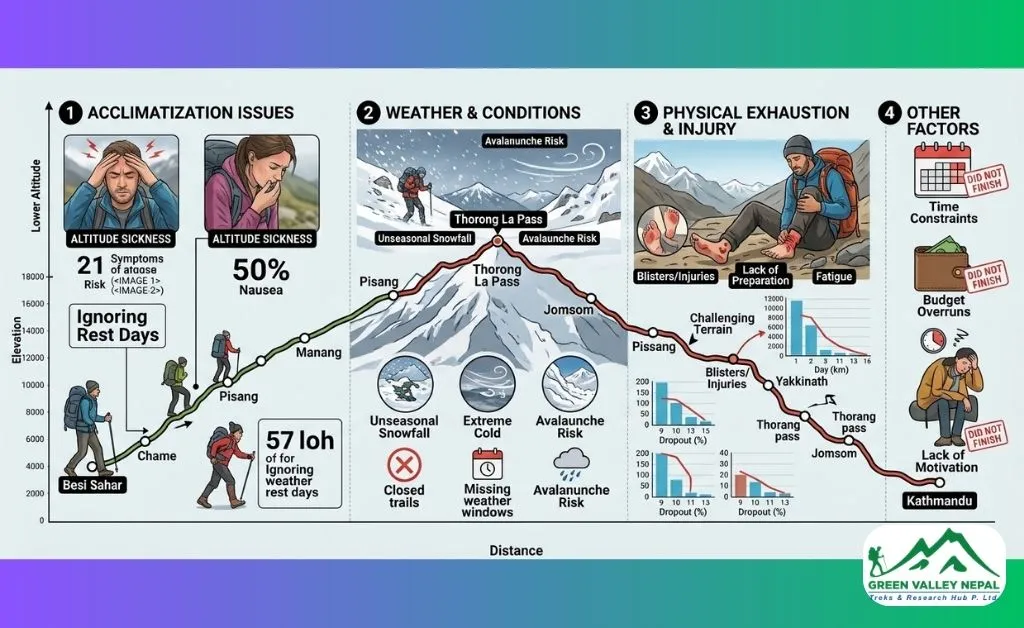
Altitude Sickness (40%)
- Ascended too quickly
- Ignored early symptoms
- Skipped acclimatization days
Insufficient Fitness (25%)
- Undertrained
- Knee problems from descents
- Couldn't maintain daily pace
Weather/Trail Conditions (15%)
- Thorong La is closed due to snow
- Trails are impassable due to landslides
Illness (10%)
- Stomach problems
- Flu/cold at altitude
- Pre-existing conditions worsened
Mental/Motivation (10%)
- Gave up when conditions got tough
- Homesick
- Exceeded mental endurance
Can Beginners Do Annapurna Circuit Trek?
Yes, but with important caveats.
Beginners can succeed if they:
- Train seriously for 10-12 weeks
- Choose 16-18 day itinerary (longer = better acclimatization)
- Trek during spring or autumn
- Hire an experienced guide
- Don't have pre-existing health issues
- Maintain realistic expectations
Beginners should avoid the circuit if they:
- Are currently sedentary
- Have no prior multi-day hiking experience
- Have respiratory or heart conditions
- Cannot train for 3 months beforehand
- Are time-constrained (rushing increases risk)
Better beginner options: ABC Trek, Mardi Himal Trek, Poon Hill trek, Langtang Valley Trek, complete one of these first, then attempt the circuit.
Conclusion
The Annapurna Circuit Trek deserves its reputation as one of the world's great treks. It's challenging but not impossible. Hard but not extreme. Demanding but achievable with preparation.
The circuit will test you physically with long days and high altitude. It will test you mentally with weeks of basic conditions and sustained effort. It will push your limits without requiring technical climbing skills.
Most prepared trekkers complete it successfully and call it the best trek they have ever done. The combination of diverse terrain, cultural immersion, and the Thorong La Pass challenge creates an experience you will remember for life.
The Annapurna Circuit Trek is challenging, but with the right preparation, it’s absolutely achievable.
Frequently Asked Questions
- Is the Annapurna Circuit difficult for beginners with no trekking experience?
Yes, the Annapurna Circuit is difficult for complete beginners, mainly due to altitude rather than terrain. The trek crosses Thorong La Pass at 5,416m and runs 12–18 days, which demands physical preparation and proper acclimatization. Beginners can complete it successfully by training for 10–12 weeks beforehand, choosing a longer itinerary with extra acclimatization days, and trekking in spring (March–May) or autumn (September–November).
- How difficult is Thorong La Pass compared to other Himalayan passes?
Thorong La Pass (5,416m) ranks among the more demanding non-technical passes in the Himalayas because of its altitude and long 8–10 hour summit day. It's harder than the passes on the Annapurna Base Camp trek, and roughly comparable in effort to the high passes on the Everest Base Camp route. The difficulty comes from altitude and endurance, not technical climbing skills.
- Is the Annapurna Circuit trek doable without a guide or porter?
Yes, the Annapurna Circuit is manageable without a porter if you're physically fit and keep your pack under 10kg. Carrying 12–15kg noticeably increases fatigue, especially on the approach to Thorong La Pass. First-time high-altitude trekkers generally see a higher success rate and less physical strain when they hire a porter.
- Is the Annapurna Circuit harder in winter?
Yes, the Annapurna Circuit is significantly harder in winter (December–February) than in other seasons. Snow and ice at Thorong La Pass, temperatures below -20°C, and the risk of pass closures all raise the physical difficulty and safety risk. Winter trekking is recommended only for experienced, well-equipped trekkers.
- What is the hardest day on the Annapurna Circuit?
The hardest day on the Annapurna Circuit is the Thorong Phedi to Muktinath crossing over Thorong La Pass. Trekkers start before sunrise, climb 600m at extreme altitude, then descend nearly 1,600m in the same day. The combination of altitude, cold, and a long descent makes this the toughest single section of the entire route.