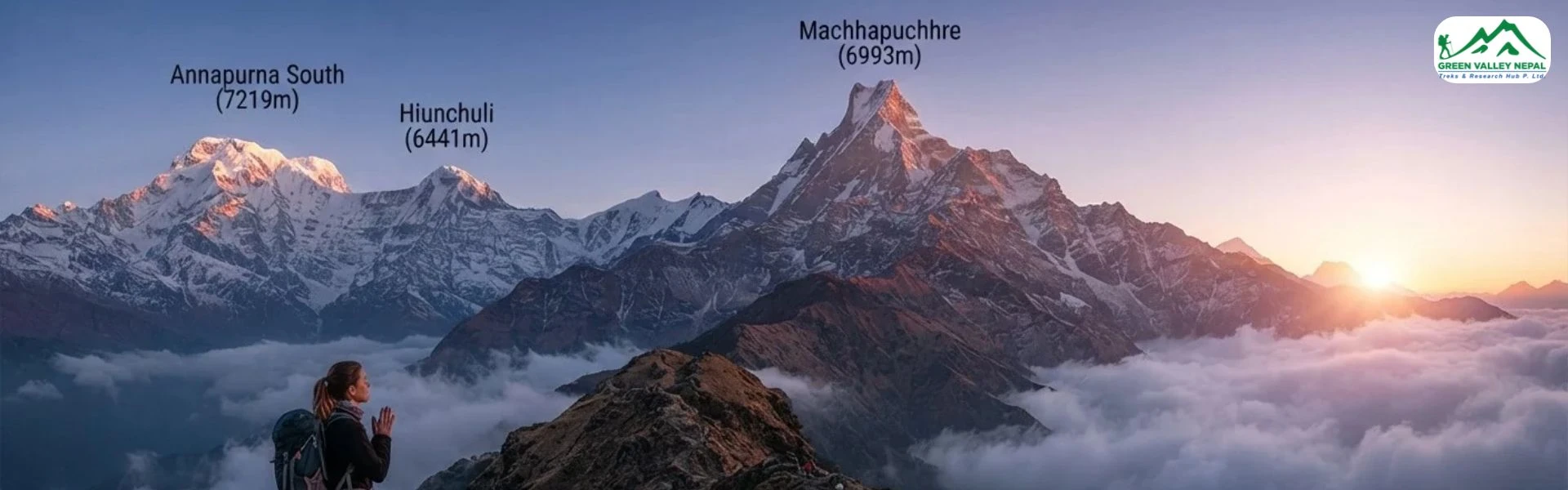
Mardi Himal Trek Difficulty at a Glance
Factor | Details |
|---|
Overall difficulty | Moderate (non-technical, but steep and sustained) |
Technical skill needed | None. No ropes, crampons or climbing |
Highest point | Mardi Himal Base Camp, 4,500 m (optional extension) |
Main goal for most trekkers | Upper Viewpoint, about 4,200–4,300 m |
Highest overnight stay | High Camp, about 3,550–3,600 m |
Typical duration | 5–7 days (3–4 days is harder; 8–9 days is gentler) |
Walking per day | 4–7 hours; the hardest day is 6–8 hours |
Total distance | Roughly 40–50 km, depending on start point and route |
Terrain | Forest stone steps, narrow ridgeline, open alpine slopes |
Best seasons | March–May and September–November |
Guide required | Yes, for non-Nepali trekkers |
Fitness needed | Comfortable walking uphill 4–6 hours on consecutive days with a daypack |
Here is how the main difficulty factors rate individually:
Factor | Difficulty Level |
|---|
Altitude | Moderate |
Trail steepness | Moderate–Hard |
Technical difficulty | Easy |
Fitness requirement | Moderate |
Cold and weather exposure | Moderate (Hard in winter and monsoon) |
Navigation | Easy with a guide |
Teahouse comfort | Basic |
Mardi Himal is harder than Ghorepani Poon Hill and roughly in the same effort bracket as Annapurna Base Camp, though the two feel different. It punches above its weight because the ascent is steep and compact: you gain a lot of height in a short time, and your body notices.
How Hard Is the Mardi Himal Trek, Really?
The route is physically demanding but non-technical, and it earns its “moderate” rating honestly. This is what the experience feels like as you go higher.
The first days (forest). The trail climbs through dense rhododendron and oak forest on well-marked stone steps. The pace is gentle, your legs are fresh and the teahouses are well spaced. It is enjoyable, but the steps are steeper than most first-timers expect.
The middle section (Forest Camp to Low Camp to High Camp). The trail narrows, and the ridge becomes exposed. Stone staircases give way to rougher ground, the tree cover thins, and you start to feel the altitude. Walking 6–7 hours here is noticeably harder than day one, and there is almost no flat ground to recover on.
The summit push (High Camp to the Upper Viewpoint or Base Camp). You start before dawn in freezing temperatures and climb steeply for 2–3 hours in thin air. Then you turn around and descend, which sounds easier but punishes the knees. Many trekkers say this day is more mental than physical.
No ropes, no climbing gear, and no mountaineering skills are needed at any point. But the effort is sustained and cumulative, which is why “moderate” here does not mean “easy”.
Upper Viewpoint vs Base Camp: How Far You Go Changes the Difficulty
Most websites treat “Mardi Himal” as a single destination at 4,500 m. In reality, there are three distinct goals, and the one you choose changes how hard the trek is.
Goal | Altitude | Extra effort | Difficulty |
|---|
High Camp (overnight stop) | About 3,550–3,600 m | Reached by most trekkers on day 2–3 | Moderate |
Upper Viewpoint | About 4,200–4,300 m | Pre-dawn climb of roughly 2–3 hours from High Camp | Moderate–Hard |
Mardi Himal Base Camp | 4,500 m | Further steep, exposed walking; the round trip from High Camp is typically 6–8 hours | Hard on the day |
The Upper Viewpoint already delivers the famous close-up views of Machhapuchhre and the Annapurna range, and many guides treat it as the main goal. Base Camp is a worthwhile extension for fit, well-acclimatized trekkers, but it is optional. If you feel unwell, go no higher. The views from High Camp are spectacular on their own.
Day-by-Day Difficulty on a 5-Day Itinerary
Here is a realistic breakdown of our 5-day Mardi Himal Trek from Pokhara, the most popular format:
Day | Route | Walking time | Difficulty | What makes it hard |
|---|
1 | Drive from Pokhara to Kande (about 1 hour), trek to Samjay Deurali | 4–5 hours | Easy–Moderate | Steep stone steps; finding your rhythm |
2 | Trek to Badal Danda (3,210 m) | 6–7 hours | Moderate–Hard | Longest ascent; forest gives way to open ridge |
3 | Trek to High Camp (about 3,600 m), acclimatisation | 2–3 hours | Easy–Moderate | Short walk, but the air is thinning |
4 | High Camp to Base Camp (4,500 m), then down to Low Camp (3,050 m) | 7–8 hours | Hard | Pre-dawn start, thin air, cold, long steep descent |
5 | Trek to Sidhing, drive to Pokhara (800 m) | About 3 hours trekking plus 3 hours driving | Easy–Moderate | Tired knees and legs |
On longer itineraries, the same ground is spread over more days, so each day is easier, and acclimatization improves. The itinerary length section further down shows how that changes the picture.
Altitude and Acclimatization: The Real Challenge
For most trekkers, altitude is a bigger challenge than the trail itself, and fitness cannot fix it. The trek climbs from about 820 m in Pokhara to 4,500 m at Base Camp, and the gain is fast. You sleep no higher than High Camp, which helps, but the day trip above it is where the air feels properly thin.
Location | Approx. altitude | Notes |
|---|
Pokhara | 820 m | Starting point |
Forest Camp | 2,600 m | Common first-night stop on longer routes |
Low Camp | 3,050–3,100 m | Useful acclimatization stop |
Badal Danda | 3,210 m | Forest-to-ridge transition |
High Camp | 3,550–3,600 m | Highest overnight stay |
Upper Viewpoint | 4,200–4,300 m | Main goal for most trekkers |
Mardi Himal Base Camp | 4,500 m | Optional extension |
For many people, the real altitude difficulty begins above 3,500 m, where even gradual uphill sections feel harder. Symptoms of acute mountain sickness (AMS) to watch for:
Persistent headache (the most common early sign)
Nausea or vomiting
Dizziness or feeling lightheaded
Loss of appetite
Poor sleep and unusual fatigue
The rule is simple: never go higher with symptoms that are getting worse. With mild symptoms, rest, drink water, and hold your altitude until they ease. If they do not improve or they worsen, descend. Confusion, stumbling or loss of coordination, breathlessness at rest, or a wet, persistent cough are emergency signs: descend immediately and tell your guide.
Altitude sickness is caused mainly by ascending too fast, not by height alone. A 5–7 day itinerary is paced reasonably, but some budget operators compress the trek into 3–4 days, which gives your body far less time to adjust and raises the risk noticeably.
Practical acclimatization tips:
Walk slowly. The Nepali phrase bistari bistari (slowly, slowly) exists for good reason
Drink 3–4 litres of water a day
Avoid alcohol and smoking above 3,000 m
Eat even when your appetite drops
Choose an itinerary with an extra night at Forest Camp or Low Camp if you have the time
Ask your doctor or a travel clinic whether preventive medication such as acetazolamide (Diamox) suits you. It never replaces a slow ascent
Our guides watch your pace and your symptoms every day, and a slower itinerary with an acclimatization stop makes the whole trek more comfortable. If you are unsure which pace suits you, talk to our team before booking.
Trail Conditions and Terrain
The terrain changes noticeably as you gain height:
Lower section (Kande or Siding to Forest Camp): Stone-paved paths through thick rhododendron and oak forest, with some muddy patches and uneven steps. In the monsoon, this section becomes slippery and leech-prone.
Middle section (Forest Camp to Low Camp to High Camp): The trail narrows, and the ridge becomes exposed, with drop-offs on both sides in places. The surface shifts between stone and compacted dirt, and in winter you meet snow and ice above about 3,500 m. The ridgeline is spectacular but needs steady footing, especially in wet, windy, or icy conditions. If you have a strong fear of heights, tell your guide in advance.
Upper section (High Camp to the Viewpoint and Base Camp): A steeper gradient, fewer trail markers, and thin air make this the most demanding stretch. In winter, microspikes or crampons can be genuinely useful above High Camp.
The trail is well marked in the main seasons. Off-season, especially after heavy snowfall, route-finding gets harder, which is one more reason the guide is not optional. Trekking poles are strongly recommended on every section: they take pressure off your knees on the descent and help your balance on the ridge.
Daily Walking Hours and Physical Demands
A typical ascending day involves 5–7 hours of walking on continuous uphill with only brief flat sections, gaining roughly 400–700 m. The hardest day, High Camp to the Viewpoint or Base Camp and back, usually runs like this:
Start: 4:00–5:00 AM, so you reach the top before clouds roll in
Ascent: about 2.5–3 hours to the Viewpoint or Base Camp
Descent: 3–4 hours back to High Camp or on to Low Camp
Total: 6–8 hours of walking
Challenge: altitude, cold, and the fatigue of the previous days
Cumulative fatigue is what trekkers underestimate most. By day three or four, your legs are already carrying the earlier climbs, and the uphill does not get easier; you just get more tired. A heavy pack makes everything harder, which is why a porter (roughly US$20–25 a day, so check current rates) is one of the best investments a beginner can make. For a full budget breakdown, see our Mardi Himal Trek cost guide.
What Most Trekkers Underestimate About Mardi Himal
Most people expect altitude to be the hardest part. Many finish saying the real challenge was something else:
Relentless uphill: There is very little flat terrain to recover on. The climb from Low Camp towards High Camp keeps rising along the ridgeline and surprises even experienced hikers.
The cold: Pre-dawn starts above 3,500 m are freezing, and nights at High Camp drop below zero even in the main seasons. A warm sleeping bag matters.
Mental fatigue near the top: After several days of climbing, the final ascent in thin air feels slow even though the distance is short.
The descent: Steep stone steps place a heavy load on knees and thighs. Poles make a real difference.
Despite all that, most trekkers describe Mardi Himal as one of the most rewarding short treks in Nepal, because the mountains feel dramatically close throughout.
Is the Mardi Himal Trek Difficult for Beginners?
This is the most common question, and the honest answer is: yes, beginners can do it, but only with proper preparation. If you are asking whether the Mardi Himal trek is easy, the answer is not exactly. For people with decent fitness and sensible pacing, it is very achievable.
The trek is designed for active people, not athletes. If you can walk briskly uphill for a couple of hours, climb stairs for 30 minutes without stopping, and do something similar again the next day, you have the foundation. From there, it is about building up.
A quick self-test before you book:
Stair or hill test: walk uphill or up stairs at a steady pace for 30 minutes with a 5 kg pack. If you need to stop more than twice, build your cardio first
Back-to-back test: do two hikes of 3–4 hours on consecutive days. If day two feels unmanageable, work on recovery fitness
Downhill test: walk down a long hill or flight of stairs for 20–30 minutes. If your knees complain, train them before the trek
Common beginner mistakes:
Walking too fast on day one and burning out by day three
Underestimating how cold it gets above 3,000 m at night
Carrying too much gear (you will regret every extra kilogram)
Skipping training because “it’s just a short trek”
Not taking altitude symptoms seriously
What actually helps beginners succeed:
Choosing a 6–7 day itinerary instead of a compressed 3–4 day one
Hiring a guide who regulates your pace, handles logistics, and knows when something is wrong
Training consistently for 6–8 weeks
Packing light and using a porter
That is why Mardi Himal has become such a popular step up for people who have done a shorter route like Poon Hill and want something higher without technical difficulty.
Who Can Do the Mardi Himal Trek? Age, Families and Health
There is no fixed age limit for the trek itself. What matters is fitness, health and pace.
Families and children: active, fit children can manage the trek on a slower itinerary. Altitude affects children and adults alike, so choose a longer itinerary, keep the daily walking short, and check with your paediatrician first.
Older trekkers: many people in their 60s and 70s complete the trek by training, walking slowly and using a porter. A medical check-up before you go is sensible.
Solo travellers and couples: both do very well, and the quiet trail suits people who like peaceful walking.
Think twice, or speak to your doctor first, if you:
Have heart or lung conditions, or high blood pressure that is not well controlled
Have a history of severe altitude sickness
Have significant knee, hip or back problems (the long descent is punishing)
Are pregnant
Cannot walk 5–7 hours on consecutive days
Expect hotel-style comfort. Teahouses here are simple
This is not meant to put you off. It is meant to help you choose the right pace and the right itinerary. If you are unsure, tell us about your fitness and experience, and we will recommend honestly.
Do You Need a Guide? Permits and Rules
Yes. Foreign trekkers in Nepal’s national parks and conservation areas must now trek with a licensed guide arranged through a registered trekking agency. The Mardi Himal Trek lies inside the Annapurna Conservation Area, so independent trekking is no longer an option for non-Nepali visitors. Rules can change, so confirm the latest requirements when you book.
You also need an Annapurna Conservation Area Permit (ACAP), which costs NPR 3,000 for foreign nationals. When you book with a registered agency, permits and paperwork are arranged for you, so you do not have to queue in Pokhara or Kathmandu.
A guide is also one of the greatest difficulty reducers on this trek. They set a sustainable pace, read the weather, watch for altitude symptoms and make the call when it is time to turn back.
Seasonal Difficulty: When Is the Trek Hardest?
The season you choose changes the difficulty more than most people expect.
Autumn (September–November): easiest overall
Stable weather, dry trails, excellent visibility, and mild temperatures make autumn the most forgiving season. It is also peak season, so book your teahouses early. Nights at High Camp are still cold.
Spring (March–May): highly recommended
Rhododendrons bloom, lower-altitude temperatures are comfortable, and trails are dry. Afternoon clouds can limit views, but mornings are usually clear. Spring is a close second to autumn for beginners.
Winter (December–February): harder, but doable
Snow and ice above High Camp make the upper trail genuinely challenging, and nights are severely cold. Views can be stunning on clear days and the trail is quiet, but the difficulty effectively shifts to moderate–hard. Winter suits experienced trekkers with proper gear such as microspikes and a high-quality sleeping bag.
Monsoon (June–August): hardest season
Slippery, wet trails, leeches in the lower forest, poor visibility, and persistent rain make this the most uncomfortable time to trek, and the mountains are often hidden behind cloud. It is best avoided by beginners.
Bottom line: if this is your first Himalayan trek, go in autumn or spring. For more detail, see our guide to the best trekking seasons in Nepal.
How Itinerary Length Changes the Difficulty
The route is the same, but how many days you take to walk it changes the difficulty more than almost anything else.
Itinerary | What it feels like | Difficulty | Best for |
|---|
3–4 days (express) | Highest daily ascent and the least time to acclimatize | Moderate–Hard | Very fit, experienced trekkers |
5 days | 4–8 hours of walking a day, with one shorter acclimatization day | Moderate | Active beginners with good preparation. See our 5-day Mardi Himal Trek |
6–7 days | Same ground spread out, with an extra night at Forest or Low Camp | Easy–Moderate to Moderate | First-timers, older trekkers, anyone nervous about altitude |
9 days or more | More gradual, with added days of walking | Moderate (spread out) | Trekkers who want to enjoy the route at an easier pace. See our 9-day Mardi Himal Trek |
If you want more time in the mountains, you can also combine Mardi Himal with other Annapurna routes in the 12-day Poon Hill and Mardi Himal Trek or the 17-day ABC Trek with Poon Hill and Mardi Himal. Starting with the gentler Poon Hill section is a good way to acclimatise before the steeper Mardi ridge.
Mardi Himal Trek Difficulty Compared to Other Nepal Treks
Mardi Himal vs Poon Hill. Mardi Himal is harder. It reaches a far higher altitude, has steeper and longer uphill sections, and is more exposed. If you are nervous about your first trek, Poon Hill is the gentler place to start.
Mardi Himal vs Annapurna Base Camp. The two are close in overall effort but feel different. Mardi Himal is shorter and steeper, so it demands more from you in a compressed time. ABC reaches a lower altitude, but it is longer, with a more gradual approach and long staircase sections, so fatigue builds over more days. Choose Mardi Himal for a compact, quieter Himalayan trek, and ABC for a fuller multi-day experience.
Mardi Himal vs Everest Base Camp and Annapurna Circuit. Mardi Himal is significantly less demanding in duration, distance, and maximum altitude, but it would be wrong to call it easy by any standard.
Not sure which one suits you? Our guide on factors to consider when choosing a trek in Nepal walks through the decision.
Teahouse Conditions and Common Challenges
Beyond the physical demands, these are the realities most trekkers meet:
Basic rooms: Twin beds, a thin mattress, a blanket, and thin walls. This is not a hotel trek
Cold nights at High Camp: Temperatures below freezing are common, so sleeping bag quality matters
Simple toilets: Western-style toilets lower down, squat toilets higher up, and limited hot water. Carry toilet paper and hand sanitiser
Limited food choice: Dal bhat, noodles, fried rice, soups, porridge and eggs. Choice narrows, and prices rise as you climb
Limited signal and electricity: Bring a power bank and download offline maps before you go
Shortness of breath above 3,500 m: Even fit trekkers feel this. It is normal and manageable with a slow pace
Knee pain on the descent: Poles and a slow, controlled pace help
Fast weather changes: Even in autumn, conditions can shift quickly above 3,500 m. Waterproof layers are non-negotiable
None of these is a deal-breaker. They are simply realities that preparation makes manageable.
Fitness Preparation: What to Do Before You Go
Start at least 6–8 weeks before your trek. You do not need to train like a marathon runner, but your body needs to be ready for sustained uphill walking with a pack. Focus on endurance, not heavy lifting.
Training | How often | Purpose |
|---|
Uphill walking or hiking | 2–3 times a week, 45–90 minutes | Leg strength and cardio |
Stair climbing with a loaded daypack | 1–2 times a week, 30–45 minutes | Closest match to the trail |
Long weekend hike, building up to 4–5 hours | Once a week | Endurance for 5–7 hour days |
Squats, lunges, and step-downs | 2 times a week | Knee and quad strength for the descent |
Cycling or jogging | 1–2 times a week | Cardio base without joint impact |
Break in your boots before you travel, because blisters on day two are miserable at altitude. Mental preparation matters too: there will be a moment, usually on a steep ascent in hour five, when your brain says stop. The legs are often capable of more, and a steady pace is what gets you to the top.
For a full plan, read our guide on how to train for trekking in Nepal. If you are based near Pokhara, the Australian Camp day hike is a good way to test your legs and your boots before the main trek.
Tips to Make the Trek More Manageable
Walk slower than you think you need to, especially in the first two days
Start early each day. Mornings are clearest and coolest, and you avoid afternoon cloud and wind
Stay hydrated. 3–4 litres a day
Use a layering system. Base layer, mid layer, wind and rain shell, and a warm down jacket for evenings
Use trekking poles, especially on descents
Pack light. Every extra kilogram is carried for 6 hours a day
Take rest when you need it. Stopping for five minutes is not failure
Hire a porter if you are a beginner or carrying camera gear
Our recommended packing list for Nepal trekking covers exactly what to bring and what to leave behind.
Safety, Insurance and Emergency Planning
The Mardi Himal Trek is not dangerous when done at a sensible pace with a guide, but you are still above 3,500 m in remote country, so plan for the unlikely.
Travel insurance: buy a policy that covers trekking up to at least 4,500 m, medical treatment and emergency helicopter evacuation. Check the maximum altitude written in the policy wording, and see our travel insurance guide for Nepal trips
Tell your guide early about headaches, nausea, poor sleep, or any medical condition
Know the turn-back rule: if symptoms worsen, you descend, whatever the plan said
Carry a basic first-aid kit with blister care and any personal medication
Green Valley Nepal Treks is a government-registered local company operating since 2010, with experienced guides and 24/7 support during your trip. You can read more on our Why Travel with Us page.
Conclusion
The Mardi Himal Trek difficulty is moderate: achievable for most people who prepare properly, but not something to underestimate or rush. The altitude, the steep ridgeline, and the cumulative physical demand over several days are real, and each one responds well to preparation, pacing, and the right itinerary.
Recommended approach by trekker type:
First-time trekkers: go in spring or autumn, choose a 6–7 day itinerary and take a guide and porter
Moderately experienced trekkers: spring or autumn on a 5-day plan works well, and winter is possible with the right gear
Experienced trekkers: any season is viable with good preparation and respect for conditions
The Mardi Himal rewards people who come prepared. They leave with more than photographs: they know they pushed through something real, above 4,000 meters, in the shadow of Machhapuchhre. For most trekkers, the difficulty of the Mardi Himal Trek is less about skill and more about preparation and pacing.
Planning your first Himalayan trek?
Green Valley Nepal Treks can help you choose the right Mardi Himal itinerary for your fitness level, season, and experience, with experienced local guides and flexible routes for beginners and veterans alike. You can also build a tailor-made trip or browse our frequently asked questions.
Frequently Asked Questions (FAQs)
The Mardi Himal Trek is moderate. It is non-technical, but steep, with 4–7 hours of walking a day and a fast gain in altitude up to 4,500 m. Fit beginners can complete it with 6–8 weeks of preparation and a guide.
Beginners can complete it with basic fitness, 6–8 weeks of training, and a paced itinerary. It is harder than Poon Hill, so complete beginners should choose a 6–7 day itinerary and take a guide and porter.
No, not as a non-Nepali trekker. A licensed guide arranged through a registered agency has been required in conservation areas like Annapurna since 2023. Check the latest rules when you book.
Most days involve 4–7 hours of walking. The longest is the Viewpoint or Base Camp day from High Camp and back, usually 6–8 hours including the descent.
The summit day from High Camp. You start before dawn, climb steeply in thin air and cold, then descend for hours on tired knees.
The Upper Viewpoint (about 4,200–4,300 m) is the main goal for most trekkers. Base Camp (4,500 m) is higher, adds hours of steep walking, and is an optional extension.
It can affect trekkers above 3,500 m, especially near High Camp. Walking slowly, drinking enough water, and following a properly paced itinerary greatly reduce the risk. Never go higher with worsening symptoms.
Yes. Mardi Himal reaches 4,500 m against Poon Hill’s 3,210 m and has longer, steeper uphill sections. Poon Hill is better suited to complete beginners.
They are close in overall effort. Mardi Himal is steeper over fewer days, so it feels more intense. ABC is longer and more gradual, so fatigue builds over more days.
Yes, if they are fit and healthy and take a slower itinerary. There is no fixed age limit, but see a doctor first, especially for children, seniors or anyone with a heart, lung or knee condition.
Yes. The same ascent is compressed into fewer days, so daily climbing is higher, and there is less time to acclimatise. A 5–7 day plan is safer and more comfortable for most people.
Yes, with experience and the right gear. Expect snow and ice above High Camp, severe cold at night, and a harder trek overall. Spring and autumn are much easier.
A dedicated rest day is not essential for fit trekkers on a well-paced 6–7 day plan, but an extra night at Forest Camp or Low Camp noticeably reduces altitude risk and makes the trek more enjoyable.
Yes. You get close-up views of Machhapuchhre and the Annapurna range, quiet trails, and a real Himalayan experience in 5–7 days.
Ghorepani Poon Hill is the easiest. Mardi Himal is the next step up, ideal for active beginners who want more altitude and a bigger challenge without technical difficulty.