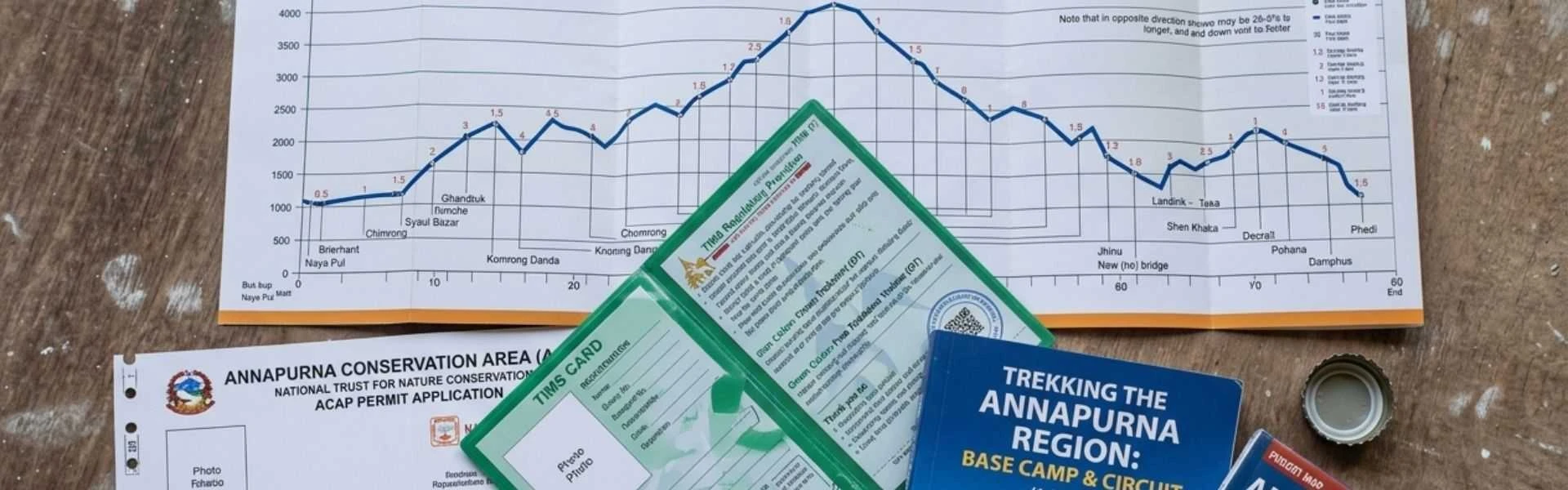
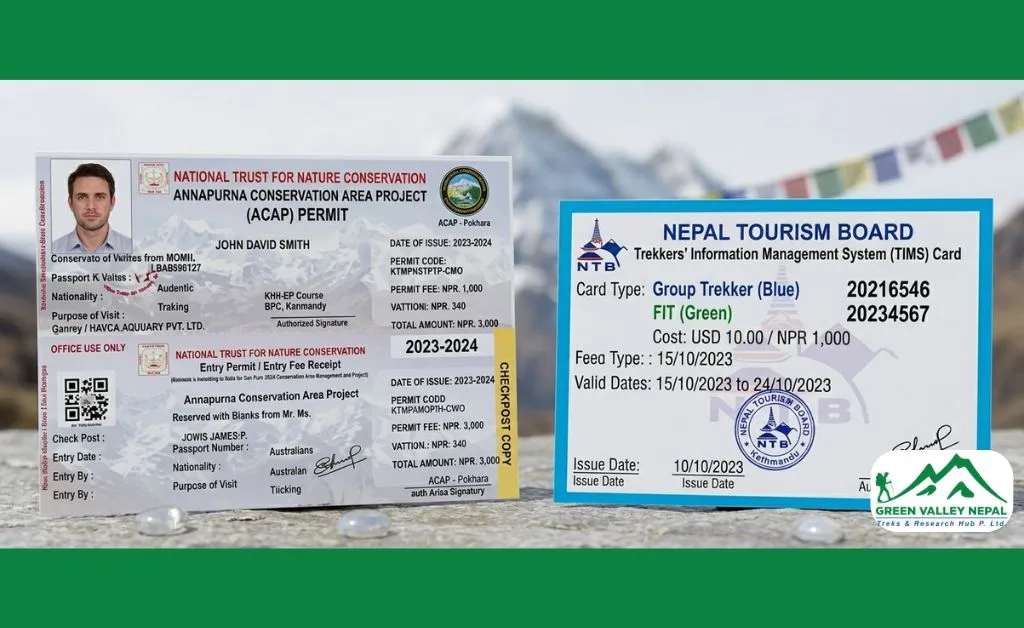
How Much Does the Annapurna Base Camp Trek Permit Cost?
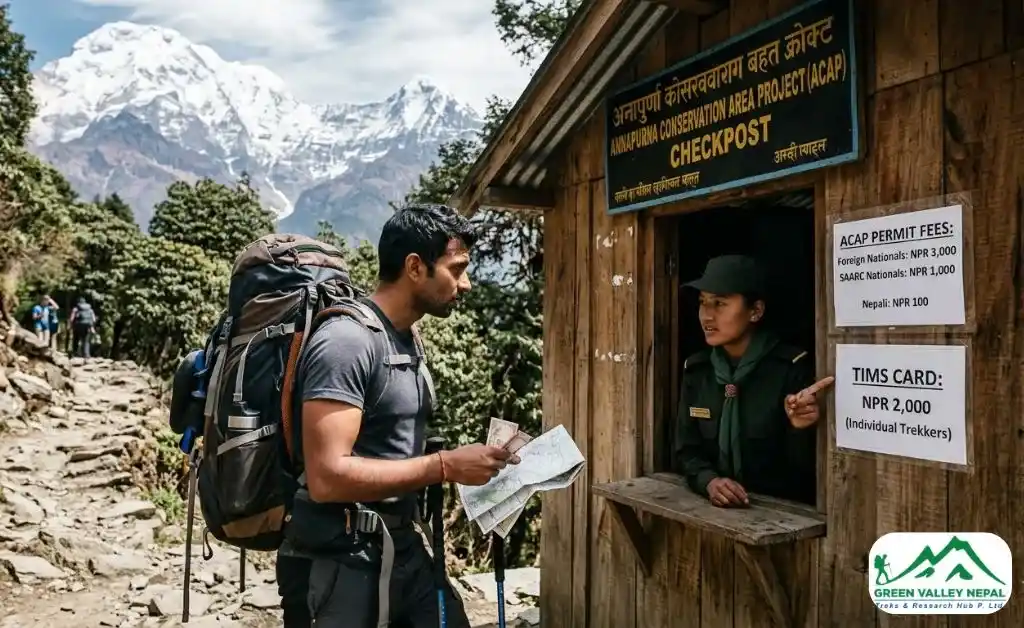
Permit fees are fixed and do not vary by Annapurna Base Camp Trekking season. Whether you trek in peak seasons (Spring and Autumn) or in off times (Monsoon and Winter), the rates are the same. Here is the full 2026 permit cost breakdown of ABC trek:
Permit | Foreign Nationals (Non-SAARC) | SAARC Nationals | Nepali Citizens |
ACAP Permit | NPR 3,000 (~$23 USD) | NPR 1,000 (~$8 USD) | Free |
TIMS Card (Group/Agency) | NPR 1,000 (~$8 USD) | NPR 1,000 (~$8 USD) | Free |
TIMS Card (Individual/FIT) | NPR 2,000 (~$15 USD) | NPR 2,000 (~$15 USD) | Free |
Total (Agency trekkers) | NPR 4,000 (~$31 USD) | NPR 2,000 (~$16 USD) | Free |
Total (Individual trekkers) | NPR 5,000 (~$38 USD) | NPR 3,000 (~$23 USD) | Free |
Note: Children under 10 years do not pay permit fees, though their details still need to be registered at the permit office.
Beyond the permit fees, budget a little extra for surrounding costs: passport-sized photos (NPR 200–500 for four photos), passport photocopies (NPR 10–20 per page), transport to the permit office, and a small agency service fee of NPR 500–1,000 if you use an agency to handle your permits. Realistically, the total permit-related expense, including all extras, comes to around NPR 5,000–7,000 ($38–53 USD).
Money-saving tips: Get passport photos printed in Thamel, Kathmandu, rather than at tourist-area shops near the permit offices. Make passport copies at your hotel; many offer this for free. Apply in person if you have the time to avoid the agency service fee.
How Much Does the ABC Trek Permit Cost for Indian Citizens?
Indian citizens benefit from lower permit rates as SAARC nationals. The ACAP Permit costs NPR 1,000 for Indian trekkers compared to NPR 3,000 for other foreign nationals. The TIMS Card is NPR 1,000 for group trekkers and NPR 2,000 for individuals trekking on their own.
To obtain permits, Indian citizens need to present a government-issued photo ID, either a valid passport or a voter ID card. The permit offices in both Kathmandu and Pokhara are familiar with SAARC discount requirements. Trekking agencies in Nepal regularly assist Indian clients with the paperwork, which saves significant time during peak season when queues can be long.
What Is the ABC Trek Permit Cost for Nepali Citizens?
Nepali citizens do not need to obtain ACAP or TIMS permits for the Annapurna Base Camp Trek. The government does not charge its own nationals these fees. However, Nepali trekkers are still expected to carry a valid national ID card or citizenship certificate, as checkpoint staff at Birethanti and Chhomrong will ask for identification.
While there is no permit fee, Nepali trekkers are encouraged to inform local authorities or the Village Development Committee (VDC) of their trekking itinerary for safety purposes, so that rescue teams can respond quickly in case of an emergency.
How Can We Obtain Annapurna Base Camp Trek Permits?
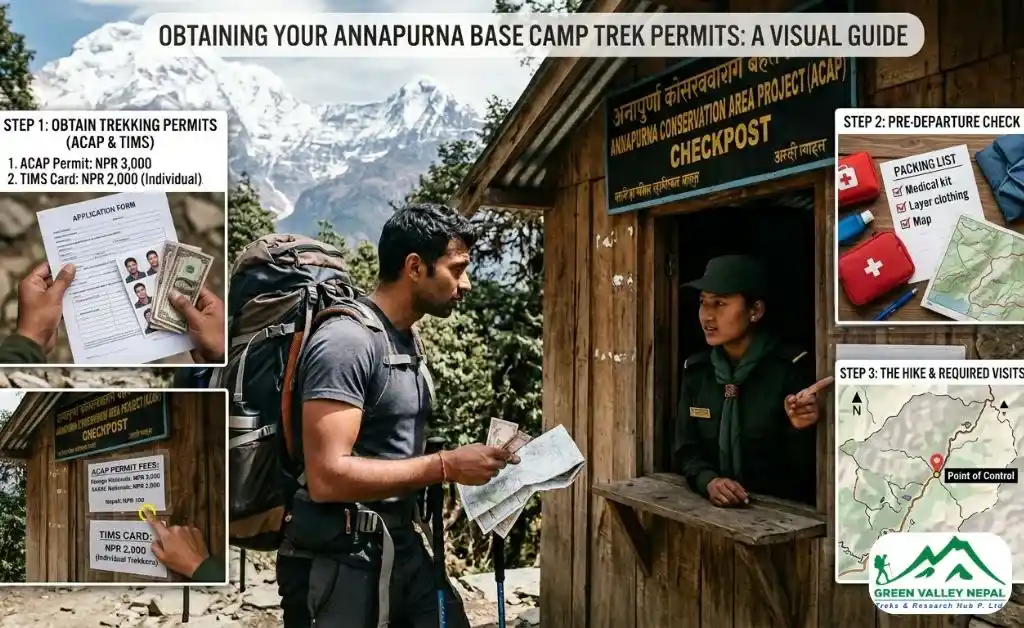
The process is simple. Visit an official permit office, fill in a form with your personal and trekking details, submit your passport and photos, pay the fees in Nepali rupees, and collect your permits, usually on the same day.
Here is everything you need to bring:
- Original passport (valid for at least 6 months) and one to two photocopies
- Two to four recent passport-sized photographs
- Valid Nepal entry visa
- Trekking dates and itinerary details
- Guide's name and license number (required since April 2023)
- Cash in Nepali rupees — most permit offices do not accept cards or foreign currency
- Trekking agency letter if applying through an agency (confirms your guide and trek dates)
Make sure all information matches your passport exactly. Even small differences in spelling or date of birth can cause delays or require you to restart the application. If applying for an SAARC discount, bring your national ID as proof of nationality.
Where Can We Obtain the Annapurna Base Camp Trek Permit?
There are two official locations where permits are issued in Nepal.
- In Kathmandu, visit the Nepal Tourism Board office at Bhrikutimandap, Pradarshani Marg. Office hours are Sunday to Thursday 10:00 AM–5:00 PM and Friday 10:00 AM–3:00 PM (closed Saturdays and public holidays). This works well if you are flying into Kathmandu and heading straight to Pokhara or the trailhead without time to stop elsewhere, or if you simply prefer sorting permits before leaving the capital.
- In Pokhara, the ACAP Permit is issued from the NTNC office at Damside near the lake, while the TIMS Card is handled at the nearby Nepal Tourism Board office. Both Pokhara offices are open Sunday to Friday, 9:00 AM–5:00 PM (closed Saturdays). Since Pokhara is the main gateway to the ABC trek, most trekkers collect their permits here, typically the afternoon before their trek starts.
Both locations are government-authorized, issue permits the same day, and process identical documents. Choose whichever fits your itinerary.
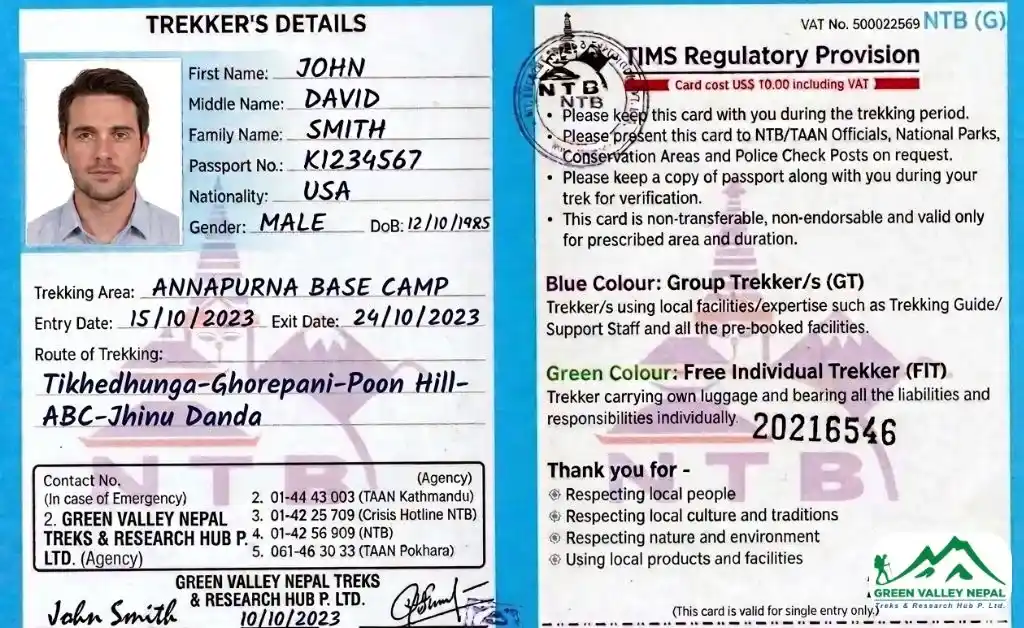
What Is the Best Way to Obtain ABC Trek Permits?
The easiest and most reliable method is through a registered trekking agency. You can contact Green Valley Nepal Trek for full details. You provide your passport copy, photos, and trek dates, and the agency handles everything, filling in forms, standing in queues, and delivering permits to your hotel. This saves two to four hours of your time and eliminates the risk of application errors. For first-time trekkers especially, the small service fee of NPR 500–1,000 is well worth it.
If you prefer to apply in person, the Pokhara offices at Damside are the best choice for most trekkers since they are close to where the trek begins. Whichever route you choose, apply at least one full day before you start, not the morning of departure. Offices get crowded, systems occasionally go down, and last-minute mistakes are both stressful and entirely avoidable.
Can We Apply for the ABC Trek Permit Online?
There is a partial online option. The NTNC operates a portal, where trekkers can pre-fill their application details before visiting the office. Submitting your information online reduces waiting time at the counter.
However, the process is not fully digital. Physical presence at an official office is still required to complete the application, pay fees, and collect your printed permit. Many trekkers also report occasional technical issues and payment failures with the portal. The in-person route remains more reliable overall.
Use the online portal to save counter time if you are comfortable with it, but plan to visit an office in person regardless.
Can I Get Permits Along the ABC Trek Trail?
No, you cannot get permits anywhere on the Annapurna trail. There are no permit offices at Nayapul, Ghandruk, Chhomrong, or any other point on the route. You must obtain both the ACAP Permit and TIMS Card in Kathmandu or Pokhara before entering the conservation area.
The first major checkpoint at Birethanti (1,025m), a short walk from Nayapul, will verify your permits before allowing you to continue. If you arrive without valid documents, you will be turned back on the spot. There is no option to pay on the trail or obtain emergency permits at the checkpoint. Plan accordingly- Kathmandu and Pokhara are your only options.
What Happens at Permit Checkpoints on the Trail?
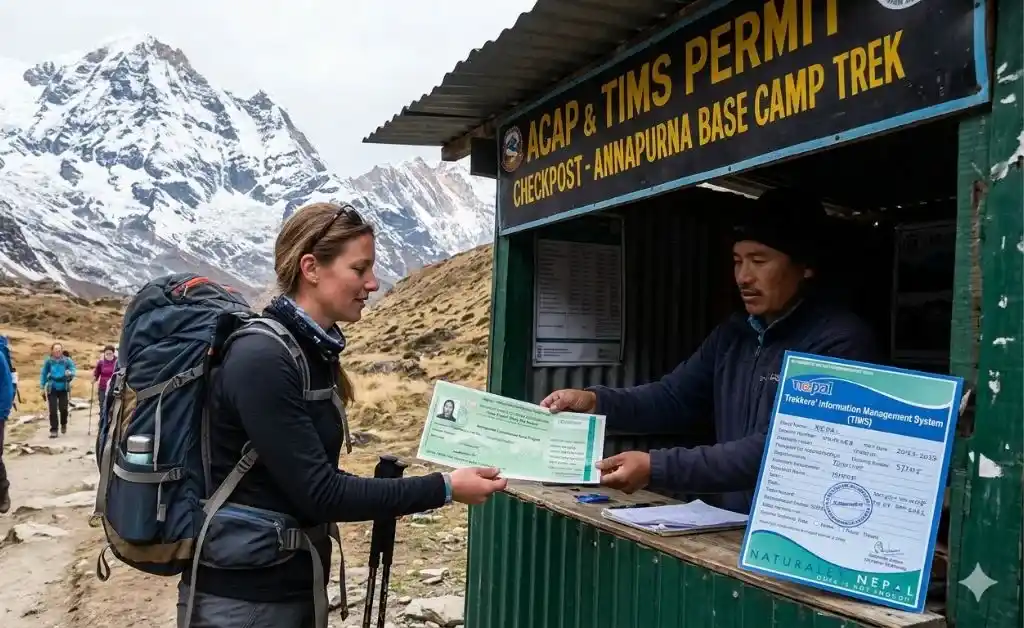
Permits are checked at multiple points along the ABC route. The two main checkpoints are Birethanti (1,025m) and Chhomrong (2,170m), with random additional checks sometimes occurring at Bamboo, Deurali, or even at Annapurna Base Camp itself.
At each checkpoint, a guard will examine both your ACAP Permit and TIMS Card, verify your name against your passport, record your entry in their log, stamp your permits, and check your guide's license. The process takes two to five minutes when everything is in order. Keep your permits in an accessible pocket, not buried in your pack, as you approach each checkpoint.
Guards are professional but strict. Missing or invalid permits cause serious problems and will stop your trek.
What Happens If You Trek Without Permits?
Some trekkers consider skipping permits to save NPR 5,000–7,000, but it's totally wrong. The Annapurna Conservation Area has checkpoints placed specifically to catch permit-less trekkers, and guards know the trail patterns, teahouses, and typical trekking schedules well.
If you are caught without permits, the consequences are significant. Fines start at NPR 10,000 ($75) and can reach NPR 50,000 ($375) or more. You can be forced to return to Pokhara to obtain permits, losing precious trek days. In serious cases, police involvement, deportation from the trekking area, and blacklisting from future trekking in Nepal are all possible outcomes.
The permits themselves cost $31–38. The minimum fine alone is double that, before you factor in lost trek days, return transport costs, and the frustration of having your journey cut short. The results strongly favor getting your permits sorted in advance.
Mandatory Guide Requirement since April 2023
Since April 1, 2023, foreign nationals are not allowed to trek independently. Hiring a licensed guide is mandatory, and this directly affects your permit application.
First, you will need to provide your guide's name and license number when applying for both the ACAP and TIMS permits. Without this information, your application cannot be completed. Second, because you are trekking through a registered agency or guide, you qualify for the lower TIMS fee of NPR 1,000 rather than the NPR 2,000 individual rate, which is actually a financial benefit of the new rule.
Guide fees typically run NPR 2,500–3,500 ($19–26) per day. For a standard 10-day ABC trek, the mandatory guide adds roughly $250–350 to your overall cost on top of permits. Many trekkers who were initially frustrated by this regulation have found genuine value in having a guide who handles checkpoint procedures, monitors early signs of altitude sickness, provides cultural context, and offers real safety support at altitude.
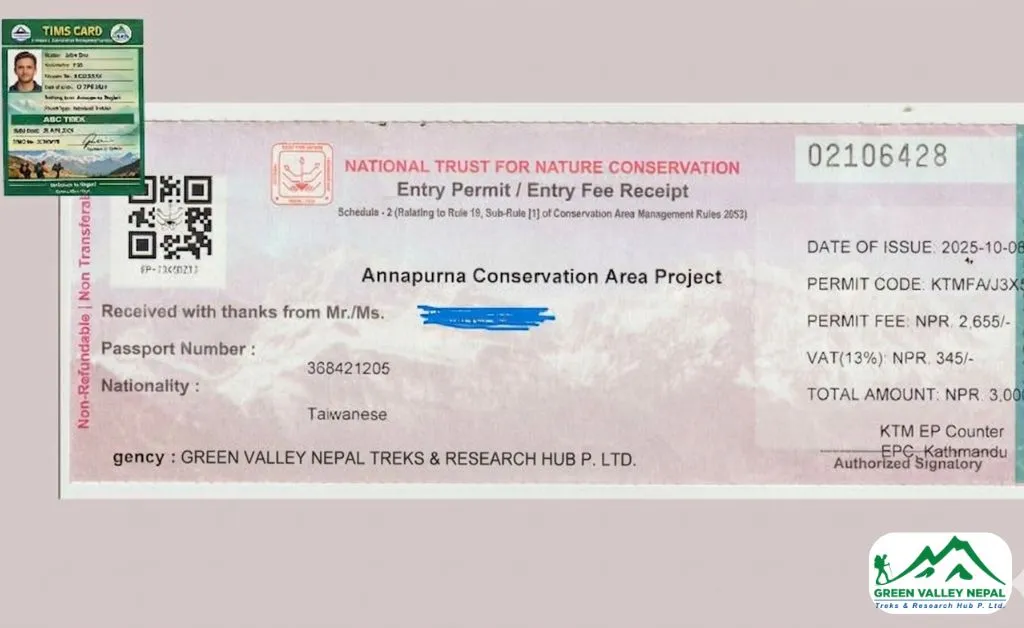
Why Do Trekking Permits Actually Matter?
Beyond the legal requirement, permits serve purposes that directly benefit every person who walks the trail.
Your TIMS card exists for your safety; rescue teams use TIMS data to coordinate emergency responses, and the system has helped locate trekkers who would otherwise have been very difficult to find. Your ACAP fee goes toward repairing trails damaged by monsoon rains, building and maintaining suspension bridges, protecting the forests and wildlife you pass through, and supporting the villages along the route with education, healthcare, and infrastructure funding.
The NPR 4,000–5,000 you pay is not a tax; it is a direct investment in the trail, the communities that depend on trekking, and the conservation of a region that draws visitors from across the world. Every trekker who pays their permits contributes to keeping the Annapurna region beautiful, safe, and sustainable.
Practical Tips for Getting ABC Trek Permits Smoothly
Apply at least one full day before your trek starts, not the morning of departure. Offices get crowded, systems occasionally crash, and last-minute problems are avoidable with a little planning. During peak season in October and April, arrive at the permit office at opening time. By early afternoon, the queues can add one to two hours to your wait.
Bring extra passport photos; four is a safe number as some offices request up to three. Carry permit fees in exact change in Nepali rupees, since offices often cannot break large bills. Store your permits in a waterproof bag from the moment you receive them; monsoon rain, river crossings, and sweat can destroy paper permits quickly. Photograph both permits on your phone immediately after collecting them as a digital backup.
Finally, confirm the office will be open before making the trip. Saturday closures are standard, and certain public holidays shut permit offices without much notice.
Conclusion
Getting your Annapurna Base Camp Trek permits is one of the most straightforward parts of planning the trip, as long as you know the process in advance. Two permits, ACAP and TIMS, costing a combined NPR 4,000–5,000 ($31–38 USD), are all that stand between you and legal entry into one of the world's most stunning mountain regions.
Apply in Pokhara or Kathmandu at least a day before your trek starts. Use a trekking agency if you want to avoid the queues. Bring your passport, photos, and cash, and store your permits carefully from the moment you collect them.
Need help arranging your ABC trek permits? Contact us for permit assistance and guide arrangements.
Frequently Asked Questions
- What permits do you need for Annapurna Base Camp?
You need two permits, the Annapurna Conservation Area Permit (ACAP) and the TIMS Card. Both are mandatory for all foreign nationals and must be obtained before starting the trek in either Kathmandu or Pokhara.
- Can you go to Annapurna Base Camp without a guide?
No. Since April 1, 2023, foreign nationals are required to hire a licensed guide to trek in the Annapurna region. Independent trekking is no longer permitted, and permit offices will not issue a TIMS Card without guide details on your application.
- How long is the ACAP permit valid for?
The ACAP permit is valid for the full duration of your registered trek with no strict daily limit. You must complete your trek within a reasonable timeframe matching your application dates. Each new trek requires a fresh permit; previous ones cannot be reused.
- How much does it cost to go to Annapurna Base Camp (permits)?
The two mandatory permits: ACAP (NPR 3,000) and TIMS (NPR 1,000 for agency trekkers) cost approximately NPR 4,000 ($31 USD) in total for most foreign nationals. Including photos, photocopies, and transport, the budget is around NPR 5,000–7,000 ($38–53 USD).
- What if I lose my permits on the trail?
Report to the nearest checkpoint immediately with your passport. Guards may issue temporary documentation or direct you back to Pokhara for replacements. Always store permits in a waterproof bag and keep a photo of them on your phone as a backup.
- Do permits cover rescue or emergency costs?
No. The TIMS card helps authorities locate you in an emergency, but does not cover rescue costs. Helicopter evacuation and medical expenses are not included; comprehensive travel insurance covering altitude trekking up to 5,000 meters is essential.