What Permits Do You Need for the Annapurna Circuit Trek?
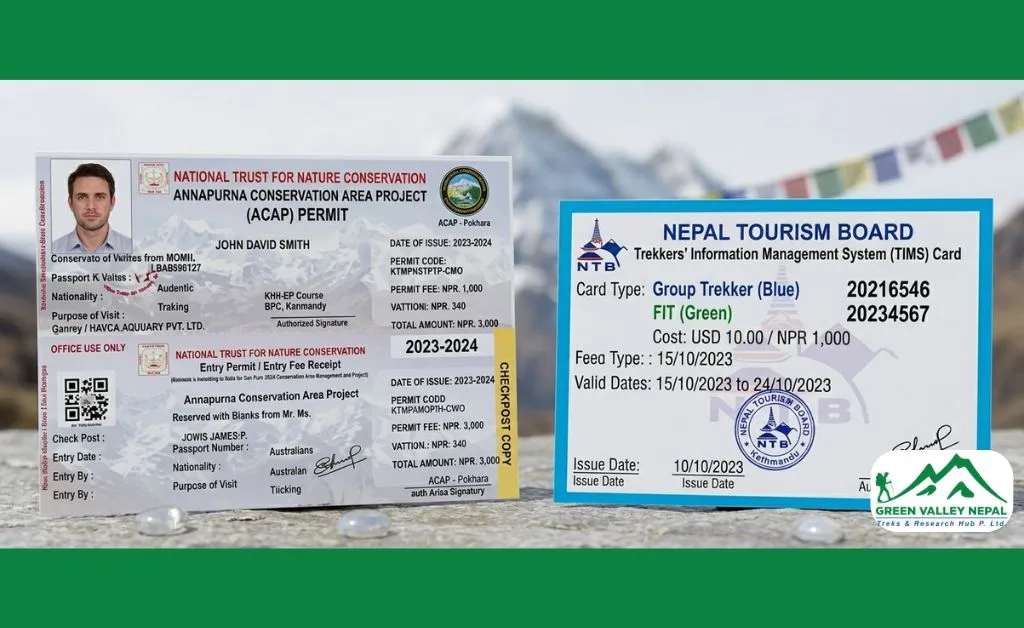
Every foreign trekker on the standard Annapurna Circuit needs the ACAP Permit (Annapurna Conservation Area Permit). This is the core entry permit. It is mandatory, strictly enforced, checked at multiple points along the route, and carries real consequences if you don't have it.
The TIMS Card (Trekkers' Information Management System) is where things get complicated because the situation is genuinely messy. Here is the honest picture as of early 2026: TIMS was officially discontinued for most Annapurna region treks after 2023, and on the ground, checkpoints across the Annapurna Circuit verify your ACAP permit only.
Local operators state clearly that TIMS is not actively enforced at Annapurna trailheads. However, many agencies still issue TIMS cards as a precaution because the Trekking Agencies' Association of Nepal (TAAN) has pushed for it to be made mandatory again, and enforcement is inconsistent depending on which checkpoint you encounter.
The safest approach is to get your ACAP; it is non-negotiable. On the TIMS, you can simply contact Green Valley Nepal Treks at the time of booking, since policy may have shifted by the time you travel. If you are booking through us, we will handle this and tell you exactly what is needed.
If your trekking route extends into Upper Mustang or Nar-Phu Valley, you will also need a Restricted Area Permit (RAP), which is a separate, much more expensive permit issued only through registered agencies.
How Much Does the Annapurna Circuit Trek Permit Cost?
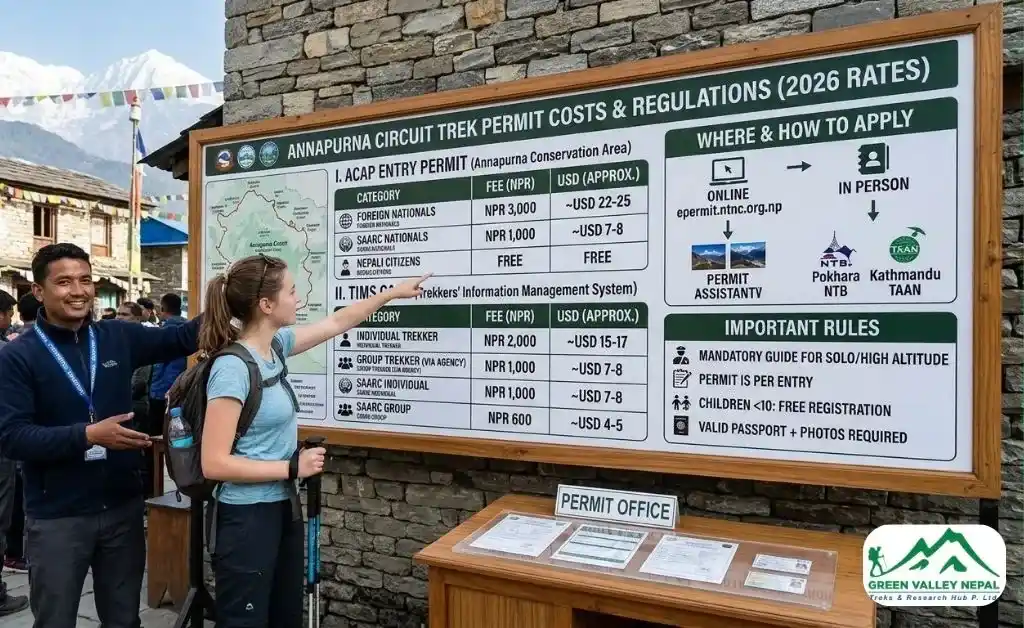
Permit | Foreign Nationals (Non-SAARC) | SAARC Nationals | Nepali Citizens |
ACAP Permit | NPR 3,000 (~$23 USD) | NPR 1,000 (~$8 USD) | Free |
TIMS Card (Group/Agency) | NPR 1,000 (~$8 USD) | NPR 1,000 (~$8 USD) | Free |
TIMS Card (Individual/FIT) | NPR 2,000 (~$15 USD) | NPR 2,000 (~$15 USD) | Free |
Total (Agency trekkers) | NPR 4,000 (~$31 USD) | NPR 2,000 (~$16 USD) | Free |
Total (Individual trekkers) | NPR 5,000 (~$38 USD) | NPR 3,000 (~$23 USD) | Free |
Children under 10 do not pay permit fees, though their details still need to be registered.
Beyond the permit fees themselves, budget a little extra for passport-sized photos (NPR 200–500 for four prints), passport photocopies (NPR 10–20 per page), and a small service fee of NPR 500–1,000 if you use an agency to handle your permits. In practice, the total permit-related expense, including all extras, runs NPR 5,000–7,000 ($38–53 USD) for most international trekkers.
Tip on saving money: Get passport photos printed in Thamel in Kathmandu rather than at tourist-area shops near the permit offices. Most hotels will photocopy your passport for free if you ask. And if you have time to go in person, you can avoid the agency service fee.
Annapurna Circuit Permit Cost for Indian Citizens
Indian nationals pay the SAARC rate: NPR 1,000 for the ACAP Permit, compared to NPR 3,000 for most other foreign trekkers. If trekking with an agency (which is required for all foreign nationals since 2023), the TIMS Card costs NPR 1,000. If trekking individually, that rises to NPR 2,000.
Indian trekkers need a government-issued photo ID; either a valid passport or a voter ID card is accepted. Permit offices in both Kathmandu and Pokhara deal with SAARC discount applications routinely, so the process is well understood. During peak season, going through a local Nepali trekking agency saves significant queuing time.
Do Nepali Citizens Need Permits for the Annapurna Circuit?
No. Nepali citizens do not pay for ACAP or TIMS permits. The government does not charge its own nationals for trekking in the Annapurna region. However, Nepali trekkers are still expected to carry a national ID card or citizenship certificate, as checkpoint staff at Besisahar and along the route will ask for identification.
Nepali trekkers are also encouraged to inform local authorities or their trekking agency of their itinerary, particularly for high-altitude sections near Thorong La, so that rescue coordination is possible if something goes wrong.
Does the Permit Cost Change by Season?
No. ACAP and TIMS fees are identical whether you trek in the spring rhododendron season, summer monsoon, autumn crisp-sky season, or winter. This permits one of the most predictable parts of your trekking budget.
What does change by season is everything else: accommodation rates, guide and porter fees, flights to Pokhara, and food prices all rise in peak season (March–May and September–November) due to demand. Permits stay constant.
The TIMS Card in 2026: What's Actually Going On?
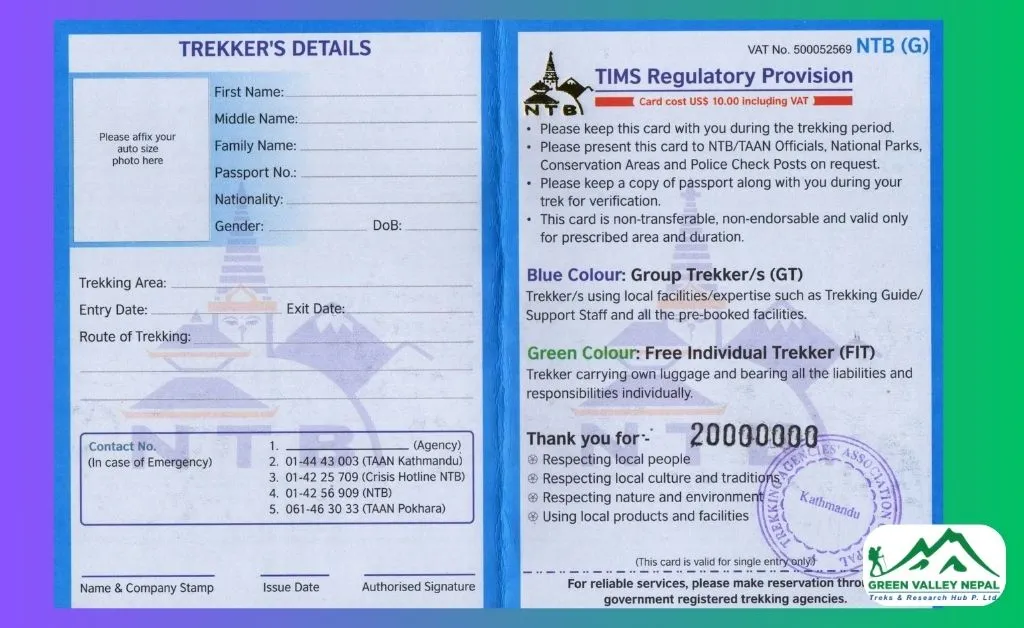
This is the question most trekkers Google before they leave, and the answer genuinely depends on who you ask and when you ask them.
Here is what the evidence shows as of early 2026:
Officially, TIMS was revised after April 2023, when the mandatory guide regulation came in. Since guides and registered agencies now track trekker information through their own registration system, the need for individual TIMS cards has reduced significantly. Many agencies stopped issuing them for Annapurna routes.
On the ground, checkpoints from Besisahar through to Jomsom consistently check ACAP permits. TIMS is not uniformly verified. Multiple sources with field experience confirm that Annapurna Circuit checkpoints do not routinely require TIMS.
However, TAAN has formally requested the government to reinstate TIMS as mandatory. Some checkpoints, particularly if you encounter local police rather than conservation staff, may still ask for it.
The practical advice: If you are booking through a registered agency, they will advise you based on the current situation at the time of your trek. If they include TIMS in their permit handling, accept it; at NPR 1,000 for group trekkers, it adds minimal cost and avoids any checkpoint friction. If you are navigating permits independently, get ACAP without question, and ask the permit office in Pokhara about TIMS requirements on the day you apply.
Where to Get the Annapurna Circuit Trek Permit?
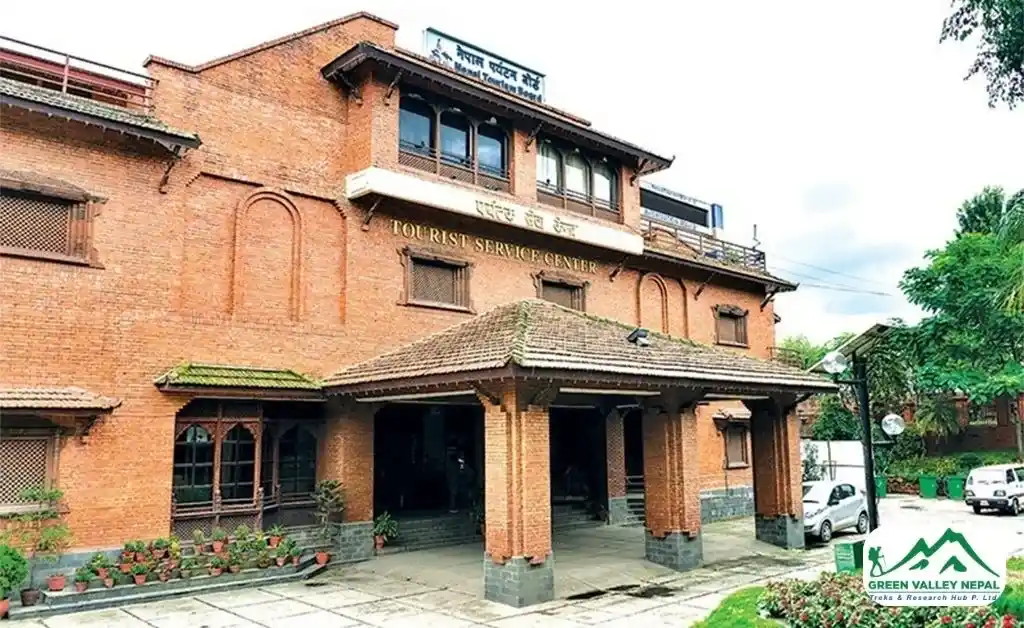
There are two main official locations in Nepal where permits are issued.
In Kathmandu, visit the Nepal Tourism Board (NTB) office at Bhrikutimandap, Pradarshani Marg. Office hours are Sunday to Thursday 10:00 AM–5:00 PM and Friday 10:00 AM–3:00 PM (closed Saturdays and public holidays). This is the right choice if you are flying into Kathmandu and want everything sorted before boarding your flight to Pokhara.
In Pokhara, the ACAP Permit is issued from the NTNC (National Trust for Nature Conservation) office at Damside, and the TIMS Card is handled at the nearby NTB Pokhara office. Both are open Sunday to Friday, 9:00 AM–5:00 PM (closed Saturdays). Since Pokhara is the main gateway city for the Annapurna Circuit, the majority of trekkers collect their permits here, usually the afternoon before starting the trek.
Both locations issue permits on the same day, process identical documents, and are equally official. Choose whichever fits your itinerary.
On the trail: You cannot. There are no permit offices at Besisahar, Chame, Manang, or anywhere else along the Annapurna Circuit route. The first major checkpoint at Besisahar (760m) will verify your permit right at the start. Arriving without one means being turned back. There is no emergency permit window at the checkpoint; Kathmandu and Pokhara are your only options.
How to Get the Annapurna Circuit Trek Permit: Step by Step
The process is simple once you know what to bring. Here is exactly what to do:
- Gather your documents (see the full list below)
- Visit the permit office in Kathmandu or Pokhara
- Fill in the application form with your personal and trekking details
- Submit your passport and photos
- Pay in Nepali rupees; most offices do not accept cards or foreign currency
- Collect your printed permit, usually within 20–30 minutes if everything is in order
Documents required:
- Original passport (valid for at least 6 months) and one to two photocopies
- Two to four recent passport-sized photographs (printed, not digital photos from your phone; checkpoints do not accept phone screens)
- Valid Nepal entry visa
- Trekking dates and itinerary details
- Guide's name and license number (required since April 2023)
- Cash in Nepali rupees for the permit fees
- Trekking agency letter if applying through an agency
One thing that catches people out: every detail on your permit must match your passport exactly. A misspelled name or wrong date of birth will require you to restart the application. Double-check before you leave the counter.
Can I Apply for the Annapurna Circuit Trek Permit Online?
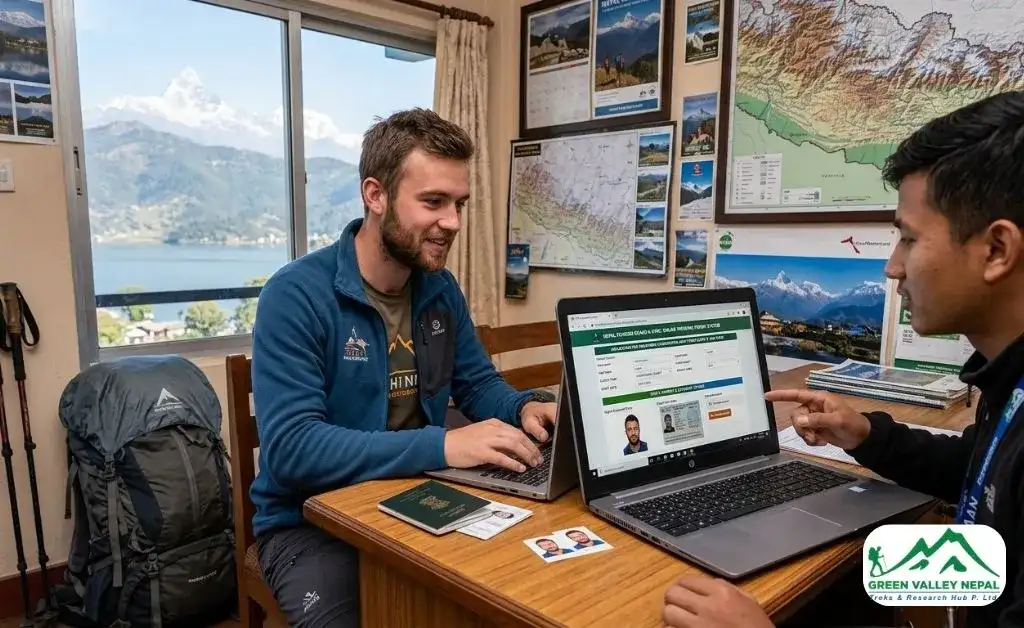
There is a partial online option. The NTNC runs a pre-registration portal at https://epermit.ntnc.org.np/ where you can fill in your application details before visiting the office. This reduces counter waiting time.
But it is not fully digital. You still need to appear in person to complete the application, pay fees, and collect your printed permit. The portal also has a reputation for occasional technical issues and payment failures. If time is tight, pre-register online to save counter time, but plan to attend the office in person regardless.
Easiest Way to Get Your Permits
If you want zero hassle, use a registered trekking agency. You provide a passport copy, photos, and your trek dates. The agency handles the forms, queuing, and delivery. For first-time trekkers especially, the NPR 500–1,000 service fee is worth it, particularly during peak season in October and April when permit office queues can stretch two to four hours. Arriving early in the morning makes a real difference during those months.
Apply at least one full day before your trek starts. Not the morning of departure. Offices get busy, systems occasionally go down, and last-minute errors are avoidable stress.
Permit Checkpoints on the Annapurna Circuit Trek
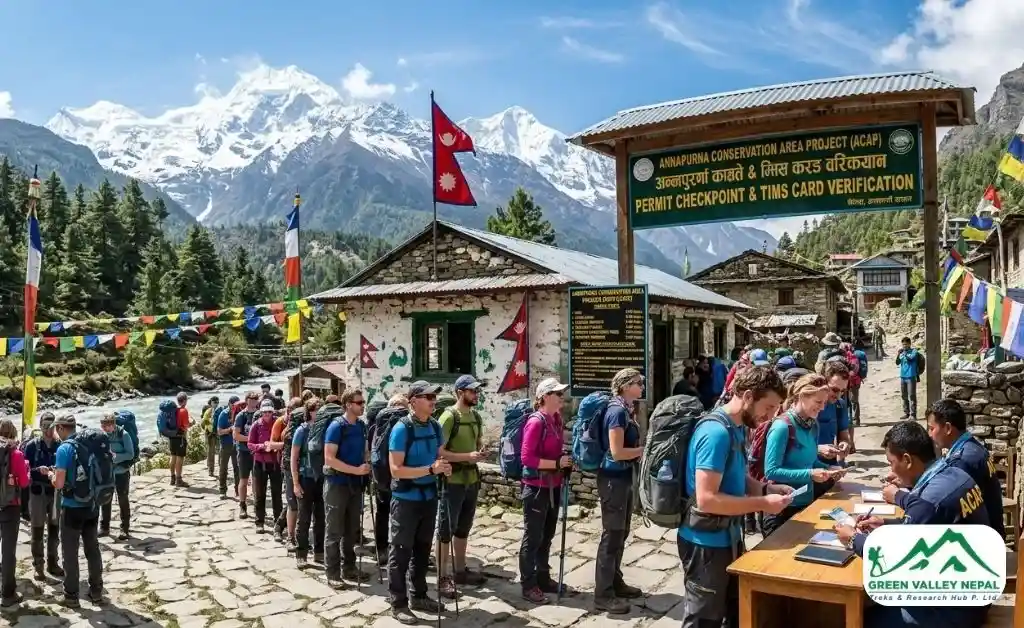
Your ACAP permit is checked at multiple points along the route. The main checkpoints on the Annapurna Circuit are:
- Besisahar (760m): The main entry registration point where your trek officially begins
- Dharapani / Chame (2,670m): Midway check, authorities verify permits and itinerary
- Manang (3,540m): A more detailed check before high-altitude terrain; health information may also be noted here
- Thorong Phedi (4,520m): The last checkpoint before Thorong La Pass; safety focus here is high
- Muktinath (3,800m): Descent validation after the pass
- Jomsom area: Lower Mustang section check, where anyone extending into Upper Mustang will also be checked for RAP
At each checkpoint, a guard examines your ACAP permit, verifies your name against your passport, records your entry in their log, and stamps your permit. It takes two to five minutes when everything is in order. Keep your permits in an accessible pocket, not buried in your pack.
Guards are professional but consistent. Missing or invalid permits will stop your trek.
What Happens If You Trek Without a Permit?
The Annapurna Circuit has checkpoints placed specifically to catch permit-less trekkers, and guards know the trail patterns, typical schedules, and teahouse stops well. Attempting to skip permits is not just legally risky; it almost certainly will not work.
If you are caught, the consequences are real. Fines start at NPR 10,000 ($75) and can reach NPR 50,000 ($375) or more. You can be forced to return to Pokhara to obtain permits, losing trek days and paying for return transport. In more serious cases, police involvement, deportation from the trekking area, and blacklisting from future trekking in Nepal are all documented outcomes.
The ACAP permit costs $23 for most international trekkers. The minimum fine alone is more than three times that, before you factor in transport costs, lost trek days, and the frustration of having your Thorong La crossing cancelled by a checkpoint officer. The math strongly favors getting your permits sorted before you leave Pokhara.
What if you are adding Upper Mustang or Nar-Phu Valley?
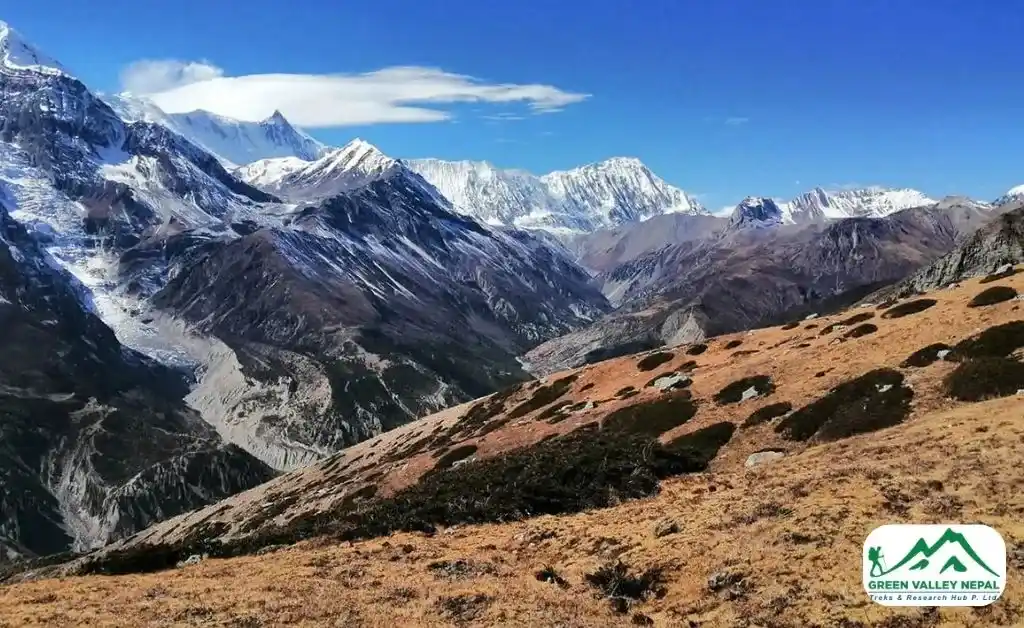
The standard Annapurna Circuit Trek route passes through Lower Mustang, the section from Kagbeni through Jomsom and down to Pokhara, which requires only your ACAP permit. You do not need a Restricted Area Permit for Lower Mustang.
Upper Mustang (the route beyond Kagbeni toward Lo Manthang) is a different story. It is a restricted area and requires a separate Restricted Area Permit (RAP) issued only through a registered trekking agency. Under the updated system, the Upper Mustang RAP now costs USD 50 per person per day, making shorter visits significantly more affordable. A minimum of two trekkers is required, and solo trekking permits are not issued. Your agency arranges this; you cannot get it yourself.
Nar-Phu Valley, which branches off northeast of Manang near the Tibetan border, has its own RAP. The fee is USD 100 per person for the first seven days during peak season (September–November) and USD 75 per person for the first seven days off-season (December–August). Additional days cost USD 15 per day. Again, this requires a registered agency and a minimum group.
If you are considering the Nar-Phu extension, our Nar Phu Valley Trek with Kang La and Thorong La Pass covers the full 17-day itinerary with all permit details included.
Practical Tips for Getting Annapurna Circuit Permits Smoothly
- Apply at least one full day before you start. Not the morning of departure. During peak season, October and April especially, arrive at the permit office at opening time. Afternoon queues in those months can stretch two to three hours.
- Bring more passport photos than you think you need. Four is a safe number; some offices request up to three, and having spares means you are not scrambling.
- Carry permit fees in exact change in Nepali rupees. Offices frequently cannot break large bills, and many do not accept cards or USD.
- Store your permits in a waterproof bag from day one. The Annapurna Circuit involves river crossings, rain, and significant sweating at altitude. Paper permits destroyed by moisture are a serious problem at checkpoints.
- Photograph both permits on your phone immediately after collecting them. Digital backups are not accepted at checkpoints instead of physical permits, but they are essential if you lose the originals and need to prove what you had.
- Confirm office hours before visiting. Saturday closures are standard. Certain public holidays close permit offices without much advance notice.
- Check whether the office will be open on your departure date. If you are flying into Nepal and heading to the trailhead the next day, getting permits the same afternoon you land in Kathmandu is possible, but confirm hours in advance.
Frequently Asked Questions (FAQs)
This one's genuinely confusing right now. TIMS was revised after 2023 and isn't consistently enforced at Annapurna Circuit checkpoints. Most agencies still include it since it's only NPR 1,000 extra and removes any checkpoint risk. Check with your agency before you go; the situation can shift.
- Where can I get the Annapurna Circuit permit?
Either Kathmandu (Nepal Tourism Board, Bhrikutimandap) or Pokhara (NTNC office at Damside). Most trekkers pick them up in Pokhara the day before starting. You cannot get permits anywhere on the trail itself; the Besisahar checkpoint will turn you back without one.
- How much is the Annapurna Conservation Area (ACAP) permit?
NPR 3,000 (~$23 USD) for most foreign nationals, NPR 1,000 (~$8 USD) for SAARC nationals, including Indians, and free for Nepali citizens. The fee is the same year-round regardless of season.
- Can I do the Annapurna Circuit on my own?
Officially, no solo independent trekking for foreign nationals has been allowed since 2023. You need a licensed guide, and permit offices won't process your application without guide details. Some sections see inconsistent enforcement, but getting caught without a guide mid-circuit isn't a risk worth taking.
- How much money do I need for the Annapurna Circuit permits?
Budget roughly NPR 4,000–5,000 (~$31–38 USD) for ACAP plus TIMS if required. Add NPR 500–1,000 for passport photos and photocopies. If using an agency to handle permits, expect a small service fee on top. Permits are actually one of the cheapest and most predictable parts of the whole circuit budget.