Why the 2026 Trekking Rules Change Your Budget
Before you build a spreadsheet, it's worth knowing this. Since April 2023, Nepal's government requires every foreign trekker in a conservation area or national park, including the entire Annapurna Circuit, to trek with a licensed guide or porter-guide booked through a registered agency. Fully independent, guide-free trekking is no longer permitted on this route, and checkpoints do enforce it.
This one rule reshapes the whole cost conversation you will see on older blogs:
- TIMS is now a genuinely inconsistent line item rather than a fixed cost; more on the exact numbers and current enforcement in the permits section below.
- A guide fee is now a fixed cost of the trek, not an optional upgrade, so "going solo to save money" isn't really on the table the way it used to be.
- The cheapest realistic route to a lower budget is a shared guide with a small group, not skipping the guide altogether.
Keep this in mind as you read the rest of this guide: every cost tier below assumes a licensed guide is part of the package, because in 2026, it has to be.
Full Annapurna Circuit Trek Cost Breakdown: 12–16 Day Standard Guided Trek
Expense Category | Estimated Cost (USD) |
Permits (ACAP, + TIMS if applied) | $23 – $38 |
Guide (14 days) | $350 – $490 |
Porter (14 days) | $250 – $350 |
Food (14 days) | $280 – $420 |
Teahouse Accommodation (14 days) | $50 – $140 |
Ground Transportation | $60 – $200 |
Gear Rental | $60 – $150 |
Travel Insurance | $100 – $200 |
Tips (guide + porter) | $180 – $280 |
Total | $1,353 – $2,268 |
This range spans our Standard Guided to Mid-Range tiers above; where you land depends mainly on lodge quality, whether you fly from Jomsom, and how much you spend on daily extras.
Daily on-trail spending (food, accommodation, small extras) typically runs $25–$40 per day, on top of the fixed costs: permits, guide, porter, and insurance, that apply regardless of trip length.
Annapurna Circuit Trek Permits Cost: ACAP and TIMS in 2026
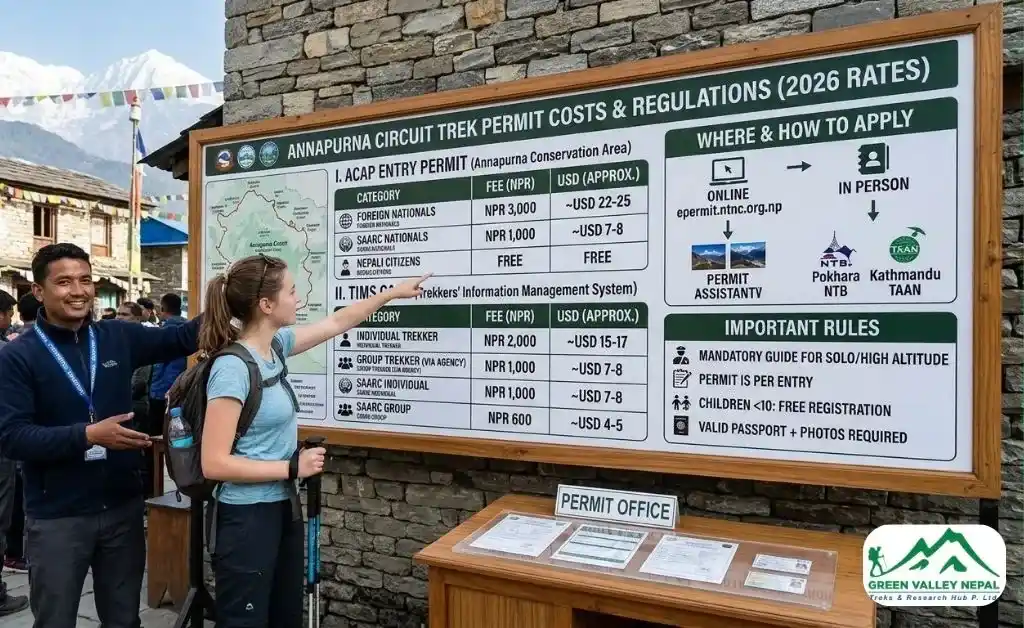
One permit is confirmed and non-negotiable; a second has a genuinely confusing status right now, but the numbers themselves are settled:
Permit | Foreign (Non-SAARC) | SAARC / Indian | Nepali Citizens |
ACAP Permit | NPR 3,000 (~$23) | NPR 1,000 (~$8) | Free |
TIMS Card (agency/group) | NPR 1,000 (~$8) | NPR 1,000 (~$8) | Free |
TIMS Card (individual/FIT) | NPR 2,000 (~$15) | NPR 2,000 (~$15) | Free |
Total (agency-booked) | ~$31 | ~$16 | Free |
- ACAP (Annapurna Conservation Area Permit): Every current source agrees this is mandatory and checked at every checkpoint on the circuit: Besisahar, Chame, Manang, Muktinath, and Jomsom included. This fee funds trail maintenance and conservation work across the region.
- TIMS (Trekkers' Information Management System) card: Genuinely inconsistent in 2026. TIMS was revised after the 2023 guide-mandatory reforms, and checkpoints along the Annapurna Circuit now verify ACAP only in most cases, but many agencies still add it as a low-cost precaution since TAAN has pushed to reinstate it as mandatory.
Budget roughly $23–$38 USD per person for permits (agency-booked trekkers typically land near $31 once TIMS is included; add a few dollars more for passport photos and photocopies). A good agency, including Green Valley Nepal Treks, will tell you exactly what's being charged for your travel dates. For the full walkthrough: checkpoints, required documents, online pre-registration, and what happens if you show up without one, see our complete Annapurna Circuit Permits Cost guide.
If you are extending your route, the Annapurna Circuit Trek with Tilicho Lake or the Nar Phu Valley Trek with Kang La and Thorong La Pass both use the same ACAP permit and add a side-valley detour rather than a separate permit fee, though each adds 2–4 days to your food, guide, and porter costs. Extending into Upper Mustang or Nar Phu Valley is a different story; those require a separate Restricted Area Permit costing $50–$100+ per person per day, on top of everything above.
Annapurna Circuit Trek Guide and Porter Costs
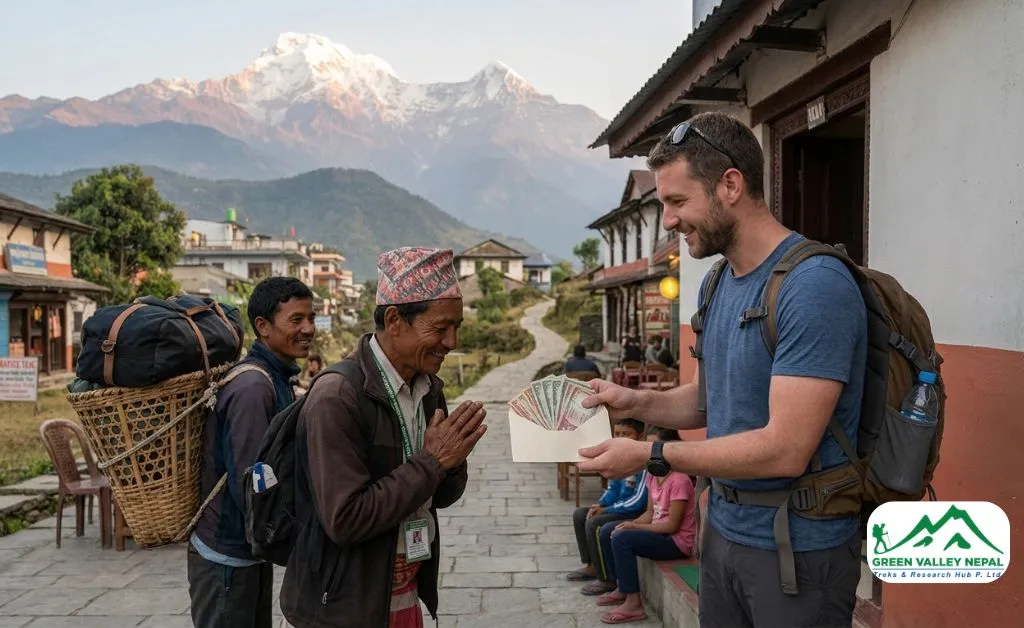
Licensed guide: $25–$35 USD per day (up to $40+ for a senior or specialist guide). This covers their pay, food, lodging, and insurance while on the trail. Over a 14-day trek, that's roughly $350–$490.
A guide on this route does more than point the way; they manage permit checkpoints, negotiate teahouse rates, monitor you for altitude sickness symptoms, and coordinate evacuation if something goes wrong near Thorong La. Since 2023, this is also a legal requirement, not just good practice. For the acclimatization schedule that keeps this a non-issue, see our altitude sickness prevention guide for trekking in Nepal.
- Porter: $18–$25 USD per day. A porter carries up to 20–25 kg (split between two trekkers) so you can walk the pass with a light daypack. Over 14 days: $250–$350.
- Porter-guide (combined role): $25–$30 USD per day. A practical, cheaper middle ground for trekkers on a tighter budget, one person carries your bag and provides basic route guidance, though with less depth than a dedicated licensed guide.
- Tips: Budget $8–$12 per day for your guide and $5–$8 per day for your porter. Over 14 days, that's roughly $180–$280 in tips: a real cost, not a nice-to-have, since tipping is standard practice in Nepal's trekking industry. See more detail in Tipping Culture in Nepal.
Annapurna Circuit Trek Food and Accommodation Cost on the Trail
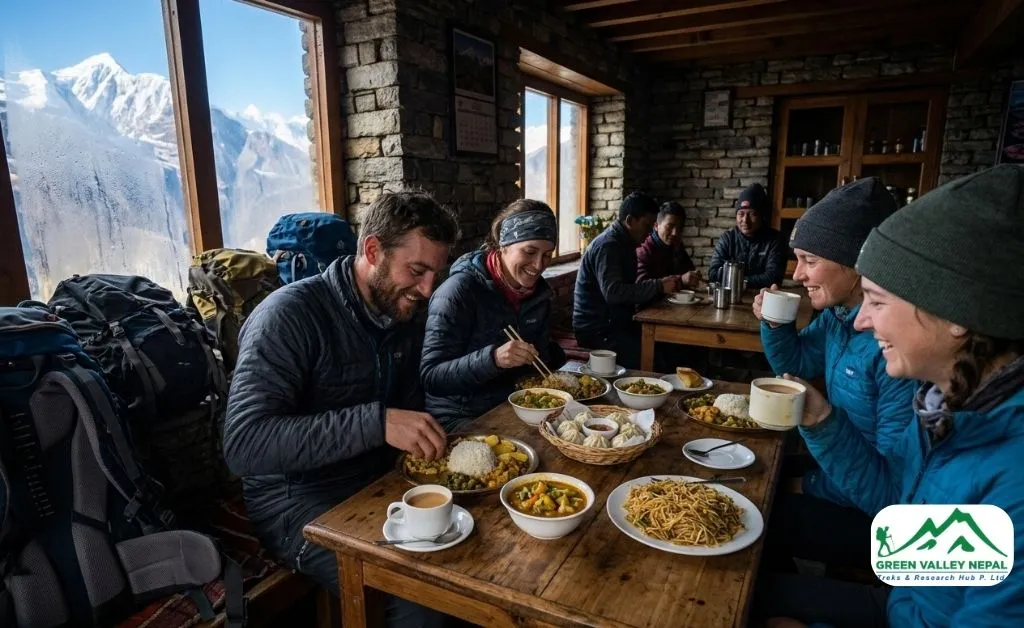
Teahouses keep this trek more affordable than it looks on paper, once you understand the system. For a deeper look at what's actually on the menu at altitude, see our Annapurna Circuit food and drink guide; for what the rooms themselves are like, see our teahouse accommodation guide.
How teahouse pricing works: Most lodges offer rooms for $0–$5 per night if you eat all your meals there and that's the norm, not a discount. Room-only (no meal commitment) runs $5–$10. At altitude: Manang, Yak Kharka, near Thorong La, expect $8–$15 per room regardless of meal plan, since everything is carried up by porter or mule.
Typical Meal Prices:
Meal | Cost (USD) |
Breakfast (porridge, eggs, toast, tea) | $4 – $6 |
Lunch (dal bhat, fried noodles, soup) | $6 – $10 |
Dinner (rice, pasta, vegetable curry) | $7 – $12 |
Tea / hot drinks | $1 – $2 |
A full day of meals runs $18–$28 in lower villages and $30–$40+ near Muktinath and Thorong La. Over a full trek, budget $280–$420 for food.
Hot showers ($2–$4), Wi-Fi ($2–$5 per session), and device charging ($1–$3) are extra. Over two weeks, budget an additional $50–$100 for these small daily comforts.
Annapurna Circuit Trek Transportation Cost
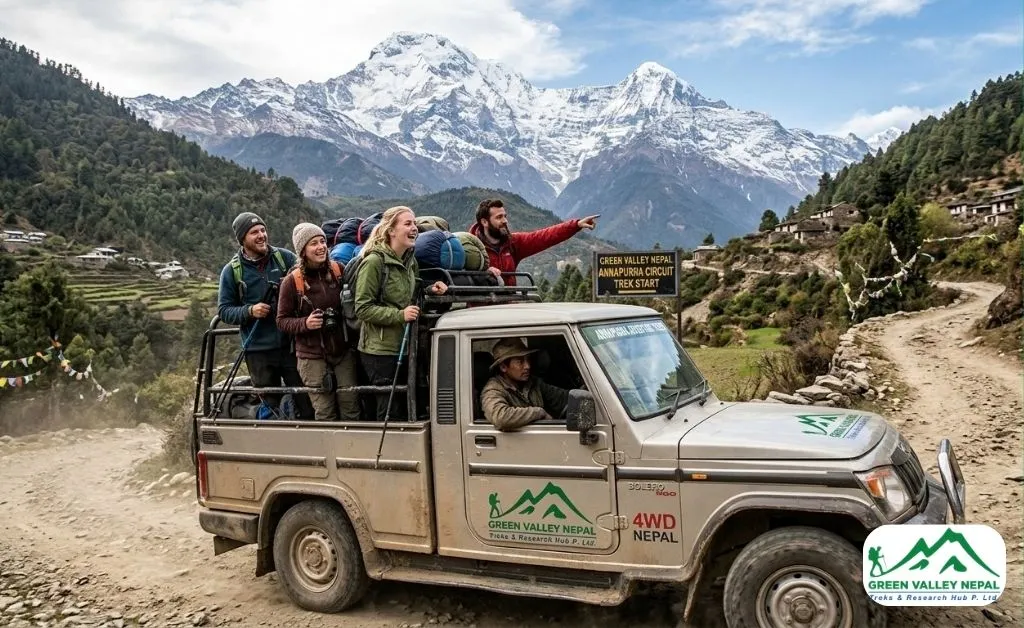
Getting to and from the trailhead has several legs, each with a budget and premium option.
Kathmandu to Besisahar (trek start)
- Local bus: $10–$15
- Tourist bus: $15–$25
- Private jeep (shared): $80–$150 total, split among the group
Jomsom to Pokhara (trek end)
- Flight: $100–$150 (saves 2–3 days of walking or driving)
- Local jeep/bus: $15–$25
Pokhara to Kathmandu:
- Tourist bus: $15–$20
- Domestic flight: $80–$120
Most trekkers spend $60–$150 on ground transport and add a Jomsom flight if time is tight. Flying out from Jomsom pushes total transport costs to roughly $200–$300.
Annapurna Circuit Trek Gear and Equipment Cost
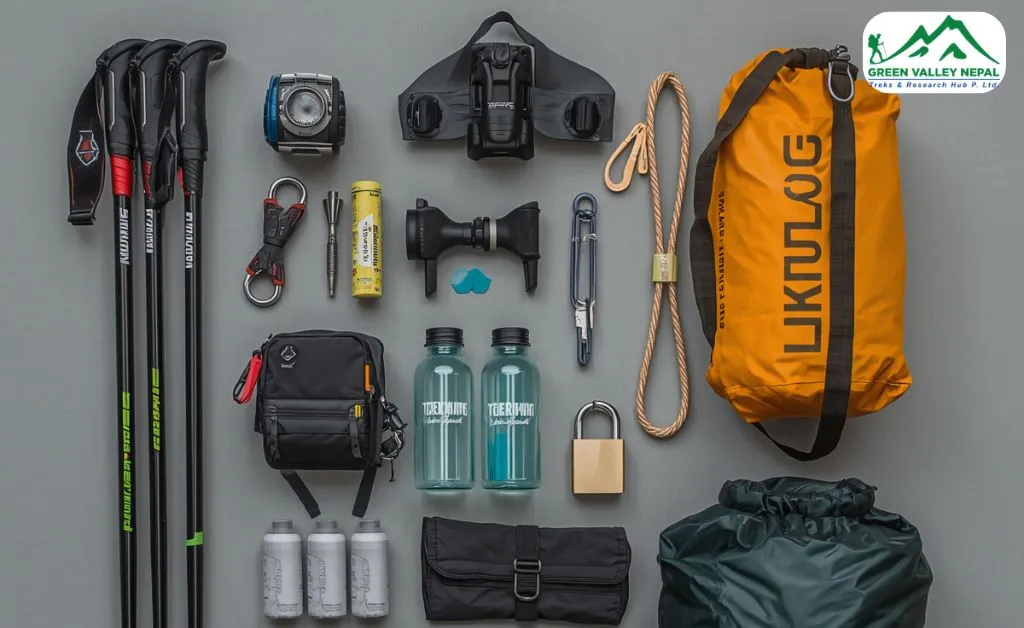
If you don't already own cold-weather trekking gear, renting in Kathmandu or Pokhara is far cheaper than buying:
- Rental (sleeping bag, down jacket, trekking poles, gaiters): $60–$150 for the full trek
- Buying new gear in Thamel: $150–$400+
Renting is the better call for a one-time trek unless you plan to trek regularly in Nepal. For the full list of what to pack versus rent, see our Annapurna Circuit Trek packing list.
Annapurna Circuit Trek Travel Insurance Cost: A Fixed Cost, Not Optional
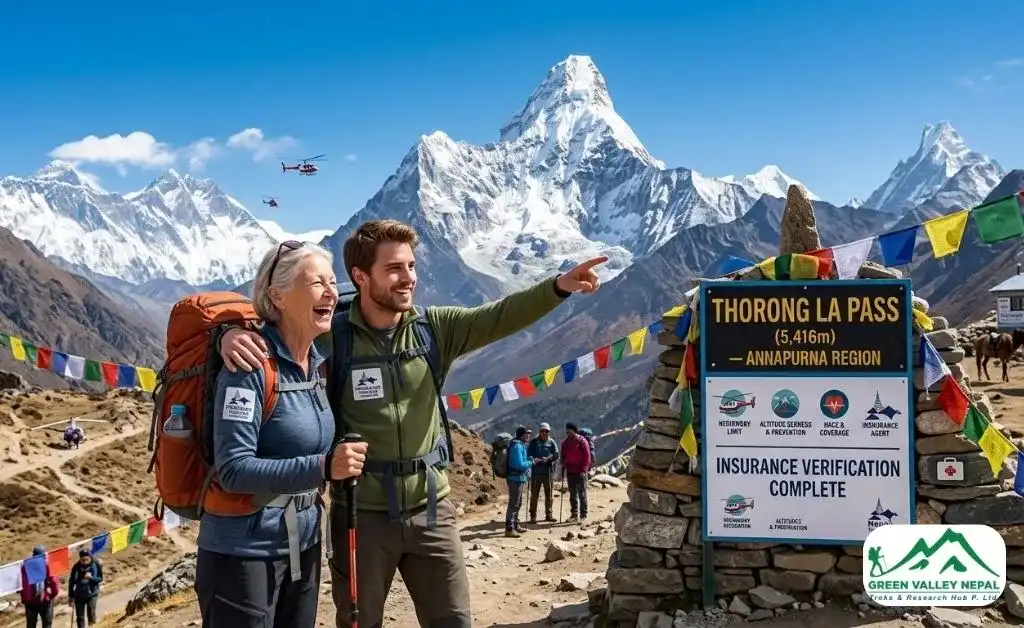
Budget $100–$200 for travel insurance covering high-altitude trekking up to at least 5,500 meters and emergency helicopter evacuation. This is a genuine fixed cost of the trek, not a line item to skip. Thorong La sits at 5,416 meters, and standard travel insurance policies typically exclude altitude-related emergencies above 4,000–5,000 meters. Check the fine print before you buy. For a full walkthrough of what to look for, see our recommended travel insurance for Nepal trips.
Annapurna Circuit Trek Cost by Trekking Style
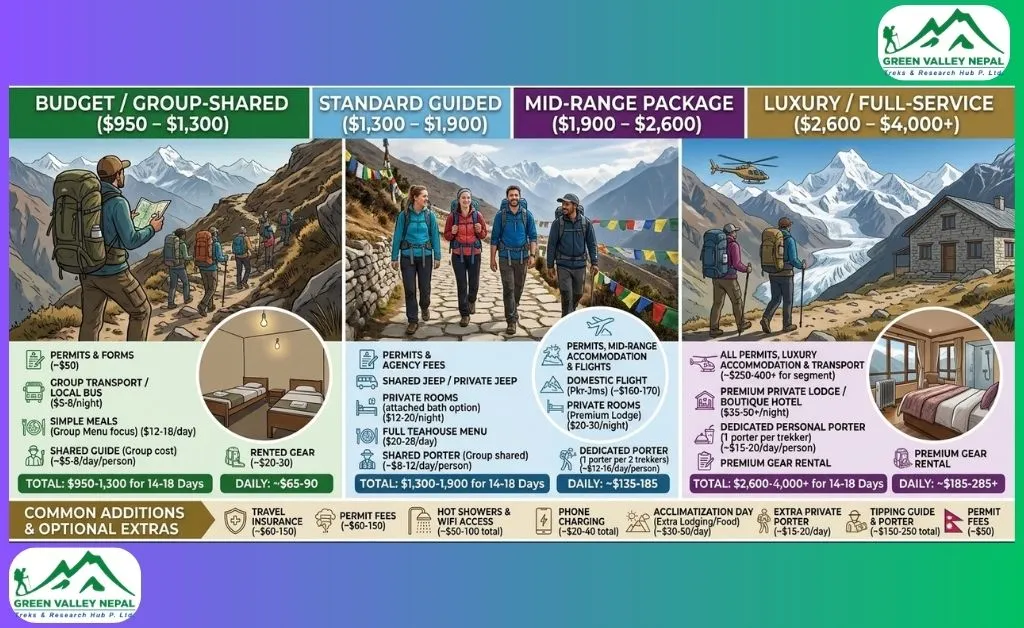
Budget / Group-Shared ($950 – $1,300)
- Shared guide and porter across a small group booked through a local agency
- Local buses for transport
- Basic teahouse rooms, meals included
- Local food only (dal bhat, noodles)
- No hot showers or Wi-Fi add-ons
As a real-world reference point, Green Valley Nepal Treks' own Annapurna Full Circuit package starts at $900 per person in a group of 11–16, rising to $995 for a solo booking: permits, guide, teahouse accommodation, and meals included. That's a good sanity check against inflated "budget" figures you will see quoted elsewhere.
Standard Guided ($1,300 – $1,900)
- Dedicated licensed guide and porter
- Comfortable teahouses, some with attached bathrooms
- Mix of local and Western meals
- Occasional hot shower
- Local transport, ground-based return
Mid-Range Package ($1,900 – $2,600)
- Dedicated guide and porter
- Better lodge choices at each stop
- Jomsom flight for the return leg
- More frequent hot showers and Wi-Fi
Luxury / Full-Service ($2,600 – $4,000+)
- Senior, highly experienced guide plus porter
- Private jeep transport where the road allows
- Best available lodges booked in advance for peak season
- Post-trek hotel night in Pokhara lakeside
Most first-time trekkers land happiest in the standard-to-mid-range bracket, enough support for a safe crossing of Thorong La without paying for comfort upgrades you won't notice at 4,500 meters.
Annapurna Circuit Trek Operator Cost: Local Nepali vs. International Operator
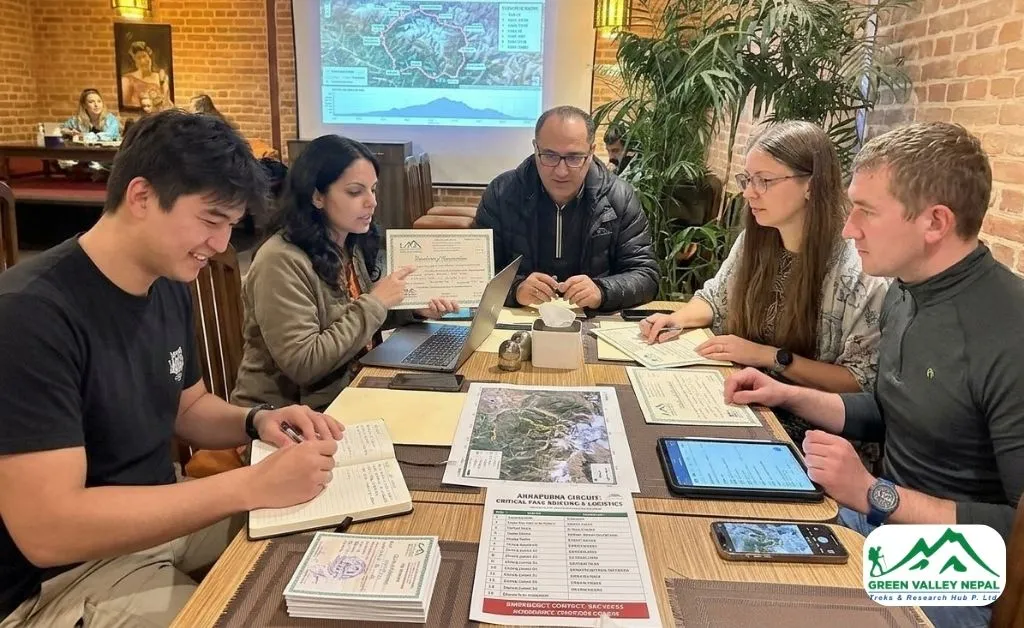
Booking through a local Nepali agency, one registered with NMA and TAAN, typically costs meaningfully less than booking the same itinerary through an international operator reselling the same on-the-ground services, often at similar or better quality. Organized 12–16 day packages from local agencies generally range from:
- $950–$1,300 for a standard 12–15 day trek
- $1,900–$2,800 for a 15–18 day full-service package with extras like Tilicho Lake
A typical package includes your ACAP permit (and TIMS, where it still applies), licensed guide and porter, teahouse accommodation, three meals a day on the trail, ground transport to and from the trailhead, and basic insurance coverage for staff. Your agency handles the paperwork and daily logistics, and can coordinate emergency support if needed, genuinely useful given the guide-mandatory rules now in place.
Annapurna Circuit Trek Cost for Nepali, SAARC, and Indian Trekkers
Permit fees differ significantly by nationality:
- Foreign (non-SAARC) trekkers: ACAP ~$23, plus TIMS ~$8 (agency) to $15 (individual) if applied, total ~$23–$38.
- SAARC nationals (including Indian trekkers): ACAP NPR 1,000 (~$8), same reduced TIMS rate. Total permits run ~$8–$16, a fraction of the non-SAARC rate. Overall trip costs for Indian trekkers typically fall around INR 45,000–65,000 (~$540–$780 USD), depending on itinerary and comfort level, since accommodation and food rates are comparable but permit costs are much lower.
- Nepali citizens: Minimal or waived permit fees and no guide requirement under the foreign-trekker regulation; daily costs are also lower due to local rates and language.
Always confirm current fee schedules at the Nepal Tourism Board office in Kathmandu or Pokhara before departure, as SAARC and citizen rates are reviewed periodically.
How to Reduce Your Annapurna Circuit Trek Cost
You don't have to overspend to do this trek safely. Some real, practical ways to trim the budget without cutting corners on safety:
- Travel in a small group. Sharing a guide, porter, and jeep hire with two or three others cuts your per-person cost significantly. Many agencies offer 10–15% group discounts.
- Take local transport. Buses between Kathmandu, Besisahar, and Pokhara cost a fraction of private jeeps.
- Eat dal bhat. It's the most filling, affordable trail meal at $5–$8, often with unlimited refills, and it's genuinely what most guides and porters eat too.
- Carry a refillable bottle with purification tablets. Bottled water on the trail costs $1–$3 per bottle and adds up fast.
- Book direct with a local, registered agency. Booking directly with a Kathmandu- or Pokhara-based agency usually costs less than going through an international reseller for the same on-ground service.
- Trek in shoulder season. Late November or early March can be 15–20% cheaper than peak spring and autumn dates, with thinner crowds. See our Annapurna Circuit best time to trek guide for the month-by-month weather trade-offs before you commit to a date.
- Limit daily extras. Hot showers, Wi-Fi, and charging add up over two weeks; budget $2–$5 a day and decide what you actually need.
- Bring your own snacks. Energy bars and instant coffee from Pokhara supermarkets cost far less than trail-side prices.
Frequently Asked Questions (FAQs)
- How much does the Annapurna Circuit Trek cost in 2026?
Total cost ranges from about $950 to $4,000+, depending on trekking style. A lean group-shared trip runs $950–$1,300, a standard guided trek $1,300–$1,900, and luxury packages $2,600 and up. Guide and porter fees, transport choices, and daily food/accommodation spending are the biggest variables.
- Do I need a guide for the Annapurna Circuit Trek?
Yes. Since April 2023, Nepal requires all foreign trekkers on this route to hire a licensed guide or porter-guide through a registered agency. Fully independent trekking without a guide is no longer permitted, and this is enforced at checkpoints along the trail.
- Is the Annapurna Circuit Trek expensive compared to other Nepal treks?
It's one of the more affordable major Himalayan treks. A standard guided Annapurna Circuit trek averages $1,300–$1,900, versus roughly $1,500–$2,200 for a comparable Everest Base Camp trek, mainly because ground transport is cheaper than flying in and out of Lukla. See our full Everest Base Camp vs. Annapurna Circuit comparison for the rest of the differences.
- What are the mandatory costs I can't avoid?
The ACAP permit (~$23), a licensed guide (~$25–35/day), and travel insurance with high-altitude and evacuation coverage (~$100–200) are effectively fixed costs under current regulations. TIMS (~$8–15, where still applied) may or may not apply to your booking; see our Annapurna Circuit permits guide for the current situation. Everything else- porter, food quality, transport mode, gear is where your budget flexes.
- Can a beginner do the Annapurna Circuit Trek, and does it affect the cost?
Yes. Beginners should budget slightly more, not less; a dedicated guide and porter are strongly worth it for a first high-altitude crossing at Thorong La, and adding 1–2 extra acclimatization days adds modestly to your total. See our Annapurna Circuit difficulty guide and training guide to gauge your readiness before you book.
- How does the Annapurna Circuit cost compare to Kilimanjaro?
Kilimanjaro runs $2,000–$5,000 due to mandatory crew and park fees for a shorter 5–9 day summit climb. The Annapurna Circuit, at roughly $950–$2,300 for 12–16 days, offers considerably more trail time and cultural depth per dollar.
- How much should I budget for travel insurance?
Plan on $100–$200 for 2–3 weeks of coverage that explicitly includes high-altitude trekking above 5,000 meters and helicopter evacuation. Treat this as a fixed cost; many standard policies exclude altitude emergencies by default.
Ready to plan your Annapurna adventure without the guesswork? Contact Green Valley Nepal Treks for a transparent, itemized quote, an NMA- and TAAN-registered guide team, and route planning built around your budget and timeline.